


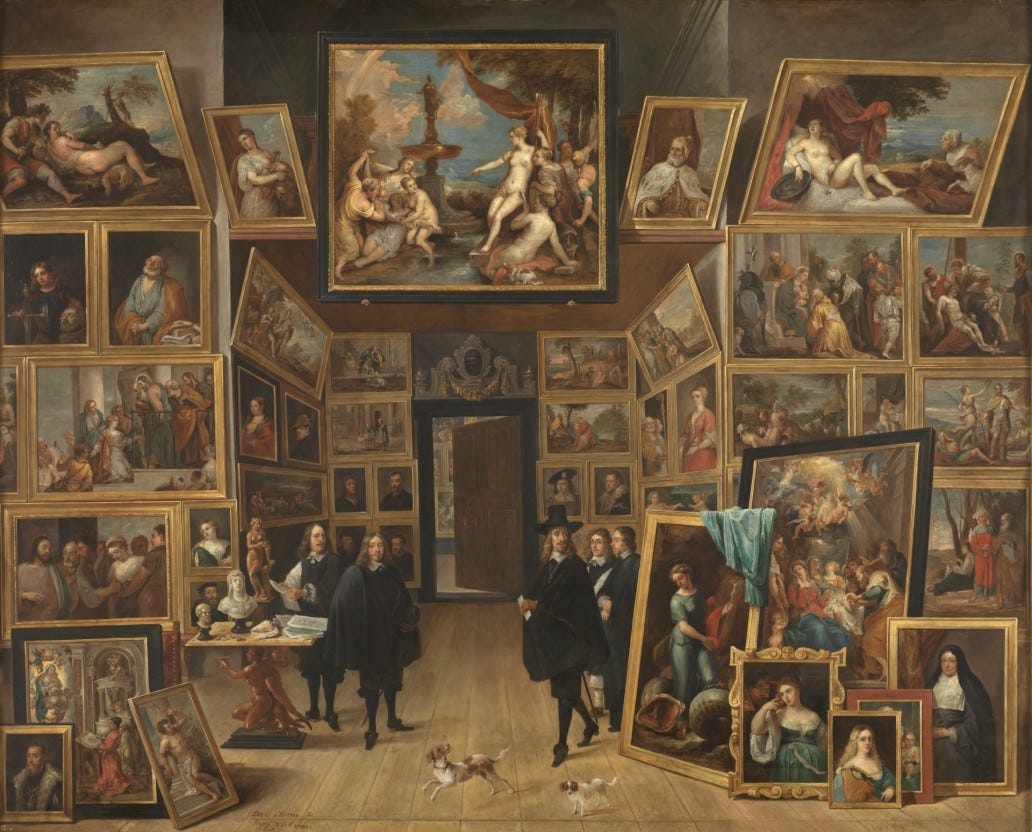
Thinking in Museum Time
One of the unexpected gifts of building an archive is that it changes your relationship with time.
Most people think in days.
Businesses think in quarters.
Governments think in election cycles.
Even many artists think in terms of the next exhibition, the next grant, the next sale, the next deadline.
Museums think differently. A museum thinks in centuries.
When you hold an object that is a hundred years old, or five hundred years old, or two thousand years old, your own lifetime suddenly finds its proper scale. You become one caretaker among many across generations.
This has become increasingly important to me as I continue making work and building the archives of the Collage Museum.
Recently I found myself sorting through papers collected from the walls of European cities. At first I was overwhelmed by the sheer abundance of material. There seemed to be enough paper for hundreds, perhaps thousands, of future collages.
Then something shifted.
I realized I was looking at the collection through the wrong lens. I was seeing it through the calendar.
Instead, I needed to see it through the consciousness of the museum. Museums are never in a hurry. Their collections are not waiting to be finished. They are waiting to be encountered and understood.
A drawer may remain unopened for decades until someone recognizes its importance. A document may sit quietly in an archive for a century before becoming exactly the piece someone needed to complete a story. An artwork may disappear into storage for generations before returning to public view and finding an audience ready to understand it.
Nothing has been wasted. It has simply been waiting.
Artists can benefit enormously from adopting this perspective. The studio begins to resemble an archive more than a factory. Materials are not inventory that must be consumed. They are a collection entrusted to your care to be distributed as opportunity presents itself.
Ideas are not obligations. They are possibilities. Sketchbooks become archives. Experiments become documents. Failures become evidence. Everything joins the larger story.
When I think this way, I no longer feel pressured to use every sheet of paper or pursue every idea. My responsibility is much smaller and much more achievable.
I simply have to do what the day calls for.
The collection will still be here tomorrow.
And if some materials outlive me, perhaps that is exactly as it should be.
Every museum contains objects collected by people who never lived to see the importance those objects would eventually have.
They collected because they recognized value.
Future generations discovered why.
The artist, in a similar way, is always participating in a conversation that extends far beyond a single lifetime. We inherit materials, techniques, traditions, and ways of seeing from people we never met. We add our own contribution. Then we pass everything forward.
Thinking in Museum Time encourages patience because history itself is patient. It encourages generosity because - as we have been supported by those from the past - the future is filled with people we will never know and it is to them that we make our offering. It encourages careful craftsmanship because our work may survive longer than our names. Most importantly, it relieves us of the illusion that everything important must happen now.
The present moment is not the entire story. It is only the page we happen to be writing today.
The archives reminds us that we are not merely making objects. We are participating in civilization. The pressure to produce gives way to the privilege of contributing.
The anxiety of finishing gives way to the satisfaction of adding one more careful piece to an endless collection that began long before us and, if we do our work well, will continue long after we are gone.
That is Museum Time. And strangely enough, once you begin living in that mindset, there is always enough time and little urgency to worry over.
Related:


Please share your thoughts in the comments.
See what happened in NOTES
Take a Minute
Observe your breath. Feel your breath going in and out. Feel the breath on in your nostrals or mouth. What is the quality of your breathing? Shallow, deep? Slow, fast? Labored, easy? Count your breaths to ten. Use your breathing as an anchor to quiet your mind.
In a comment write what you observed.
Such a interesting and rich observation. It resonates with my experience of living in a 300 year old house. I often lie in bed at night and think of all those who’ve slept in this room before me and those who will, hopefully, sleep here when I’m gone. I feel we are temporary caretakers, making changes our time allows, changes I try to make as unobtrusive as possible. We also have an apartment I designed that once was very “modern” and now is of its time and looks very 80s. The daily reminders of the ephemeral nature of our lives is reassuring, surprisingly. We’re not alone. We’re part of the great sweep of history.
Stuff, things, objects, junk............I buy, find, collect and use when needed for my assemblages. As units I really like just handling a piece I am drawn to to appreciate, fondle, imagine where it will fit one day in my work. I also have a boxes of things I may never use but can't get rid of. And if I finally do get rid of something........there's a lot of hesitation involved as I can't be 100% sure I'll never ever need it. I may have 'outgrown' it......lost my adoration for, may even find it stupid and unnecessary. I wrestle with such decisions daily but not to the point of losing sleep over it. So, I continue to breathe and let it go even if I don't literally let go of a piece of something.