


This is a response to a comment by Portia from the last article: The Saccadic Rhythm discussing Asemic Writing…
The Saccadic Rhythm: Why Seeing is a Time-Based Art

In the previous article From Utility to Aura I talked about the idea of transforming the vernacular artifact, through a palimpsestic process, into an artistic relic. In this article I will talk about the idea of how we have been trained not just to see but to read and by reading I mean a form of listening.
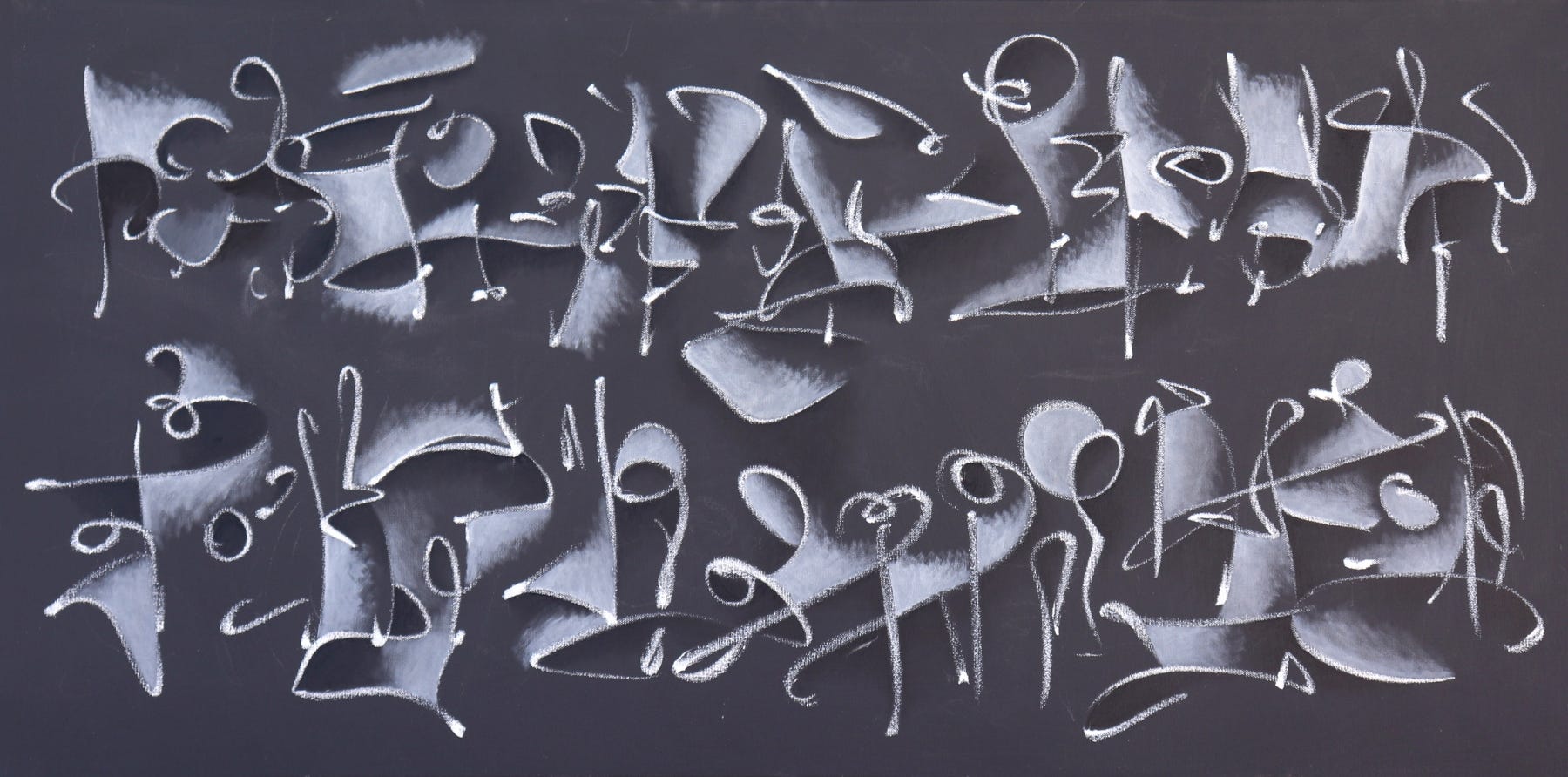
The Arts as a Unified Field
For some time now I have been interested in what I think of as the crossover between the arts. A reader recently suggested that my Asemic Writing drawings may create a synesthetic experience. That observation made me stop and think because I do not believe what I am doing is exactly synesthesia, at least not in the neurological sense. Although that is not to say that the viewer may have such an experience.
Synesthesia is generally understood as an involuntary crossing of the senses. Someone may hear a sound and automatically perceive a color. A letter may always appear blue or a musical note may always produce the sensation of a particular shape. It is a remarkable phenomenon, but it is not quite how I work I don’t think.
My own exploration is intentional as opposed to involuntary.
I might be walking while listening to Hans Zimmer, John Adams, Steve Reich, or Igor Stravinsky. As I walk I find myself moving my hands through the air, conducting invisible gestures, imagining how those movements might later become marks on paper. I am not trying to illustrate the music. I am trying to understand its form. I am asking myself how rhythm, repetition, acceleration, pause, density, silence, and release might become visual events that express musicality.
The drawing does not represent the music. It is composed according to similar principles that I acquire through listening.
The same thing happens with collage poetry.
When I think about collage poetry, I am rarely thinking about the literal meaning of words. I collect phrases from other peoples texts that catch my attention and then arrange and rearrage them. I am thinking about cadence, ambiguity, abrupt justaposition of the phrasing, compression, openness, emphasis, repetition, interruption, and the unexpected turn. I don’t really think of them as spoken but as read. Good poetry has architecture. It unfolds through time while maintaining an internal coherence that is felt before it is analyzed.
Can a drawing possess cadence? Can a collage have meter? Can an asemic work contain alliteration without letters?
Such questions fascinate me.
Perhaps we have been separating the arts too completely. We organize them according to the senses through which they are most commonly experienced. Music belongs to hearing. Painting belongs to sight. Dance belongs to movement. Poetry belongs to language.
Yet when one begins making art, these distinctions may begin to dissolve. In my case I am always looking for the in-between states. I think that is where the creative impulse lives.
A composer speaks of texture. A painter speaks of rhythm. A poet of color. A dancer of line. The vocabulary itself begins migrating across disciplines because the underlying experience is no longer confined to the artistic discipline of a single sense.
I am looking for the deeper language from which all of the arts arise.
This relates closely to what I have elsewhere called the Root-Tongue.
The Root-Tongue is not English or Chinese or music or drawing. It is the underlying field of relationships through which the universe speak to itself and from which all expressive forms emerge. Rhythm exists before music. Gesture exists before drawing. Silence exists before poetry. Pattern before mathematics. Movement before dance.
The various arts are simply different human dialects interpreting the same original language through which the universe converses with itself.
When I make asemic drawings I often think less about writing than about conducting and composing. The hand becomes a performer responding to something that cannot yet be spoken. The page becomes a recording device whose music is visible rather than audible.
Likewise, when I listen to music I often find myself seeing gestures as I am hearing notes. Not because the music literally becomes visual, but because I am listening for its structure. I am translating one dialect of the language of art into another.
This may explain why artists so often understand one another across disciplines. A sculptor may deeply appreciate Bach. A poet may understand abstract painting. A choreographer may discover ideas in architecture. They are not borrowing subjects from one another. They are recognizing familiar principles spoken in different dialects.
Every art form is engaged in the same ancient conversation. The media differ. The senses differ. The artifacts differ. The root language beneath them remains the same.
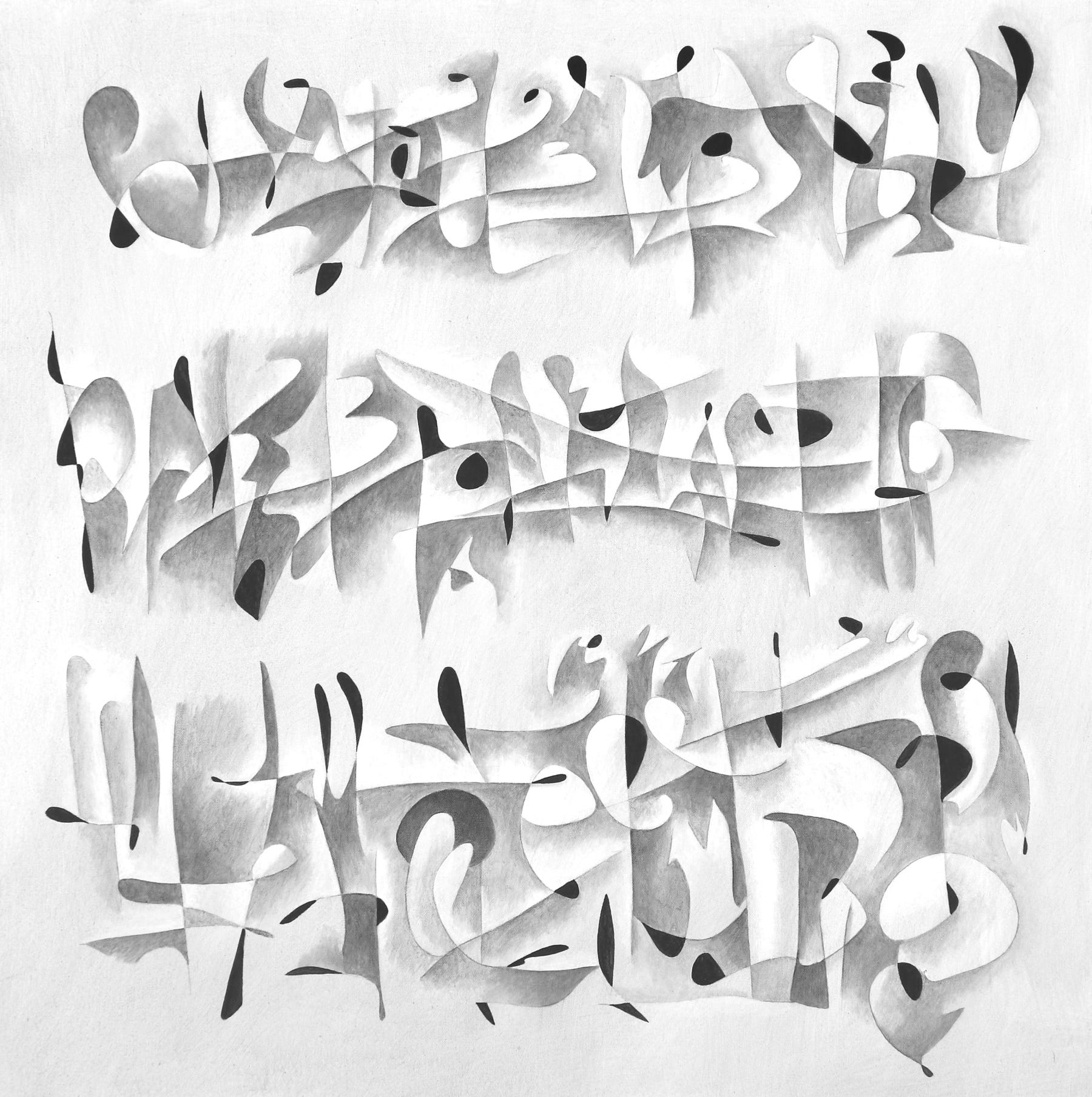
At the Root of Things
As I continued thinking about this, I realized that perhaps I had stopped one step too soon.
I suggested that music, poetry, drawing, dance, and the other arts might all be different dialects of the same Root-Tongue. I still believe that is true, but where exactly does this Root-Tongue reside?
It cannot be located in the eye. It cannot be located in the ear. Nor in the hand.
The eye only receives light. The ear only receives vibrations. The skin responds to pressure and temperature. Each sense gathers only a fragment of the world.
Yet somehow we do not experience fragments. We experience a seamless reality.
Somewhere beyond the senses themselves there exists a synthesizing awareness that gathers these independent streams into a single coherent experience. We do not consciously assemble sight, sound, touch, memory, balance, smell, language, emotion, expectation, and imagination. They simply arrive already woven together.
Consciousness is performing an extraordinary act of composition every moment of our lives. This synthesis is so complete that we rarely notice it. Perhaps this is where the arts truly originate.
An artist does not merely paint what is seen or compose what is heard. The artist works from the already synthesized field of experience. When a composer writes music, the music carries movement, emotion, architecture, color, memory, silence, anticipation, and physical gesture. When a painter makes a drawing, the drawing contains rhythm, duration, weight, acceleration, pause, and breath. These qualities are not borrowed from another art form. They were never separate to begin with.
The separation occurs only after we begin naming the senses.
Consciousness itself is not divided into departments. The eye does not know that it is visual. The ear does not know that it is auditory. Those distinctions belong to analysis, not experience.
Before we divide the world into seeing, hearing, touching, speaking, and moving, there is simply awareness meeting the world in its wholeness.
Perhaps this explains why artists are continually crossing boundaries between disciplines. We are not importing musical ideas into drawing or poetic ideas into sculpture. We are returning upstream to the place before those distinctions existed.
It may be the natural activity of consciousness itself as it encounters reality before thought separates experience into categories.
The various arts then become different ways of revealing that original unity. Each medium makes visible one aspect of an indivisible whole. Each artwork becomes evidence that consciousness is fundamentally synthetic rather than analytic.
Creative insight comes first. Analysis begins afterward.
Cecil, your essay touches upon so many aspects of knowledge and awareness, two pillars of human consciousness that in varying degrees crosses over into pretty much everything humanity is about as it lifted itself away and apart from the purely animal world. Consciousness is and always has been a key for me. But consciousness is also the lock hole. It's the door and it's the key maker as well. Sometimes simultaneously, sometimes working solo. Consciousness, I've come to understand, is a subjective, not an objective experience. And over time (seconds, minutes, hours, days, weeks, months, years, a lifetime) it is in constant flux. What i detect as red on Monday morning in bright sunlight, might seem mauve come the evening as the sun settles in the West. My experience of myself and what I do is also changing – minutely – as is my understanding of what I produce: The paper I cut, the way I attach it to a support, the way I compose. What "looks" good on Tuesday, is oftentimes torn up on Wednesday. Why? What happened? What this all means to other people, if anything at all, is often a mystery. And while language can and does help detail the distinctions and differences between us and our experiences of reality and the meanings involved in moving through reality and time and our social experiences, it (language) is also vulnerable to flux. Meaning perhaps is best fixed in mathematics, a language supporting science (at least on this planet). It's all perhaps a glorious, evolving puzzle.
I enjoy how you articulate how your mind works as you conceive and create your art. It's really fascinating. I really haven't thought about my own mind and how it functions as I'm conceiving/creating my art but your article has now got me thinking about thinking. Many years ago I would listen to music in the studio as I made my art but since I've been in this home with my studio, I don't listen to any music and prefer the silence or the 'noise' of my own thoughts whether intrusive or just flowing as I'm engineering the hows of attaching objects. I talk aloud sometimes, I'll cuss, cry, and even talk to the piece I'm working on. I feel music would be a distraction to me now as I prefer to listen to music doing other things or merely just listening.