


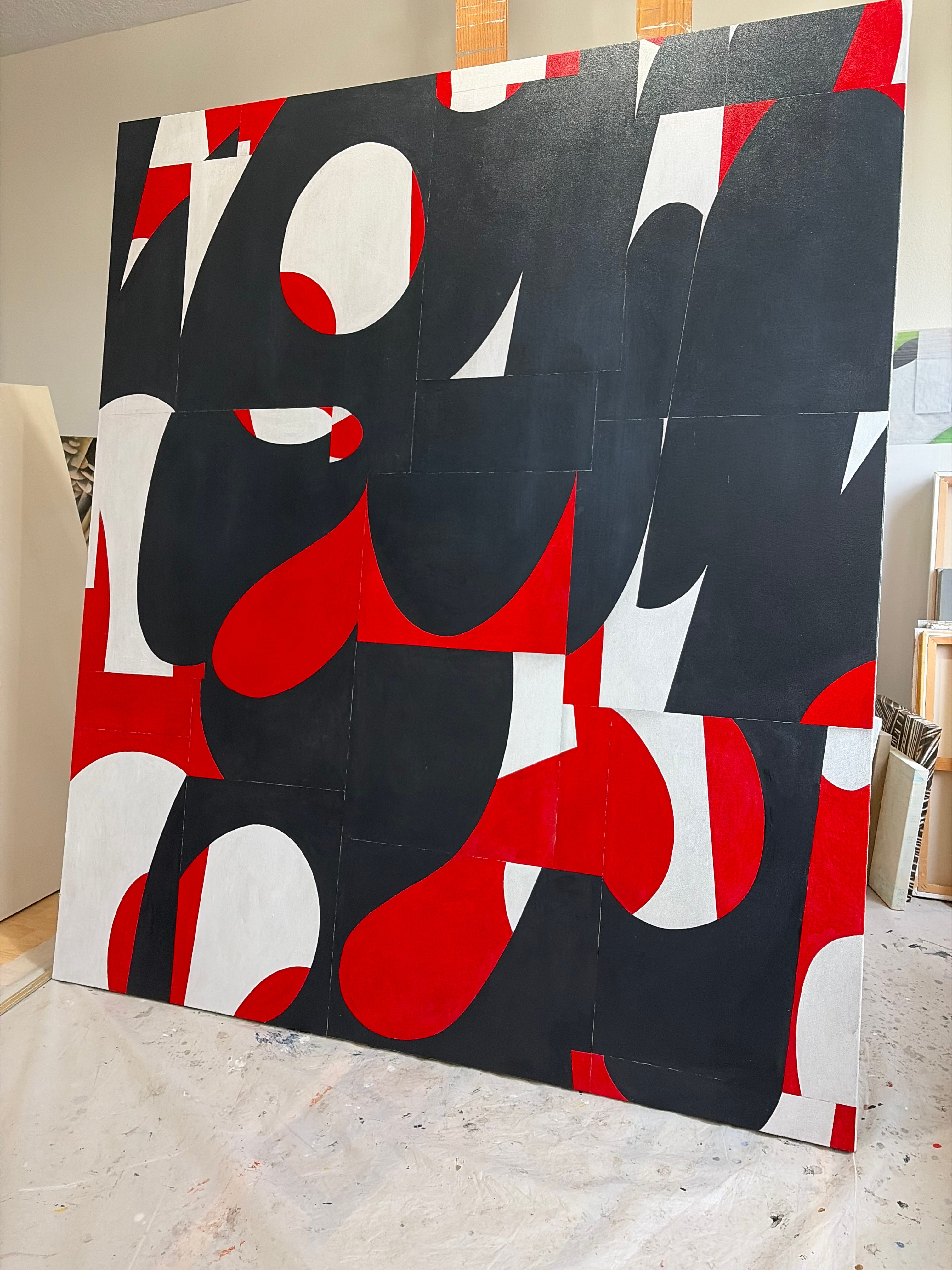
It has finally cooled off here in the high desert and it has been raining all day. Hooray! It was the hottest summer on record. Even the Rio Grande went dry this summer. Not hot like Texas thank goodness becuase Albuquerque is at 5,000 feet. It still cools off at night.
I was sitting here at the computer thinking I need to write a little something for my journal which I try to write into every day. I have noticed that I have gotten a little off track becuase I have gotten lost in my studio immersed in new artworks and have forgotten to sit down and write the most minimal entries:
The date,
what time I woke up
and later; what time I went to bed
and how many steps I walked that day.
Also I write my substack articles in my journal and was thinking I need to write about something or other. So I started writing a little something about this problem of creative immersion and it led me to this series of new articles.
This first article in an introduction to the series of three essays about Creative Immersion. So here we go…
The Cycle of Creative Immersion - Entering, Disappearing, Returning
There is a place artists sometimes go.
It is not exactly a physical place, although the studio, the writing desk, the rehearsal room, the workshop or even a particular chair may provide the entrance to it. It is a condition of attention in which the ordinary world begins to recede and the work moves toward the foreground until, eventually, there seems to be very little else.
Time behaves differently there.
Hours can pass unnoticed. Hunger can go unnoticed. The phone may ring without being heard. At some point the distinction between the artist and the activity begins to soften. Instead of thinking about making the work, one is simply making it.
Sometimes even that description feels inaccurate.
The work seems to be making itself.
Artists have described this experience in many ways. We speak of being in the groove, being in the zone, being carried along, losing ourselves in the work. Psychologists have given us the useful term flow. Older spiritual traditions have offered images such as the empty vessel, the hollow reed and the clear mirror.
These different descriptions circle around a common experience: for a period of time, the ordinary sense of ourselves as the person directing everything becomes quieter.
But there is more to creative immersion than what happens while we are inside it.
There is an entrance.
And there is an exit.
Those two thresholds may be just as important as the experience itself.
Over many years of working as an artist, I have come to think of creative immersion as a cycle with three movements:
Entering. Disappearing. Returning.
Each requires a somewhat different skill.
Entering
First we have to get there. This can be surprisingly difficult.
We arrive at the studio carrying the ordinary world with us. There are messages to answer, appointments to remember, things that need fixing, conversations still running through the mind, news from elsewhere, unfinished obligations and the endless invitation to look at a screen.
The body may have entered the studio while the attention remains scattered across twenty other places. So the first problem of creative work is not necessarily What should I make?
It may be: How do I become completely present enough to make anything?
Artists develop countless techniques for accomplishing this, sometimes without recognizing them as techniques.
We prepare the studio. We arrange our materials. We make coffee. We put on certain music or insist upon silence. We take a walk. We sharpen pencils. We clean the brushes. We reread yesterday’s pages. We sit in the same chair. We turn off the phone.
Then we begin.
Perhaps most importantly, we begin before inspiration arrives.
We make one mark. Move one object. Write one sentence. Play one chord. Cut one piece of paper.
The first action leads to another. Then another. Repetition gathers momentum. Attention begins to narrow. The noise of ordinary consciousness gradually becomes quieter.
We cannot necessarily command immersion to occur. But we can learn to make ourselves available to it. Every artist eventually discovers a particular doorway. The first task is learning how to find it.
Disappearing
Then something changes. We cross a threshold without necessarily noticing when it happened. The person who was wondering what to do has become absorbed in doing it.
The internal commentator becomes quieter. Decisions occur without requiring lengthy deliberation. The hand seems to know something before the conscious mind can explain it. One thing calls for another. The work develops an internal logic that begins suggesting where it wants to go. The artist moves from commanding to attending. Time begins to disappear.
There is an old metaphor that I find useful here: consciousness as a luminous mirror.
When the mirror is clouded by our anxieties, ambitions, expectations, judgments and self-consciousness, we see everything through them. When the mirror becomes clear, it simply reflects what appears before it.
The reflection does not belong to the mirror. The mirror does not need to possess what it reflects. It simply becomes completely available to what is there.
Something similar can happen during creative immersion.
For a while, we stop standing outside the work judging it. The separation between observer and observed becomes thinner. The painter becomes absorbed in color, edge, rhythm and gesture. The writer disappears into language. The musician disappears into sound.
The ordinary self has not ceased to exist. It has simply stopped insisting upon its presence. This is often where the work surprises us.
Something appears that we did not plan. We look at it afterward and wonder: Where did that come from?
This is what artists mean when they say that the work made itself.
Returning
But eventually we have to come back.
This is the part of creative immersion that interests me increasingly because it receives much less attention.
I know from experience how completely time can disappear while working. Hours can pass. Sometimes entire days seem to merge into one another. I have missed appointments, forgotten what day it was and become so absorbed in working that I once forgot to pick up my children from school. Well, OK more than once.
Creative immersion can be wonderful. It can also become a problem.
My son Zach, who has the same capacity for intense creative absorption, sometimes calls it a “condition,” almost as though it were a psychological disorder. There is humor in the word, but there is also apprehension behind it. He knows that when he becomes deeply engaged creatively, the rest of everyday life can begin falling apart.
That observation raises a question that belongs alongside all our celebrations of artistic flow:
How do we disappear without becoming lost?
Perhaps the ability to enter creative immersion requires a complementary ability to leave it. The artist needs to learn reentry. If our internal sense of time becomes unreliable while we are working, then the boundary has to come from somewhere outside the immersive state.
An alarm.
A calendar.
A stopping time.
Another person expecting us.
A ritual that says: save the document, photograph the painting, put down the brush, write yourself a note about what comes next.
The alarm clock must remain outside the dream.
External boundaries do not necessarily interfere with creative freedom. They may be what makes that freedom sustainable. A canvas has edges. Music occurs within time. A poem eventually reaches its final line.
Creative immersion may also need a container. Within that container we can disappear completely. Outside it, there are people waiting for us. There are promises we have made. There are bodies that need feeding and sleeping and moving. There is an ordinary life that must somehow coexist with the extraordinary life of making things.
The Complete Practice
This suggests to me that creative practice consists of something larger than learning how to make paintings, poems, songs, novels, films or anything else. We are also learning how to move between different states of attention.
We learn how to leave the distracted world without rejecting it. We learn how to surrender ourselves to the work without trying to control every moment of its becoming. And we learn how to return.
Entering.
Disappearing.
Returning.
These are three movements of a single creative practice.
The first requires preparation.
The second requires surrender.
The third requires responsibility.
Over the next three essays, I want to examine each of these movements separately.
First: how do we prepare ourselves to enter sustained creative attention?
Second: what actually happens when the ordinary sense of being the doer recedes and the work seems to begin making itself?
And finally: how do we come back without destroying the very capacity for immersion that we are trying to protect?
Because perhaps the goal of an artistic life is neither to remain safely on the shore nor to disappear permanently into the depths. It is to become increasingly accomplished at making the crossing.
To know how to enter.
To know how to disappear.
And to know the way back home.
The next three articles to look more closely at each of these three stages.
A gem of an article. Just the kind of discussion that, in itself, is a creative immersion. Its those discussions when the participants follow the trails of concepts as they unfold between them. There’s joy and mystery and satisfaction in such talks. I so look forward to this series!