Editor’s Note
You may recall the earlier post Why West Texas Should be a Part of New Mexico
But wait, that's not all.
In my imagination and google satellite images I started traveling down to the designated part of west Texas concerning my border proposal to get a bird’s eye view and ended up wandering around in Wink, Texas and befriended a new charactor by the name of Billy 'the Snake' Schytte, a native of Wink and he was telling me he has a completely different take on things.
What follows is the beginning of an occasional series documenting the statements and proposals of Billy “the Snake” Schytte.
According to Billy, he has, in recent weeks, positioned himself as the acting Presidential Governor of what he describes as the Provisional Republic of New Texico.
While the existence of such a republic remains, at present, unconfirmed, Billy’s commentary on the ongoing Texas-New Mexico border tussle has proven difficult to ignore. As Billy says;
“There’s thought, speech and action. I’m currently in the speech phase.”
These entries are offered as a matter of record.
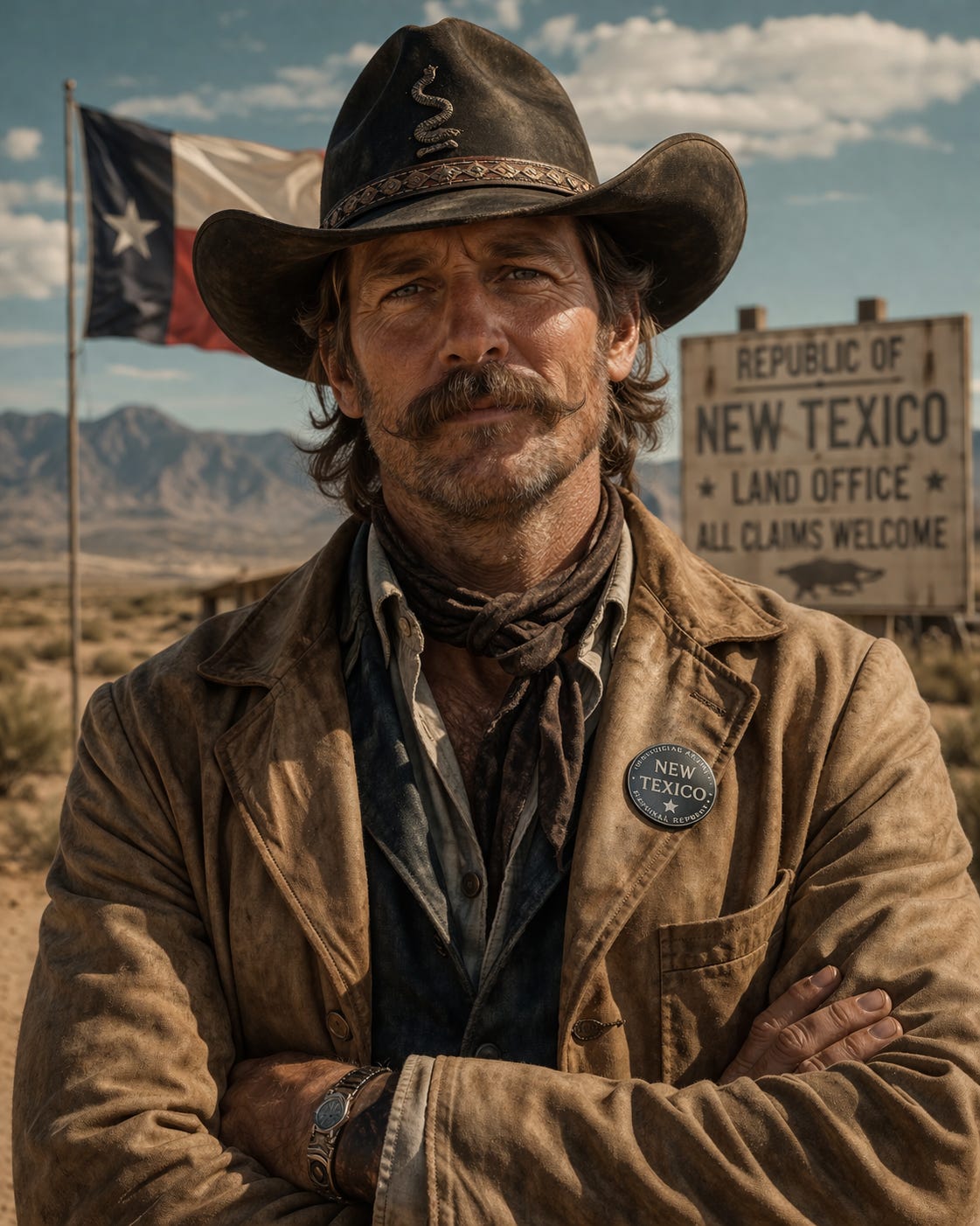
Who Is Billy ‘the Snake’ Schytte?
Journal Entry: April 2, 2026 - 12:57 PM (Mountain Time)
There are men who arrive in public life by way of law school, donor networks, polished shoes, and the kind of smile that suggests a committee taught it to them.
And then there is Billy the Snake Schytte.
At present, Billy tells me that he serves as Presidential Governor of the Provisional Republic of New Texico, a position he assumed, by his own account, not out of vanity but out of what he describes as “insuring continuity of governance in an uncertain time while there is a shortage of serious-minded alternatives.” Whether New Texico is to become a fully sovereign desert republic or eventually enter the Union as a U.S. state later, if they act right, Billy maintains that his title has been designed with sufficient constitutional flexibility to accommodate either outcome. As President if he can gain enough support to become an independant republic or as Governor of the 51st state should that become an option.
But in the meantime, to advocate for his West Texas community depending on how things play out between Texas and New Mexico.
Those who know him, or claim to, say this is typical of Billy’s civic minded nature.
Billy was born Wilhelm Schytte, a name inherited from the old family line and worn down over time by weather, labor, and local practicality. In childhood it became Willim, and for a period in his younger years he was known as Wolf, either because of a solitary disposition, a habit of watching before speaking, or some other event no one now tells in the same way twice. The name Billy came later, during his years working on a crew in West Texas. Billy insists this was because his coworkers recognized early that he was the GOAT at what he did and began calling him Billy Goat accordingly. Surviving witnesses may remember the matter differently.
The title “the Snake” came after, and in Billy’s own carefully repeated phrasing, “after an incident I consider resolved.”
Pressed beyond that point, he has occasionally offered a more philosophical explanation.
“I have come to think the Snake part is less about the incident and more about how my mind works. I tend to slither around through ideas, lookin’ for what’s hidin’ under things, takin’ ’em in whole and digestin’ ’em till I come up with my solutions. That’s what I’m good at.”
This may be the clearest available summary of Billy’s governing style.
He is not, by any conventional measure, an ideologue. He appears to hold a broad distrust of centralized authority in nearly all forms, including but not limited to Austin, Washington, most large urban planning initiatives, and anyone who says the phrase stakeholder engagement without visible embarrassment. His politics, if one can call them that, seem to emerge less from theory than from prolonged exposure to:
distance,
weather,
labor,
machinery,
and what he once referred to as “the accumulated stupidifications of people in office.”
Billy comes from what appears to be a long line of Schyttes, a family whose self-understanding is both specific and expansive. Billy has often repeated the family doctrine that the Schytte name is so particular that anyone carrying it is kin. This has not, to date, been formally verified by any genealogical authority, but it possesses a rough internal plausibility, especially given the rarity of the name and the tendency of sparse-country families to maintain a stronger sense of bloodline than paperwork.
The Schyttes, by all available signs, were never much drawn to crowded places.
They appear to have been, in origin, a Danish / Scandinavian people, perhaps carrying with them whatever old northern instincts survive migration:
weather sense,
route sense,
practical intelligence,
a certain dry fatalism,
and a preference for places where there was still enough room left for thinking.
One branch of the family, Billy maintains, is distantly related to the Danish composer Ludvig Schytte, whom he refers to simply as “the European branch.” While no documentation has yet been produced to settle the matter, Billy cites the connection whenever questions of refinement, structure, or inherited cultural range arise.
The family appears to have drifted southward and westward through the American interior in the late nineteenth and early twentieth centuries, likely through Colorado and eventually into the rougher reaches of West Texas / southeastern New Mexico country, where one branch secured and held onto a modest stretch of dry family land known simply as the Schytte place.
It is not a grand ranch in the modern aspirational sense.
It is something older and more useful than that:
a piece of held ground,
a fallback position,
a family argument,
and a point of return.
The Schyttes seem to have worked, across generations, in the practical sparse-country professions:
railroad work,
land routes,
surveying-adjacent labor,
transportation,
and the broad family of occupations involving timing, territory, movement, and survival.
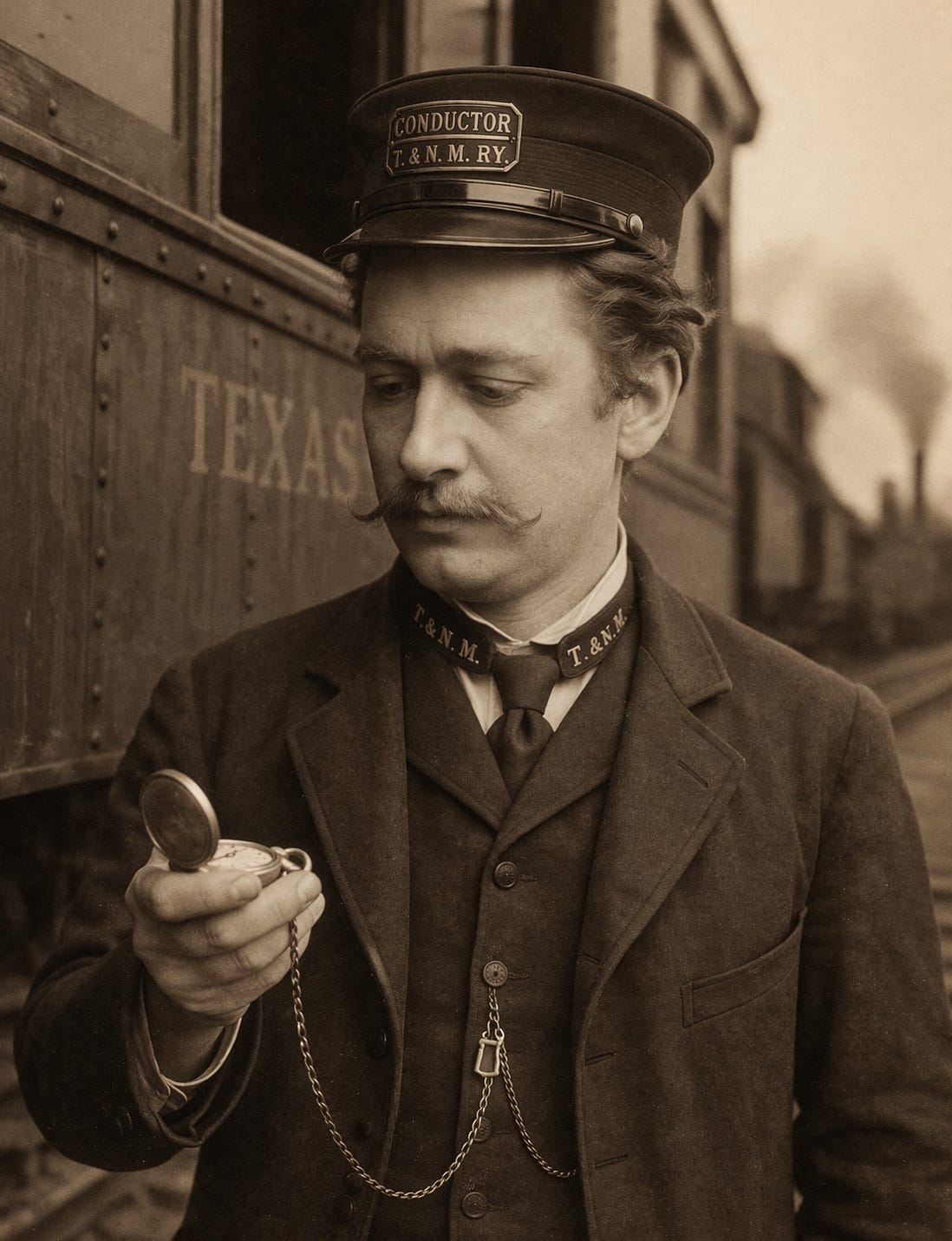
Billy’s great-grandfather, according to family memory, may have worked in some relation to the railroad, possibly in land acquisition, route judgment, or rights-of-way, helping determine where lines would pass through difficult country. His grandfather is said to have worked as a conductor or rail man in rough country and, according to one durable family legend, was once caught up in a train robbery during which his pocket watch was taken - an event Billy still speaks of as though it were not merely theft but an assault on order itself.
Whether all of these details can be fully verified is perhaps beside the point.
They are true in the way family structures are true.
Billy’s father appears to have belonged to that next familiar generation of desert-edge men whose work touched land, machinery, movement, and practical systems - oilfield work, road work, lease work, or surveying in one form or another - while keeping some connection to the family place alive.
That pattern passed directly into Billy.
He is most often seen in a red 1955 Chevrolet pickup, equipped with a 261 straight-six, which he appears to regard as both transportation and moral argument. The truck is not a polished collector’s object so much as a lovingly maintained working artifact - the kind of machine that continues to justify itself. This, Billy seems to feel, is the proper standard for both vehicles and republics.
He is also rarely without his working gold Swiss pocket watch from the 1920s, marked Touchon & Co., which he says belonged to his grandfather and which he appears to trust more than nearly any modern timekeeping system. The watch is not ornamental. He winds it. He checks it. He consults it. He carries it with the seriousness of a man who believes that if you no longer know what time it really is, then you are already in the early stages of civilizational drift.
As Billy has observed:
“A watch like that don’t run on sentiment. It runs on discipline.”
And elsewhere:
“The only time you’ve got is the time you keep and you gotta keep a watchful eye on what matters at that time.”
This may be the nearest thing he has to a political theology.
To Billy, a thing worth trusting ought to be:
understandable,
maintainable,
durable,
and built to last.
He has little patience for systems designed:
to drift invisibly,
fail quietly,
become unfixable,
and then require replacement by somebody else’s authority.
This appears to explain:
his affection for old trucks,
his suspicion of bad government,
his views on time zones,
and his growing insistence that West Texas, southeastern New Mexico, and the Big Bend region ought to be governed according to actual lived geography rather than inherited clerical laziness.
It is in this context that Billy has become the leading public advocate for the creation of New Texico, a proposed sovereign republic encompassing the western reaches of Texas and the adjacent borderlands, to be established initially as an independent desert nation and potentially considered for U.S. statehood later, that is, ‘if the federal government demonstrates sufficient maturity’.
His major policy initiatives include:
time zone realignment
straightened borders
desert self-rule
strategic alien discretion
future climate migration planning
and the construction of the Big Bend Maritime Corridor, a vast canal project intended to provide New Texico with maritime access, border security, economic development, and what Billy has repeatedly described as “all the beachfront property this sand’s been waitin’ on.”
Critics have called these proposals impossible, delusional, and geologically unserious.
Billy considers this encouraging.
He is known to speak in:
rough aphorisms,
unexpectedly memorable slogans,
and the kind of vulgar civic wisdom that sounds ridiculous until one notices it has somehow explained the situation better than the governor.
Among his better-known lines are the following:
“Government ain’t nothin’ but organizing shit with stationery.”
“Bad government is finally getting your shit together and then forgetting where you put it.”
“When shit hits the fan, it won’t be Billy Schytte.”
Around parts of West Texas, where reverence and mockery have long maintained a practical coexistence, Billy is known in some circles simply as Billy Shit, a fact he appears to have folded into his public identity with amusement and increasing strategic use.
He does not appear especially precious about names.
Among his Hispanic friends, he is often known as Guillermo, or Memo for short.
As he has said:
“I’ve been called all kinds of things. Most of ’em I answer to. But like I always say, Call me what you want, just don’t call me late for dinner, especially if fajitas and margaritas are involved.”
This, too, seems typical.
At present, Billy has:
no official office,
no recognized government,
no formal campaign apparatus,
and no digital presence of his own.
And yet he already carries himself with the settled confidence of a man who believes history has merely been delayed in catching up to him.
Whether Billy the Snake Schytte will one day preside over a sovereign desert republic, govern a future U.S. state, or remain what he is now - a highly articulate regional disturbance with constitutional ambitions - remains to be seen.
But one thing appears increasingly certain: he has already begun acting as though the map belongs to whoever is committed enough to go through the effort to make some improvements upon it.
Help me maintain the illusion of being a professional writer by becoming a paid subscriber and thanks to my patrons who support this publication!
This is an independent fake news publication.