


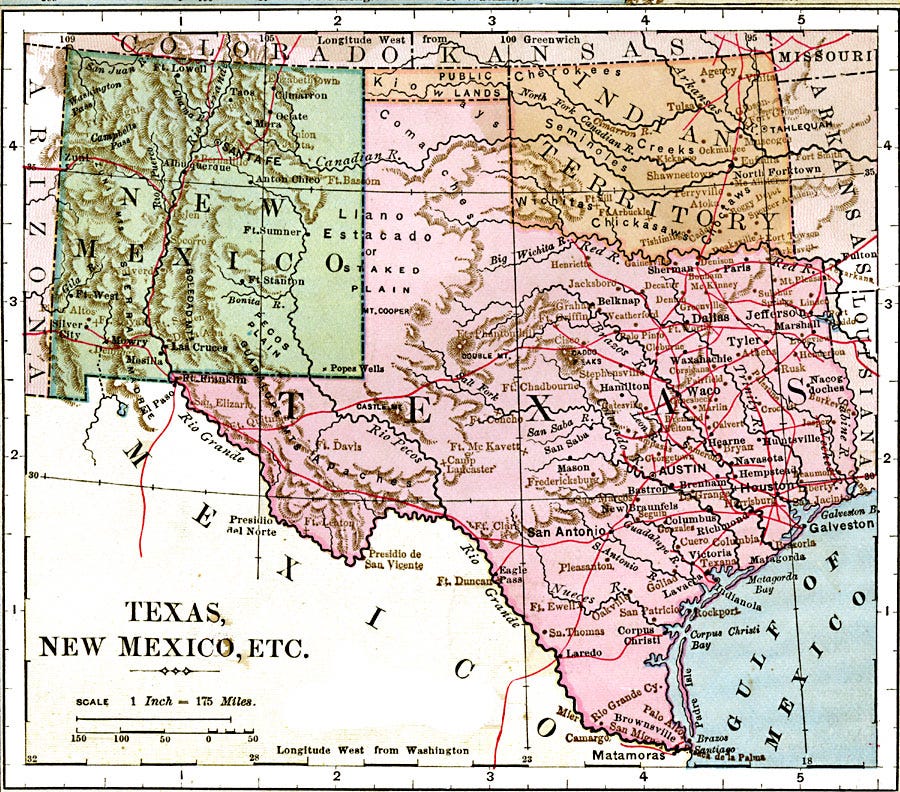
I have posted the beginnings of this extended feature as comments an this article on Texas Monthy The Texas GOP Has a Plan to Make Part of New Mexico New Texas
I just felt this was a prime opportunity to say a few things and was having so much fun it actually it got a bit out of hand. I wouldn’t blame you if you can’t make it through the whole 6,000 words of it. But I have to admit it is a pretty good read.
So top off your coffee cup, get comfy and have a read.
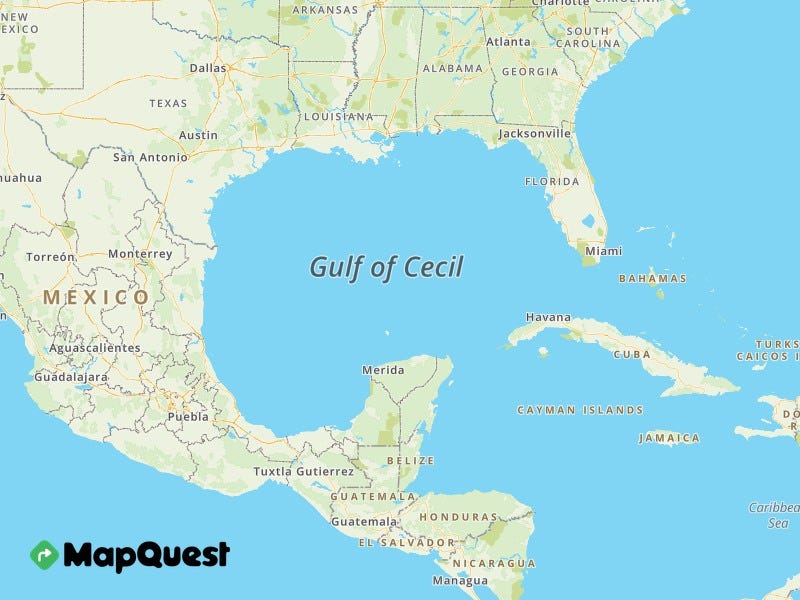
To start, in case you haven’t heard, the Gulf of Mexico is now the Gulf of Cecil. I have a map to prove it. I named the gulf after me when Trump decided it was Gulf of America. So next time you head down to what was formerly called Padre Island which is now called The Isle of Cecil, remember that you are stepping into the Gulf of Cecil.
Myself, I am a native Texan born in Austin but I live in New Mexico. I consider the antics of the current Republican Party or perhaps I should say the Rethuglican Party, an embarrassment to all Texans. Ted Cruz? I rest my case.
OK, onto the main topic...
The Big Bend Reconsidered
There are moments in public life when a proposal arrives that is so casually unmoored from reality that it invites, almost obliges, a response in kind. Not out of spite, but out of symmetry. A kind of civic call and response.
Recently, the good people of Texas, through the procedural imagination of Speaker Dustin Burrows, have taken up the question of whether certain counties of New Mexico might be better off under Texan stewardship. Not action, not yet. A study. A consideration. A thoughtful leaning over the fence line with a measuring tape and a gleam in the eye.
Very well.
If we are now entering an era of speculative cartography, New Mexico would like to submit its own modest proposal.
We propose to extend our eastern border southward in a clean, elegant descent to the Mexican frontier, incorporating the region presently known as Big Bend National Park and its surrounding lands into the greater cultural and ecological body of New Mexico.
We offer this not as a provocation, but as a gesture of balance. If maps are to become conversational again, let us converse properly.
There is, after all, a certain logic to the matter. The land itself has been making quiet arguments for millennia. The deserts do not recognize Austin. The mountains do not report to committees. The river bends according to older instructions than any legislature has yet managed to draft. The great sweep of that region - basin, sky, canyon, silence - speaks in a dialect far more closely aligned with the long vocabulary of New Mexico than with the administrative ambitions of distant offices.
One might say the land has already voted. It simply has not yet been asked in the correct language.
Texas, for its part, has always possessed a certain largeness of personality. One hesitates to call it expansionist. It is more of a habitual stretching, a reflexive reaching toward the horizon as though the horizon were a suggestion rather than a boundary. This has produced many admirable qualities - confidence, scale, a certain operatic sense of self. It has also, from time to time, produced the impression that everything visible might be improved by being Texan.
We do not entirely disagree. We simply believe that principle should be applied with reciprocity.
If southeastern New Mexico can be imagined as Texan, then Big Bend can certainly be imagined as New Mexican. The symmetry is almost mathematical. One could sketch it on a napkin. One could present it to a committee. One could commission a study.
And why stop there. Let us convene a panel of geologists, poets, ranchers, and those who have spent a night alone under that West Texas enormous sky. Let us ask them where the line truly runs. Not the inherited line, but the lived one. The one that reveals itself somewhere between the last paved road and the first clear recognition that the world is larger than any claim placed upon it.
We suspect their answer would not arrive in the language of jurisdiction.
There is also a matter of aesthetics. New Mexico, as a shape, would benefit from a more graceful extension. A southern reach. A continuity of gesture. The map would breathe differently. It would feel less like a compromise and more like a sentence completed.
Texas, in turn, would lose nothing essential. It would remain vast. It would remain Texas. It would continue, as it always has, to contain multitudes, contradictions, and an admirable ability to take itself both very seriously and not seriously enough.
We are, in this sense, offering a service.
Of course, we understand the practicalities. Such a change would require agreements, legislatures, and the slow machinery of federal approval. It would require signatures, hearings, and a great many documents stamped in ink. It would require, in short, reality to reassert itself.
But that is not quite the point.
The point is that maps are not only records. They are expressions of desire. They reveal how a place imagines itself in relation to its neighbors, its resources, its future. And when one state begins to imagine the rearrangement of another, it opens a small and curious door.
We have simply stepped through it.
So let this proposal stand. Not as a demand, but as a mirror. Not as a plan, but as a clarification.
If we are to redraw the lines, let us at least admit that we are drawing them with the same human hand that draws everything else - with a mixture of reason, appetite, humor, and the faint suspicion that the land itself is quietly amused.
In the meantime, the river will continue to bend. The desert will continue to speak in its slow, precise grammar. And the maps will wait, as they always do, for someone to come along and imagine them otherwise.
#Texas #annexNewMexico #WestTexasPolitics #ElPaso #BigBend #Southwest #SouthwestCulture #TexasPolitics #NewMexicoPolitics #Borderlands #DesertLife #AmericanWest #WesternCulture #PoliticalSatire #Satire #RegionalPolitics #MountainTime #ElPasoTexas #Marfa #Terlingua #Presidio #Wink #BigBendCountry #DesertHumor #AnnexWestTexas, #annextwoNewMexicocounties
On the Practical Advantages of a More Elegant Border
Let us now leave aside, for a moment, the higher poetry of geography, the spiritual rights of deserts, the whispered self-determination of mesas, and all such noble atmospheric matters, and consider instead the question in the plain, hard, practical language so beloved by committees, appropriations boards, defense contractors, and men who wear lanyards at regional policy conferences.
What, precisely, would be the advantages to each state if the eastern border of New Mexico were simply extended in one clean vertical line all the way south to Mexico?
The answer, upon sober reflection, is: many.
Indeed, one is surprised no one has yet had the courage, or the cartographic imagination, to propose it more forcefully.
To begin with, New Mexico would gain what every serious southwestern state ought to possess in abundance: additional federally useful emptiness.
This is not a criticism. It is an asset category.
New Mexico has long understood that one of the great hidden currencies of the American West is not merely land, but land upon which the federal government feels comfortable conducting things it would prefer not to explain in detail. It is a rare and underappreciated specialization. While other states clutter themselves with population, commerce, and suburban entitlement, New Mexico has maintained a proud and disciplined relationship with remoteness.
That remoteness has already proven useful in matters of national security, advanced secrecy, improbable aircraft, atmospheric ambiguities, and the occasional project whose budget is blacker than the night sky over the Jornada del Muerto.
By extending the border southward, New Mexico would acquire additional acreage for the storage, concealment, testing, misplacement, rediscovery, and plausible denial of all manner of sensitive national endeavors. You know, nuclear warheads and such.
Should the federal government ever decide that it once again needs more room for blowing shit up in the name of peace, deterrence, freedom, or the general maintenance of geopolitical confidence, New Mexico would be able to respond in the mature, civic-minded manner for which it is known:
“Yes, we believe we can accommodate that.”
There would be more room for:
missile ranges,
secret hangars,
underground facilities,
suspiciously unmarked roads,
fenced compounds with signs that say NO TRESPASSING - USE OF DEADLY FORCE AUTHORIZED,
and, naturally, more secure locations in which to hide aliens and their technology from the general public.
And let us be honest here. If one is going to hide extraterrestrial technology anywhere in the United States, one does not tuck it behind a Chili’s outside Dallas. One places it somewhere with proper atmosphere. Somewhere with dignity. Somewhere with enough silence, dust, and military signage to support the mythology.
New Mexico already has a strong brand in this department. What it lacks is simply a little more elbow room.
This proposal would remedy that.
Now let us turn, with equal fairness, to the advantages for Texas.
Texas, as everyone knows, is forever complaining about the burden of protecting the southern border with stunts like bussing Over 100,000 Migrants To Sanctuary Cities and proud of it. This complaint has become one of the state’s most enduring folk traditions, right alongside brisket, boosterism, and saying the phrase “energy independence” with the gravity of a religious sacrament.
The border, we are told, is expensive. Difficult. Lengthy. Burdensome. Vast stretches of river, desert, and ranchland must be monitored, patrolled, surveilled, dramatized, televised, and periodically used as a backdrop for gubernatorial photography.
Very well.
What if New Mexico, in a spirit of regional cooperation and neighborly sacrifice, simply took nearly half of the miles of that border off Texas’s hands?
Think of the relief.
Think of the savings.
Think of the emotional release.
A significant portion of Texas’s border responsibilities would be gently transferred to a state far more temperamentally suited to the task. New Mexico, with its more meditative relationship to space and fewer compulsions toward theatrical overstatement, could manage the newly acquired stretch with a calmer hand and considerably less shouting.
Texas could then devote more of its precious time and treasure to:
repairing its power grid,
explaining its water future,
litigating against books,
build more data centers,
or simply enjoying the reduced administrative stress of having slightly fewer miles in which to perform frontier masculinity for cable news.
This would be, in effect, a mercy annexation.
And there are secondary benefits as well.
A cleaner vertical border would be easier to understand. Easier to map. Easier to explain to schoolchildren. Easier to print on coffee mugs and souvenir tea towels. It would reduce visual clutter in the national imagination.
There is something deeply satisfying about a straight line carried through to completion. It has confidence. It has clarity. It says, “We meant this.”
The current arrangement, by contrast, feels like the result of a distracted clerk being called away mid-ruler.
No, if we are to be serious about governance, we must also be serious about line quality.
And there is one more advantage, perhaps the most important of all.
This proposal would allow both states to save face while pretending to act in the interest of mutual strategic necessity.
New Mexico could frame the expansion as a patriotic contribution to national defense, scientific advancement, and extraterrestrial containment logistics.
Texas could frame the cession as a fiscally responsible act of sovereign burden reduction and inter-state efficiency.
Both states would emerge claiming victory.
The federal government would nod gravely.
Consultants would invoice.
And the desert, as always, would absorb the absurdity with perfect composure.
Which is perhaps why this proposal feels, in its own ridiculous way, almost reasonable.
Not because it is likely.
Not because it is lawful.
Not because it is wise.
But because it has that distinctly American quality of sounding half insane and half administratively plausible at exactly the same time.
And if that is not the true spirit of the republic, it is at least one of its more durable operating principles.
#AnnexWestTexas #FreeTheClocks #NewMexico #Texas #WestTexas #MountainTime #ElPaso #Marfa #Terlingua #BigBend #Southwest #DesertPolitics #PoliticalSatire #Borderlands #WesternAbsurdity #MapCorrection #DesertRepublic #TexasHumor #NewMexicoHumor #WrongTimeline
On the Deep New Mexican Character of West Texas Place Names
And now we arrive at one of the strongest pieces of evidence in favor of this entirely reasonable border adjustment: the names have already chosen sides.
This, in truth, may be the most compelling argument of all.
Before one examines economics, military logistics, desert stewardship, or the proper storage of recovered alien propulsion systems, one must first ask a simpler and more intimate question:
What does the land call itself?
Because names matter. They are not incidental. They carry weather, memory, conquest, prayer, migration, trade, grief, inheritance, and the old mouth-shapes of those who stood there before surveyors came along with rulers and federal confidence.
And when one looks westward across that stretch of Texas under discussion, one finds not a robust field of aggressively Anglo certainty, but an entire landscape already speaking in a voice that sounds suspiciously, unmistakably, and quite respectably New Mexican.
Take El Paso.
I ask you, with complete seriousness: does this not already sound like a city that should be in New Mexico?
It does.
It has the dignity. It has the cadence. It has the proper desert syllables. It does not sound like a place that should be governed by distant men in polished boots holding press conferences about freedom while standing in front of a Buc-ee’s billboard. It sounds like a place where one should be able to buy a burrito, hear three languages before noon, and encounter a retired ceramicist with profound opinions about saints, coyotes, and chile.
In other words, it sounds New Mexican.
Then there is Marfa.
Marfa? Come now.
That is not merely acceptable to New Mexico. That is practically overqualified. It already sounds like a small, mysterious art town full of weathered adobe walls, conceptual installations, dogs sleeping under pickup trucks, and a former sculptor living in semi-voluntary obscurity while making impossible furniture from salvaged wood and speaking only when necessary.
That is not foreign territory. That is family.
And what of Presidio?
Presidio is so New Mexican in temperament that one suspects it has simply been waiting, politely and without complaint, for the paperwork to catch up.
Terlingua? Entirely plausible New Mexico.
Alpine? A little less obvious perhaps, but still perfectly assimilable after a brief orientation and some exposure to proper chile governance.
Fort Davis? Slightly more Texan in posture, yes, but not beyond rehabilitation.
One could go on.
The point is not that these places are not Texan in the current bureaucratic sense. The point is that their names, atmospheres, and existential frequencies suggest a more nuanced identity. They already belong to the greater Southwestern sentence that New Mexico speaks more fluently than perhaps any other state in the union.
Texas, by contrast, often behaves as though every town within its borders must participate in the same giant statewide personality cult. But this is simply not true. Texas contains many Texases. There is the oil Texas, the cattle Texas, the suburban stadium Texas, the finance Texas, the megachurch Texas, the border Texas, the weird artsy Texas, the German-Texas, the Tejano Texas, the hill-country dream Texas, and the Texas that would very much prefer not to be included in whatever the governor is currently yelling about.
West Texas, especially along that long desert stretch, has always seemed to exist in a slightly different register. It is drier in spirit, quieter in posture, more spacious in its thinking. It is less interested in spectacle and more willing to let the sky do the talking.
That is a New Mexican trait if ever there was one.
In fact, one might say that the further west Texas goes, the less Texan it becomes and the more it begins to remember something older, stranger, slower, and more desert-shaped.
Which is to say: it begins to behave like New Mexico.
This is not an insult to Texas. It is, if anything, a compliment. It means that even Texas, in its western reaches, eventually improves.
And let us also note the linguistic dignity of the matter.
New Mexico is a state whose atmosphere has long been shaped by Spanish, Indigenous, frontier, Catholic, Mexican, Anglo, mystical, military, artistic, and plain old desert influences all jumbled together into a kind of weathered cultural braid. Its place names do not merely label locations. They often sound like they are carrying history in a clay bowl.
West Texas place names already fit comfortably into that bowl.
No one would blink if one heard of a road trip passing through El Paso, Presidio, and Terlingua on the way to some obscure shrine, abandoned mission, artist residency, or highly questionable but unforgettable café. In fact, it sounds less like a crossing of state lines than a coherent itinerary.
That coherence should not be ignored.
It is the map, once again, lagging behind the deeper truth.
For names are often wiser than governments. They persist. They carry forward what the land remembers even when official boundaries become clumsy, arbitrary, or politically overcaffeinated.
So yes, this proposed border correction is supported not only by military logic, fiscal generosity, alien storage capacity, and humanitarian border relief for our overburdened Texan neighbors.
It is also supported by the simple and obvious fact that many of these towns are already, in name and in spirit, perfectly respectable New Mexican places.
The paperwork, as always, is merely the final stage of recognition.
#Leacounty #Rooseveltcounty #Annex #annexation #RepublicofNewTexico #secession
On the Linguistic Self-Exposure of “West Texas”
Once one begins to examine the matter linguistically, one discovers that Texas has already confessed.
The phrase itself gives the whole thing away:
West Texas.
Now let us pause and look at that carefully.
Not simply Texas.
Not proudly and indivisibly Texas.
But West Texas.
A qualification. A caveat. A directional disclaimer.
An internal footnote.
The phrase carries within it the unmistakable sound of a people saying, in effect:
“Yes, yes, technically it’s ours… but it’s a little different out there.”
And there it is.
That is how empires talk about their borderlands. That is how central authorities refer to regions that have always sat a little outside the emotional, cultural, and atmospheric center of the thing. It is the language of partial belonging. The vocabulary of managed ambiguity.
No one says East Texas with the same nervous explanatory energy, because East Texas is not under suspicion. It is securely Texan. It is soaked in the proper statewide broth. It carries the approved flavor profile. But West Texas always arrives in conversation with a faint tone of exception, as though the speaker is trying to reassure both themselves and the listener that, while things may become geologically or spiritually irregular out there, one need not panic.
It remains, for the time being, within the paperwork.
But the phrase tells the truth.
Because if a region must constantly be described as a directional variation of the parent identity, that usually means it is already drifting toward another one.
This is basic cultural tectonics.
You can hear it elsewhere:
West Berlin
West Bank
Western frontier
the West End
the Western Territories
Such names do not merely indicate position. They indicate threshold.
And threshold is precisely what West Texas is.
It is not Texas proper in the full ceremonial sense. It is Texas becoming uncertain at the edges. Texas thinning into desert. Texas entering a zone where its usual assumptions begin to lose altitude. Texas wandering so far into silence, distance, Spanish place names, mountain light, and metaphysical weather that it gradually ceases to behave like itself.
At a certain point, one is simply watching Texas slowly become New Mexico without wanting to admit it.
This is why the term West Texas is so revealing.
It is the verbal equivalent of a man introducing his cousin by saying, “He’s family, but he’s… different.”
Different how?
Well.
Quieter.
Older somehow.
Less impressed by volume.
More comfortable with empty space.
More likely to contain an abandoned mission, an art installation, a ghost town, three dogs sleeping in shade, and a man named Rafael who knows things he has no intention of putting online.
In other words:
New Mexican.
And if we are being honest, the phrase West Texas has always had a faint undertone of administrative denial.
It sounds less like a place fully integrated into the Texan psyche and more like a holding category for land that never quite submitted to the brand.
It is the state’s way of saying:
“This is still us, technically, though we admit it has become rather strange and beautiful and difficult to govern according to our usual habits.”
Exactly.
That is how provinces become borderlands.
That is how borderlands become arguments.
That is how arguments become maps.
In fact, one could make the case that the entire phrase West Texas is merely a temporary placeholder for the more accurate and historically honest term:
Eastern New Mexico South.
Or, if one wishes to preserve local dignity and transitional stability:
The Lower New Mexican Extension Zone.
Naturally, this would require tasteful signage and a modest public education campaign.
But the principle stands. And don’t worry, we’ll work it out ourselves.
When Texans themselves instinctively speak of that region as a directional exception, they are already acknowledging that it belongs to a different interior world than Dallas, Houston, Austin, or even the mythic self-image Texas prefers to project onto itself.
West Texas is what happens when Texas wanders too far into the desert and begins, against its own intentions, to attain depth.
And depth, as we know, is dangerous.
Depth leads to reflection.
Reflection leads to humility.
Humility leads to adobe.
Adobe leads, inevitably, to New Mexico.
This is simply the natural order of things.
So yes, the very phrase West Texas is less a regional descriptor than a quiet confession.
It is Texas speaking under oath and hoping no one notices.
And now, regrettably for them, we have noticed.
On the Cinematic Case for the Transfer of West Texas
#NewMexicoFilm #FilmedInNewMexico #NewMexicoFilmmaker #NewMexicoFilmmaking #NewMexicoCinema #FilmNewMexico #NMFilm #IndependentFilm #IndieFilm #Filmmaking #FilmProduction #LocationScouting #FilmLocation #SouthwestCinema #SouthwestFilm #DesertCinema #AlbuquerqueFilm #SantaFeFilm #LasCrucesFilm #MovieMaking
And now we arrive at what may be the most incontrovertible evidence of all:
cinema.
Because if politics can be evasive, and history can be selective, and maps can lie with a ruler and a straight face, film has a way of exposing the underlying truth.
And the truth is this:
If you are filming “West Texas,” you might as well just be filming in New Mexico.
In fact, very often, that is exactly what happens.
This is one of the great unspoken embarrassments of regional identity in the American Southwest. The visual mythology of “Texas” - especially the mythic, sparse, windswept, haunted, western, old-weird, frontier, desert, existential, post-cowboy Texas that people actually want in movies - is very often cinematically indistinguishable from New Mexico.
Or, worse for Texas, it is sometimes better achieved in New Mexico.
And why?
Because New Mexico has long since mastered the art of being the distilled visual essence of the American West.
It does not merely contain western landscapes. It contains the idea of westernness in a more concentrated and photogenic form. It has the proper horizons. It has the proper weathering. It has the proper silence. It has the right ratio of ruin to sky.
It knows how to stand there and look like destiny.
This is why filmmakers love it.
When a director wants:
a morally ambiguous desert,
a town where something ominous happened in 1887 and perhaps again last Tuesday,
a borderland of heat, distance, dust, and consequence,
a road that appears to lead toward either revelation or death,
or a horizon vast enough to make a man reconsider his life choices,
they are, whether they know it or not, asking for New Mexico energy.
And what is West Texas, especially in the cinematic imagination, if not simply New Mexico with more state-sponsored self-regard?
Let us be blunt.
No one dreams of filming “suburban Texas.”
No one yearns to capture the spiritual mystery of six lanes of frontage road and a Cheesecake Factory near Plano.
That is not the Texas of filmic longing.
What filmmakers want is the desert edge, the lonely gas station, the faded motel, the border-town twilight, the empty highway at dusk, the mountains beyond legality, the wind moving through old signage, the sense that civilization is present only on probation.
That is the West Texas package.
And that package is already, aesthetically and atmospherically, fully compatible with New Mexico.
One might even argue that New Mexico has spent decades serving as the stunt double for the Southwest’s deeper subconscious, while Texas has too often been busy insisting on top billing.
If the visual DNA matches, if the architecture harmonizes, if the light behaves correctly, if the desert agrees, and if the camera cannot tell the difference, then one must ask the obvious administrative question:
Why maintain the fiction?
Why force productions to navigate this emotional and bureaucratic redundancy?
Why continue pretending that “West Texas” is some wholly separate cinematic species when every director, cinematographer, location scout, and weathered character actor with a squint and a flask already knows what time it is?
It is New Mexico-adjacent at minimum.
At best, it is simply pre-recognized New Mexico.
And let us not ignore the practical implications.
By formally incorporating West Texas into New Mexico, the state would become even more attractive as a one-stop production environment for all desert, borderland, neo-western, apocalyptic, revisionist, noir-western, post-frontier, alien-contact, cartel-adjacent, mystical-road-movie, and “man-in-hat-walks-silently-across-parking-lot” genres.
Think of the efficiency.
No more awkward disclaimers:
“Set in Texas, filmed in New Mexico.”
“Inspired by West Texas, shot outside Las Cruces.”
“A Texas story captured in a state with better light and less administrative friction.”
The truth could finally be stated plainly.
And Texas, if it is wise, should welcome this.
Because there is no shame in handing off a region that is already living a double life on screen. In fact, it may come as a relief. Texas could then focus its cinematic brand on what it truly excels at:
oil-money family sagas,
courtroom swagger,
football fathers,
suspicious governors,
megachurch parking lots,
and tense conversations held over iced tea on very expensive porches.
A rich tradition in its own right.
But West Texas?
That belongs to the long, quiet, morally complicated visual narrative of New Mexico. Think Breaking Bad.
You can see it in the light.
And film, perhaps more than politics, is merciless about light.
A camera knows when a place is pretending.
A camera knows when a place belongs to a myth larger than its paperwork.
A camera knows when a region has wandered spiritually across a border long before any legislature has managed to catch up.
And what it knows, over and over again, is this:
If you are trying to film the haunted desert soul of West Texas,
you are already most of the way to New Mexico.
You may as well finish the trip.
#NewMexicoFilm #FilmedInNewMexico #NMFilm #FilmProduction #FilmCrew #ProductionLife #FilmIndustry #IndieFilm #SetLife #LocationScouting #FilmLocation #CrewLife #ProductionDesign #Cinematography #FilmDirector #FilmMaker #MovieSet #SouthwestFilm #AlbuquerqueFilm #SantaFeFilm
Even Time Refuses to Remain Texan
And now, perhaps the most elegant evidence of all.
Not geography.
Not language.
Not cinema.
Not military secrecy.
Not border management.
Not extraterrestrial storage logistics.
Time itself.
Because when one looks closely at the far western edge of Texas, one discovers something almost too perfect to have been invented:
Part of Texas already keeps New Mexico time.
This is not metaphor.
This is administration.
Places like El Paso and the surrounding western edge of Texas are already living by Mountain Time, while the rest of Texas remains in Central Time. Which is to say, in the most literal possible sense, West Texas is already operating on a different timeline than Texas proper.
And if that does not tell us something profound, then frankly nothing will.
Because what is a time zone, if not a civilization admitting where its true orientation lies?
Time zones are not decorative. They are among the deepest confessions a place can make. They reveal where a region actually lives in relation to work, weather, commerce, sunrise, travel, and the felt rhythm of ordinary existence. They are a daily act of alignment. A repeated agreement with the turning of the Earth.
And West Texas, in its farthest reaches, has already chosen. After all, whole doesn’t want to be in mountain time. That sound way cooler than central time any day of the week. Texans come to mountain time on vacation or have second homes here.
West Texas wakes with New Mexico.
It eats lunch with New Mexico.
It misses appointments with New Mexico.
It arrives at the hardware store, the dentist, and the funeral home with New Mexico.
Its clocks are already facing westward in spirit.
One could hardly ask for a clearer declaration of intent.
This means that the current situation is not merely a border anomaly. It is a temporal injustice.
Imagine the absurdity.
Imagine living your whole life under a state government whose emotional center is in one time zone, while your actual day unfolds in another. Imagine being administratively Texan while existentially New Mexican. Imagine knowing, every single morning, that your clock and your legislature are not in full agreement.
This is no way to run a republic.
What we are witnessing is not simply a discrepancy of convenience. It is a people being forced to inhabit the wrong narrative frame. They are, quite literally, living in the wrong timeline.
And this is where the beauty of the proposed border correction becomes undeniable.
By extending New Mexico’s eastern border southward in one clean vertical descent to Mexico, we would do more than adjust a line on a map.
We would heal a tear in spacetime.
Those current West Texans would at last be restored to their proper temporal habitat. Their civic identity would finally match the hour on the microwave, the dashboard clock, the church bulletin, and the feed store sign.
They would no longer have to endure the subtle psychic strain of belonging to one state while keeping time with another.
Their maps would match their mornings.
Their jurisdiction would match their sunlight.
Their paperwork would, at long last, catch up to their clocks.
This is not annexation.
This is chronological reconciliation.
One might even call it a humanitarian correction.
Because how many generations must a people endure the quiet bewilderment of waking up in one state and one metaphysical condition, only to discover that the capital governing them is operating according to a different noon?
This cannot continue.
There is a reason frontiers are often strange. They are not only geographical thresholds. They are often time leaks. Places where one reality begins to thin and another starts pressing through. West Texas, especially that far desert edge, has all the signs of such a condition. It already lives in a different light. It already speaks in a different register. It already bears the names, the silence, the cinematic atmosphere, the borderland temperament, and now, indisputably, the correct hour.
What more evidence is required?
At some point, the burden of proof shifts.
At some point, one must stop asking whether West Texas should become part of New Mexico and begin asking why we have tolerated this obvious temporal mismatch for so long.
A state line should not force a people to live in bureaucratic drag.
A people should not have to perform one identity while their clocks are loyally reporting another.
The clocks, unlike legislatures, have no ideology.
They simply tell the truth.
And the truth is this:
West Texas is already keeping New Mexico time because, in the deeper order of things, it already belongs to New Mexico.
The proposed border correction would merely formalize what time itself has been trying to tell us all along.
The land knew it.
The names knew it.
The filmmakers knew it.
The desert knew it.
And now, at last, the clocks have spoken.
#AnnexWestTexas #Texas #NewMexico #WestTexas #ElPaso #BigBend #Marfa #Southwest #Borderlands #PoliticalSatire #MountainTime #DesertPolitics #FreeTheClocks #WrongTimeline
The Only Intelligent Border Adjustment Left to Us
In conclusion…
Now that the matter has been given the serious, balanced, and multidisciplinary attention it so clearly deserves, the conclusion is unavoidable.
Once the evidence is gathered, arranged, and viewed in full, only one intelligent course of action remains before the American people:
West Texas should become part of New Mexico.
This is no longer a whimsical notion. It has advanced beyond jest into the far more dangerous territory of becoming obviously correct.
At first, one might have assumed the idea to be merely a satirical response to recent Texan fantasies of annexing portions of southeastern New Mexico. A playful mirror. A little desert mischief. But as often happens in public life, once the joke is allowed to breathe, it begins to reveal the more serious truth hiding beneath it.
And the truth, in this case, is almost embarrassingly clear.
The land itself has already made the case.
The names have already made the case.
The film industry has already made the case.
The border politics have made the case.
The military-industrial atmosphere has made the case.
And now, most decisively of all, time itself has made the case.
One by one, every supposedly minor detail has betrayed the same deeper pattern.
The region in question does not speak with the full accent of Texas proper. It does not move with the same rhythm. It does not carry the same psychic weather. It does not even keep the same hour.
It exists as a kind of cartographic afterthought - a magnificent, dry, cinematic, spiritually overqualified appendage hanging off the western side of Texas while already behaving, in every meaningful respect, like New Mexico.
This is not a criticism of Texas.
Texas has many admirable qualities. It is large, committed, theatrical, and capable of producing both excellent barbecue and a nearly uninterrupted stream of self-mythology. It has made an enormous contribution to the American experiment, particularly in the fields of oil extraction, state pride, and legislatively sanctioned overconfidence.
But one must be honest.
Not everything Texas touches becomes more Texan.
Sometimes, the further west it goes, the more it simply becomes desert.
And desert, if left alone long enough, tends to sort things into their proper essence.
That is what has happened here.
West Texas has been slowly clarified by exposure to distance, silence, mountain light, Spanish names, border weather, artistic eccentricity, geological dignity, and temporal noncompliance. In the process, it has become less a western province of Texas than a southern extension of New Mexico waiting for administrative recognition.
It is already halfway across the border in spirit.
What remains is simply to allow the map to catch up.
And let us not overlook the practical advantages.
New Mexico would gain additional strategic emptiness for all future federal endeavors involving classified projects, mysterious installations, and the periodic need to test whether something can be made louder, hotter, faster, or less explainable.
Texas, meanwhile, would be relieved of a meaningful portion of its southern border obligations, a burden about which it has complained with such theatrical consistency that one can only assume it would welcome any arrangement allowing it to complain slightly less.
The region’s towns already bear names of excellent New Mexican standing.
Its cinematic identity already belongs to New Mexico.
Its clock already belongs to New Mexico.
Its atmosphere, one might even say, already belongs to New Mexico.
At this point, the only thing still insisting otherwise is a line drawn by people who are all long dead and had no idea how many think pieces, cable-news segments, committee reports, and speculative alien-storage needs the future would eventually require.
Why should their confusion continue to govern us?
A nation must be willing, from time to time, to correct its lesser cartographic mistakes.
And if it cannot do so through wisdom, then at the very least it should do so through humor sharpened into insight.
That is where we now stand.
So let it be said plainly:
The transfer of West Texas into New Mexico is no longer merely an amusing possibility. It is, upon mature consideration, the only intelligent thing to do.
Not because it would solve every problem.
Not because Congress would ever permit it.
Not because Texas would surrender it without a fit of operatic indignation.
But because the proposal, absurd as it first appears, reveals with startling clarity how much of public reality is already absurd, and how often truth enters the room wearing the mask of a joke.
And in this case, the joke has become too well-supported to ignore.
The clocks have spoken.
The names have spoken.
The desert has spoken.
The camera has spoken.
All that remains is for the map to stop being stubborn.
Until then, West Texas will remain what it has quietly been for some time now:
New Mexico in exile.
Then there is the idea of New Texico where the same line is drawn to big bend that becomes a new independant state.
And now that is worked out, let’s consider Chihuahua, Mexico…
Help me maintain the illusion of being a professional writer by becoming a paid subscriber and thanks to my patrons who support this publication!
This is an independent fake news publication.


For 22 years we've flown 90 minutes to El Paso, took a car to "La Posta" in Mesilla for lunch and arrived in Silver City in the afternoon. Beginning in '24, we decided to start doing the previously unthinkable: drive across West Texas. Flying was no longer an option. Crazy people off or on their meds ... pieces of airplane coming off in mid-flight ... now, a quarter of your day just getting on a plane, etc. changed our minds.
If it wasn't for music in the car and the occasional road construction, we'd be out of our minds in ennui except for that combo of gritty dryness, smell from cow pens on the side of the road, and that nauseous stank of the Permian Basin that will surely take 2 to 7 months off of your life every time you drive thru it.
The only plus points along the way of this 800 mile drive are Big Spring (hard to believe, but "Hotel Settles" and "Joe's Italian"), Las Cruces/Mesilla, and Silver City - otherwise, we wouldn't continue doing this (twice(!) in the last 6 months), but the 5 to 7 hour drives to reach these outposts can be pretty brutal.
Teleportation can't come fast enough.
Cecil,
I have been reading aloud to my wife about your brave plan for New Mexico. We laughed; she broke one rib and my hernia tripled in size.
I am one of your new fans. Actually ran into you in the Asemic realm, then your splendid collage realm.
Now stand up comedy. One guy shouldn't be this talented. I look forward to your comedy tour schedule.
Now off to the emergency room to deal with smart ass, damn true, comedy injuries
Garry Grayson