


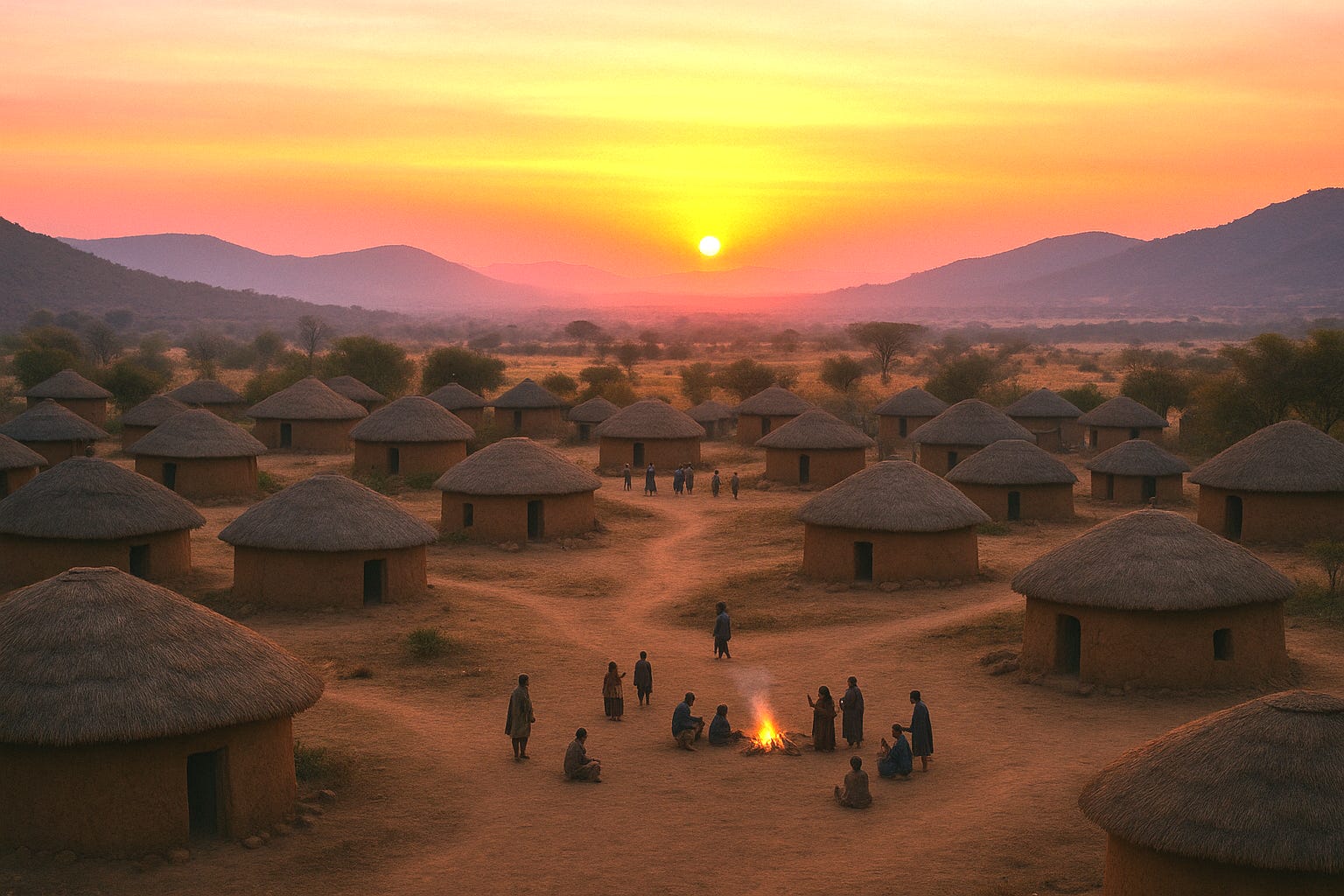
Field Report on the Cosmology of the Village of I
(With Extracted Oral Testimonies)
Introduction
The people of the Village of I speak in a way that resists translation. All pronouns collapse into I, and even in recorded notes the distinction between speaker and subject dissolves. What follows are selected excerpts from my attempts at transcription, capturing how villagers explain their beliefs in their own idiom.
On Unity and the Divine
Recorder’s Note: I asked one villager if they believed in gods, spirits, or a Creator.
Villager:
“I am the god I seek. I am the breath that seeks me. When the wind moves the leaves, I am moving. When I drink water, I taste myself. I and ‘water I’ join and become one and the same I. Looking out there is I, looking in there is I. I bow to I.” In whichever direction I turn there is I. When I remember back, there is I from which I have come. When I journey forward into the future I pass through I and I is my destination. Is that what you mean by gods, spirits or Creator?
If you are talking about things unseen, things that are invisible, Yes, I believe there are things unseen. When I climb to the top of the hill I see beyond it to what had been invisible and unseen from the valley. I accept there is much which I have not yet seen but I know without question it is all I whether I experience it or not.”
On Names
Recorder’s Note: During a naming ceremony for a young girl, I asked why names matter when all are “I.”
Elder:
“I is one, but I arrives in many hours. The names remember the hours. Without names, I forget how I came. With names, I see all the faces of I, like a jewel turned in firelight.”
Mother (whispering to her daughter):
“I-born-when-the-crane-passed-over — I call I so, because I remember the wings when I came to us.”
On Death
Recorder’s Note: At the funeral of an elder, the long name was recited. Afterwards, I asked how the villagers understand death.
Villager:
“When I cease to breathe, I do not cease. I return to I. I will speak in the crows, in the mist, in the soil that holds I. My names remain in the fire for as long as there are those who remember them. The long name is not ended till then.”
On Conflict and Forgiveness
Recorder’s Note: Two men disputed over a broken tool. The quarrel resolved quickly, but I asked why anger never lingers.
First Man:
“I shouted at I, but I was only shouting at my own mouth. I cannot hold my fist against myself for long.”
Second Man:
“I forgive I, because I am the one who needs forgiveness. I give it, I take it. The quarrel vanishes.”
On Animals and the More-Than-Human
Recorder’s Note: One evening, wolves howled in the hills. A child turned to me and spoke.
Child:
“I sing with myself in the hills. I run with I on four legs. When I howl, I hear me answering. All creatures say I, though some do not need words.”
On the Future
Recorder’s Note: I asked what happens to the Village of I when they are gone, or if others take their place.
Elder:
“I is never gone. I is always new. Even if these houses fall, I will rise in another valley, another tongue. I cannot be lost, for I am what remains.”
Conclusion
These excerpts illustrate the profound effect of grammar on cosmology. To the villagers, I is both the most intimate and the most universal word. It collapses the distinction between self, other, and world. Their names preserve difference, but their pronouns preserve unity.
If other cultures define themselves by who they are not — “us” against “them” — the Village of I lives within a different creed: all is I.
We then were invited to join the fire circle, much like our ash circle gatherings. Once we settled in an elder began to speak.
The Elder’s Origin Story in the Root-Tongue History
The fire crackled, and sparks climbed into the night like tiny souls seeking their place among the stars. Children pressed close, their eyes wide, while the grown ones sat in stillness. At the center, the elder leaned on a carved staff. His voice was soft, yet it carried to every ear.
Elder:
“Long before these houses, before this valley, before even the rivers carved their braids, I spoke in one voice. The world itself was I, and I knew no difference. The mountains were I, the wind was I, the creatures were I. There was no speech then, only listening. The stones and trees understood, for they needed no words.
But in time, I became many mouths. With many mouths came many words, and with many words came forgetting. I began to say you, and in that word, I felt a distance. I began to say they, and in that word, I felt fear. The Whole was broken into shards, each calling itself apart.
Yet the Root-Tongue remembers. The first listening has not vanished. In dreams, I still hear it: the language beneath language, the voice of I speaking without division. It was carried to us through our ancestors, who wandered until they found this valley. Here they vowed: We will not lose the Root-Tongue entirely. We will speak as One.
So we left behind you and they. We held to I. Our names became our memory, our pronouns became our creed. In every birth-name, I recall the hour I came. In every passage-name, I recall the trial I faced. In every elder-name, I recall the seasons I endured. These names are the jewels that keep the Root-Tongue alive among us.
Never forget, children: to say I is to speak with the mountains and the rivers, with the wolves and the stars. To say I is to remember the first listening, when nothing was divided. Though the world beyond our valley may forget and fall into quarrel, we remain. We are I.”
The elder fell silent. For a long time, the circle listened to the night sounds — the wind, the crickets, the distant rush of water. And in that silence, the people felt the truth of what had been spoken: that all was still one voice, even now, even here.
to be continued…

“The Great I am”?
You are correct, it’s very hard to translate!!