


When Limitation Becomes a Microscope
There is a curious thing that happens when an artist voluntarily reduces the number of possibilities available.
The world gets bigger.
This seems contradictory. We ordinarily imagine that greater freedom means having more choices. More colors. More materials. More techniques. More space. More subjects. More possibilities.
Yet anyone who has worked seriously within a narrow range eventually discovers something surprising. Once the field has been sufficiently reduced, distinctions that were previously invisible begin to appear.
The limit has become a microscope.
Imagine deciding to make a hundred drawings using nothing more than a single kind of line. At first the proposition might seem absurdly restrictive. How much could possibly happen with one line?
Quite a lot, it turns out.
The line can move quickly or slowly. It can hesitate. It can accelerate. It can become heavy or faint. It can wander and return. It can repeat itself. It can reverse direction. It can bunch together into density or open outward into spaciousness. It can establish a rhythm and then violate it. It can become melodic, percussive, nervous, lyrical, awkward, graceful, mechanical or wildly eccentric.
None of these possibilities were created by the limitation. They were already there. The limitation simply made them visible.
This is an important distinction.
Creative limitation does not necessarily reduce possibility. It can increase our ability to perceive possibility. There is simply too much available to us otherwise.
The world presents an almost unbearable abundance of potential material. Every color, every shape, every image, every object, every technique, every historical reference, every conceivable combination of them. The contemporary artist stands before a nearly infinite warehouse with all the doors open.
That can certainly be exhilarating. It can also make us blind.
When everything is available, differences become coarse. We move rapidly between possibilities because there is always another possibility waiting nearby.
But choose one thing and stay with it long enough and perception begins to sharpen.
This is one of the secrets of the étude.
An étude says: For now, forget everything else. We are going to investigate this one particular thing.
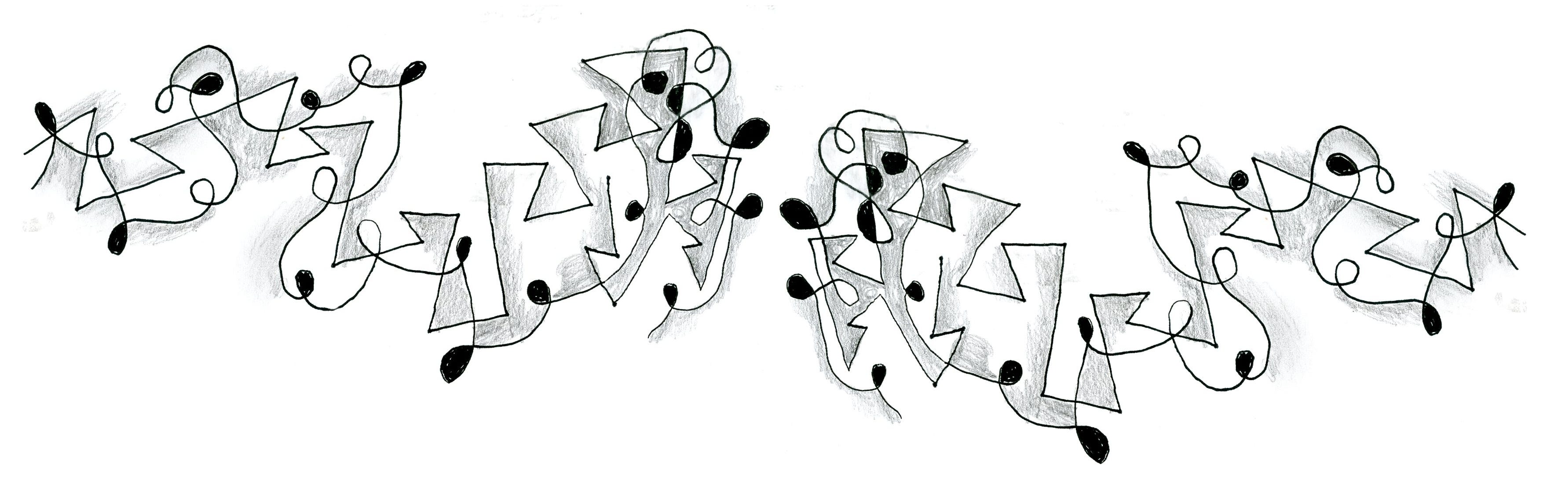
A pianist might concentrate upon a technical or rhythmic problem of interst. A poet might adopt a restrictive form. A painter might work within an extremely limited palette. A collagist might use materials gathered from one location. A visual artist might investigate nothing more than a zigzag, a reversing zigzag, a loop and a few variations produced by combining them.
Initially we see the category.
Zigzag.
After prolonged attention we begin seeing individuals.
This zigzag is compressed.
This one breathes.
This one accelerates.
This one feels architectural.
This one seems agitated.
This one becomes almost calligraphic.
This one begins behaving like music.
The object has not necessarily become more complicated. Our seeing has become more precise.
This happens everywhere with all things.
Someone who knows little about wine might simply distinguish red from white. Someone who has devoted decades to wine detects grape varieties, regions, soils, weather, fermentation methods and years.
Someone unfamiliar with birds hears birdsong. An ornithologist hears individuals.
Someone unfamiliar with classical music hears an orchestra. A conductor hears relationships among dozens of simultaneous voices.
Expertise is partly the accumulation of knowledge, but it is also the refinement of discrimination. You learn to notice smaller more subtle differences.
The artist does the same thing through sustained practice.
At first we see line.
Then we see kinds of line.
Then qualities of line.
Then relationships among lines.
Then rhythms produced by those relationships.
Then variations within those rhythms.
Then interruptions of those variations.
Eventually an entire world emerges from something that once seemed almost impossibly simple. This is where limitation becomes an instrument of consciousness.
The microscope does not create microorganisms. It allows us to perceive a scale of reality that was already present but inaccessible to ordinary vision.
Creative limitation can function similarly. It reduces the field so that attention can penetrate more deeply into it.
Instead of asking, What else can I add? we begin asking, What haven’t I noticed yet?
That is an entirely different creative question. And often a much more interesting one.
There is a tendency, particularly early in one’s development, to associate creativity with invention. We imagine that the creative person must continually introduce something new.
But mature creative practice often involves something closer to excavation.
You return.
You reconsider.
You repeat.
You make another variation.
Then another.
And another.
Someone watching from outside might wonder why you haven’t moved on. But you have moved on. You have moved downward and inward. What appeared from the surface to be repetition has become penetration.
The first ten variations reveal obvious possibilities.
The next twenty exhaust the solutions you already knew.
Then the interesting territory begins. You have used up your habits. You have exhausted your first answers. You have done the clever things.
Now you must actually look and contemplate.
This may be one reason limitations can be so productive. They eventually force us beyond our own repertoire. If every time we become uncomfortable we introduce a new material, technique or subject, novelty can rescue us from having to go deeper. But if the rules remain in place, we eventually arrive at the edge of what we know how to do.
Then imagination has to work. The limitation begins exerting pressure. Under that pressure, subtler possibilities become perceptible. A slight change becomes significant.
A millimeter matters.
A pause matters.
The thickness of a line matters.
The interval between two forms matters.
The difference between repeating something seven times and eight times matters.
These are not trivial distinctions. They are the vocabulary through which the work develops its intelligence.
Music understands this beautifully.
A composer does not need an infinite number of notes to create an infinite variety of musical experiences. Much of Western music has been constructed from twelve tones. Entire traditions have emerged from highly constrained systems of rhythm, harmony, instrumentation and form.
The richness comes through relationship.
This may be one of the great lessons for visual artists as well.
Complexity does not necessarily require more elements.
Complexity can arise through increasingly subtle relationships among very few elements.
A line encounters another line.
A rhythm repeats and reverses.
A loop interrupts a zigzag.
A dense passage opens into silence.
A gesture returns altered by everything that has happened since we last encountered it.
Suddenly we are no longer dealing merely with shapes.
We are dealing with memory, expectation, rhythm, tension and time.
A visual language has begun to form. And this is how languages always deepen.
Not through endlessly accumulating vocabulary, but through discovering increasingly subtle ways of using what is already available.
Eventually the artist begins to understand that limitation and infinity are not opposites. A small territory can contain an inexhaustible world.
One could spend a lifetime studying light.
Or line.
Or the human face.
Or rectangles.
Or scraps of printed paper.
Or the movement of the hand.
Or the mysterious sensation that occurs when one mark follows another and the eye begins to experience rhythm.
There is no requirement that we exhaust the world. We cannot.
Our task might instead be to choose some small corner of it and pay sufficient attention that the apparently ordinary begins revealing its extraordinary complexity.
That requires patience.
It requires repetition.
It requires resisting the constant temptation to escape into novelty.
Most importantly, it requires faith that there is more here than we currently perceive.
So we narrow the field.
We choose a few elements.
We establish certain limits.
We return tomorrow.
And the next day.
And the next.
Gradually our perception becomes finer.
What once appeared to be one thing becomes ten things, then a hundred things, then a thousand subtle distinctions for which we may not even have names.
The territory has not expanded.
Our consciousness of it has.
The limit has begun to function like a microscope. And through it, we discover infinity hiding inside the smallest things.
I love to contemplate this subject and I'm sure I'm repeating myself when I say once again: Less is more. I may fantasize driving an 18-wheeler across country to fill up with all the fabulous junk I buy/find for my assemblages so I'll have an unlimited amount of stuff to work with but in reality, Less is More for me. Having less or having sat on the same o' junk I've accumulated for years will make me see that junk as new or different and open up my mind to finding a refreshing way to use what I've had already. I clearly remember many years ago 'needing' a specific object for a piece I was working on and not finding it. Then, realizing I had that void to fill, I found something else that had nothing to do with what I thought I needed and the the 'new' chosen item not only fit perfectly for the piece, but gave it a depth of meaning that wasn't there earlier. So, yes, lazy me needs to have my mind 'forced' into looking beyond something easy or obvious and look into that microscope you wrote about to see what worlds open up for me use and appreciate.