


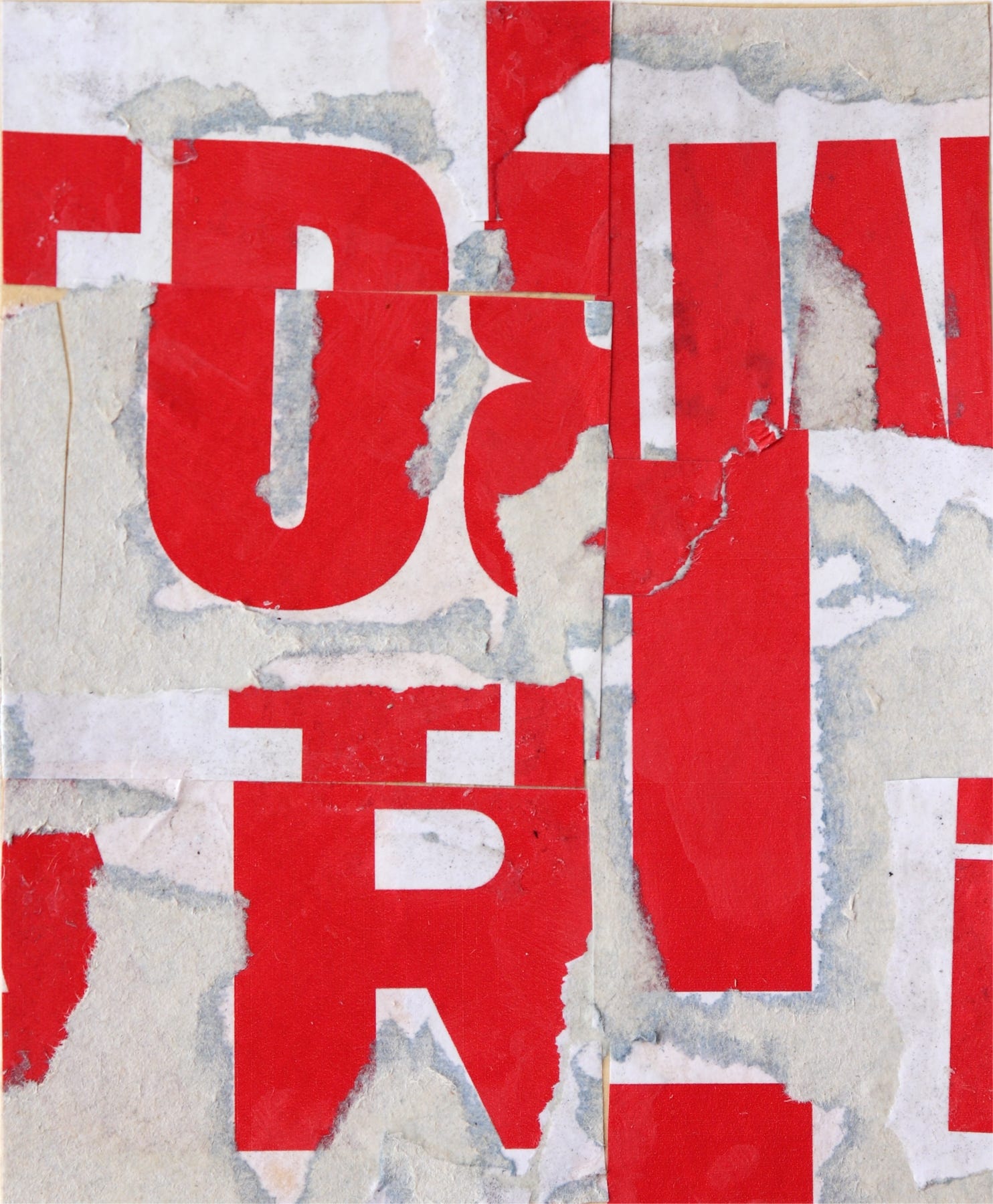
The Trans-Temporal Conversation
Artists often speak about finding their own voice.
What is less often acknowledged is that our voice is never developed in isolation. Every work of art enters into an ongoing conversation that has been unfolding for thousands of years.
It is a conversation that takes place across time.
I like to think of it as creatives carrying on a trans-temporal conversation through our art objects across generations.
When I make a collage today, I am not simply arranging paper on a table in my studio. I am responding to conversations begun long before I was born. I am responding to questions asked by anonymous makers of prehistoric markings, medieval scribes illuminating manuscripts, Japanese calligraphers, Dadaists cutting newspapers, abstract painters, typographers, poets, photographers, and countless artists whose names have disappeared while their influence quietly remains.
Most of these people never knew one another. Yet they are connected. Each added something. Each inherited something. Each left something behind.
That is how culture grows and continues.
The remarkable thing is that this conversation ignores chronology. A manuscript from the twelfth century may speak more directly to an artist today than something produced last week. A fragment of weathered paper torn from a wall in Rome may raise a question that has occupied me for years. An unknown amateur working quietly in a village a century ago may become an unexpected collaborator through something they left behind and was later collected.
Time does not prevent dialogue. Art has always found ways to cross it.
Originality is rarely the invention of something from nothing. It is the ability to hear the conversation clearly enough to contribute something that has not yet been said. The artist is neither copying the past nor rejecting it. The artist is participating.
Every artwork says, “Here is what I have discovered.” Someone decades from now may respond. Perhaps they will borrow a method. Perhaps they will challenge an assumption. Perhaps they will recognize something that I myself never understood.
The conversation continues.
Museums, libraries, and archives exist because civilization recognizes, consciously or unconsciously, that this conversation matters. Every preserved object remains available to speak again. Every collected letter. Every sketchbook. Every notebook. Every finished work. Every unfinished experiment.
They wait patiently for the next participant to arrive.
This understanding has gradually changed my own relationship to making art. I recognise that I am not competing with other artists. There is no competition in art. I am talking with them. Some have been dead for centuries. Some have not yet been born.
My responsibility is simply to speak sincerely and clearly from where I stand in this moment. Someone else will hear it. Someone will answer. Perhaps not tomorrow. Perhaps not for a hundred years. That is perfectly acceptable.
The conversation has already lasted thousands of years. It is in no hurry.
We are each given a brief opportunity to contribute a paragraph before passing the manuscript to the next generation.
That is good enough.
Please share your thoughts about how you think about the trans-temporal conversation in the comments below.
STUFF THAT HAPPENED LAST WEEK
Most stuff happened in NOTES this past week. Mostly posting incoming works for the Visual Poetry and Color Show.

This is why I love creating my assemblages. Each item has had a life before I grabbed it up to use in a piece. The patinas of objects old and worn have their own stories as to how they came to be. A banged up dented thing can fit perfectly for what my piece will need to make it right. When I was a little kid and my mother would find something interesting on the ground as she picked it up would say, "if only this could talk, what would it tell us?" It's also why I prefer used furniture, mugs, clothes, books........books with their underlines tells me what the previous reader found important. We all leave our marks whether obvious, subtle, unseen on what we use, touch, own until we don't have it any longer......then a journey for said stuff sends it to who knows where. And hopefully, I'll find some of that great junk and give it a new life in one of my pieces.