


The Puzzle Exists in the Pieces
Reality only appears fragmented because we encounter the whole through the narrow aperture of being human.
Matthew Rose recently left a thoughtful comment on one of my essays about consciousness. He pointed out that consciousness is not some fixed instrument through which we objectively observe an equally fixed world. It is itself in flux.
The red we see on Monday morning may not be quite the same red we experience Monday evening. A collage that seems perfectly resolved on Tuesday may look completely wrong on Wednesday. The paper hasn’t necessarily changed. The composition hasn’t moved. Yet something has changed because the person looking at it has changed.
We tend to imagine ourselves standing still while reality passes before us. But there is no still point from which we are observing. We are in the stream ourselves.
Everything is in motion.
The light is changing. The temperature is changing. Our bodies are changing. Our memories are accumulating. Our attention is shifting. The world around us is reorganizing itself continuously, and the consciousness through which we experience that world is reorganizing itself as well.
So perhaps the great puzzle of existence is even stranger than we imagine.
Not only are the pieces constantly changing positions. We are one of the pieces.
And yet, behind all of this movement, I have long suspected that there is something that is not fragmented at all.
The Puzzle May Belong to Us
For us humans, everything seems to be a puzzle whose pieces are constantly changing positions in ways that maintain an infinite uniqueness.
No two moments are exactly alike.
No two people occupy precisely the same perceptual position.
Indeed, even the same person cannot occupy the same perceptual position twice because by the time we return to something, we have changed.
This is something every artist knows.
You make a painting and put it against the wall.
You look at it that afternoon.
You look at it the next morning.
You turn it around for three days.
You bring it back out.
Suddenly you see something that apparently wasn’t there before.
Except, of course, it was there.
What changed? You did.
This is one of the reasons artistic judgment is so mysterious. We like to imagine that we are gradually arriving at an objective assessment of the artwork. Perhaps sometimes we are. But we are also encountering the work through a constantly changing consciousness.
Tuesday’s artist is looking at Monday’s painting.
Wednesday’s artist is looking at Tuesday’s decisions.
Years later, another version of the artist may look at the same work and discover something entirely different.
The artwork becomes strangely stable compared with the person looking at it.
And yet even the artwork isn’t really stable. The paper ages. Pigments change. The surrounding culture changes. The historical context changes. The other artworks surrounding it change. The meanings attached to its forms change.
Everything participates in the movement.
We See the Flow as Particles
The difficulty may begin with perception itself. Reality appears to be continuous, but our sensory apparatus necessarily encounters it selectively.
We don’t see everything.
We don’t hear everything.
We don’t feel everything.
We receive tiny portions of an unimaginably large field of activity.
Our eyes acquire one bit of information and then another. Our ears receive changing vibrations. Our nervous system processes temperature, pressure, balance, movement, smell, pain, pleasure, and countless other signals. Somehow consciousness assembles this flood into what feels like a continuous world.
Then something else happens.
We name it.
Tree. Cloud. Person. Red. Table. Me. You. Past. Future.
The naming is extraordinarily useful. Without this ability to divide experience conceptually, ordinary human life would probably be impossible. Language allows us to distinguish, remember, communicate, plan, compare, and construct increasingly elaborate understandings of the world.
But there is a price.
The moment we name something, we draw an imaginary boundary around it.
We turn the flow into a thing. We begin to experience a continuous reality as a collection of separate objects. The river becomes water, bank, stone, reflection, tree, fish, sky.
And somewhere standing beside all of this is something called me.
Language has not necessarily discovered these boundaries. It has created a useful way of navigating them. The map is indispensable. But the map is not the landscape.
Before the Names
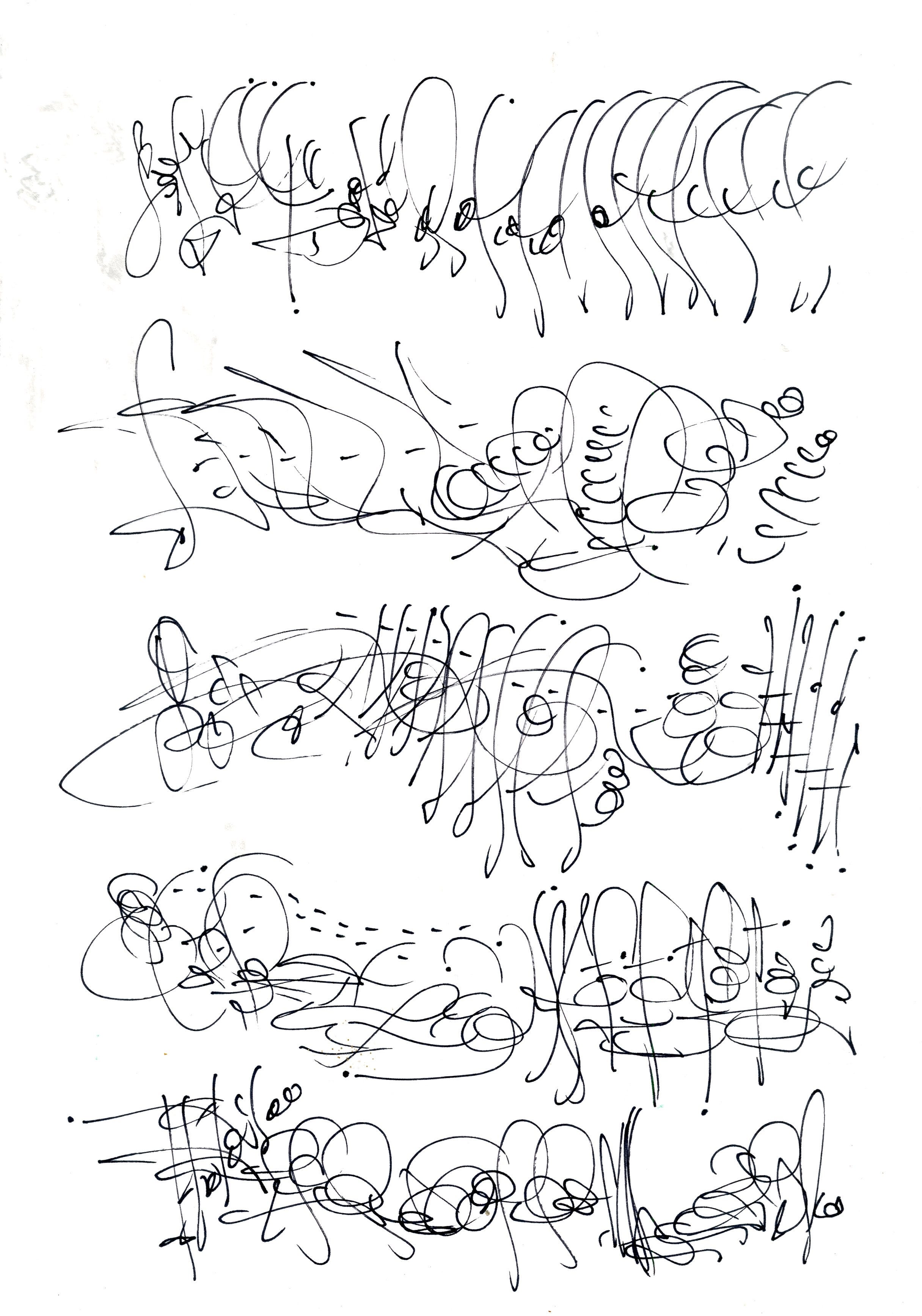
This is where art becomes particularly interesting. Art can operate very close to the territory that exists before naming.
A line doesn’t necessarily have to mean anything.
A rhythm doesn’t have to represent anything.
A sound doesn’t have to explain itself.
A gesture can simply be a gesture.
The experience came first. The naming of things comes afterward.
Artists often speak about intuition when describing the actual moment of making something. The intellect is certainly present. Knowledge, experience, technique, memory, judgment, and intention are all participating.
But something else seems to be operating upstream of them.
The hand sometimes knows before the mind knows what the hand knows.
The musician hears where the phrase must go.
The poet feels the next word approaching before knowing what it will be.
The painter senses that something must move three inches to the left.
Then afterward we explain ourselves - or try to.
We construct the conceptual framework.
We give the exhibition a title.
We write the artist statement.
We explain why the thing exists.
But the deepest part of the making may have happened before any of those explanations became available.
What If Consciousness Is Not in the Pieces?
This brings me to the suspicion I mentioned in my response to Matthew.
I suspect that behind all of this apparent fragmentation there may be a single consciousness for whom none of this is puzzling at all.
I don’t offer that as a scientific proposition. I have no experiment with which to prove it. I mean it as a metaphysical intuition arising from experience.
What if consciousness is not something produced separately inside billions of isolated creatures? What if individual consciousness is instead a localization of something much larger?
Imagine an ocean producing waves.
Each wave has a recognizable form. It arises at a particular place. It has a particular height, duration, velocity, and character. We can point to it and say, “There is a wave.”
And there certainly is.
But there is no substance called wave that is separate from the ocean. The wave is the ocean behaving locally.
Maybe we are something like that.
Perhaps what I call my consciousness is consciousness behaving locally as Cecil for a while.
And what you call your consciousness is that same mysterious field behaving locally as you.
From the perspective of the wave, everything seems separate. From the perspective of the ocean, nothing ever was.
The Lock, the Door and the Key
Matthew offered a wonderful image in his comment. He said consciousness is the lock hole, the door, and the key maker.
I would add that perhaps it is also whatever stands on both sides of the door.
This is the peculiar difficulty of investigating consciousness. We are using consciousness to investigate consciousness. The investigator and the thing being investigated cannot finally be separated.
Every scientific instrument, every mathematical equation, every philosophical argument, every mystical vision, every painting, poem and every doubt about all of the above ultimately appears within consciousness.
There is nowhere else for any of it to appear.
And so perhaps the mystery cannot finally be solved by standing outside it because there is no outside position available to us. We are trying to understand the river while being made of river.
Going With the Flow
This is where our frustration begins.
We keep trying to stop the flow long enough to understand it.
We isolate.
We categorize.
We measure.
We compare.
We name.
These are magnificent human abilities. Science depends upon them. Civilization depends upon them. Art itself frequently depends upon them.
But another possibility exists alongside them.
Instead of always trying to understand the flow, we can occasionally allow ourselves to experience being the flow.
This requires a different kind of attention - quiet attention. The sort of attention in which the machinery of naming becomes less insistent.
Anyone who has become completely absorbed in making something may recognize this. Musicians know it. Painters know it. Dancers know it. Athletes know it. People walking alone through forests know it. People sitting quietly watching sunlight move across a wall know it.
For a little while, the distinction between observer and observed becomes less important.
You are no longer thinking:
I am looking at the tree.
There is simply seeing.
You are no longer thinking:
I am making this drawing.
There is drawing.
The subject-object structure through which we ordinarily organize experience loosens slightly. And sometimes, very briefly, something astonishing becomes apparent. Nothing was separate in the first place.
The Glimpse
This is one of the great privileges of artistic practice. The artist spends a lifetime cultivating conditions in which such glimpses become more likely.
We arrange paper.
We draw lines.
We mix colors.
We listen.
We walk.
We repeat gestures thousands of times.
From the outside it may look as though we are making objects. And certainly we are. But something else is happening beneath the production of those objects.
We are practicing attention.
We are learning how to remain close to experience before experience hardens into explanation. We are occasionally slipping beneath the conceptual net we ordinarily throw across the world. And there, every once in a while, the puzzle disappears.
Not because we have solved it. Because for a moment we are no longer looking at reality as a pile of pieces requiring assembly. We glimpse the possibility that the pieces were never actually separate.
The endless changing, the paper, the light, Tuesday’s judgment, Wednesday’s doubt, the hand, the eye, the artwork, the viewer, the past, the future, the red becoming mauve in the evening sun - all of it belongs to one immeasurable movement.
It is flowing unendingly.
Our senses give us particulars.
Our language gives those particulars names.
Our minds arrange the names into worlds.
And all of that is necessary and beautiful.
But every once in a while, if we become quiet enough to see through the spaces between the names, to read between the lines, for one brief instant we encounter the whole.
Yet the whole has understood itself perfectly all along. It is the only thing here.
Love the subject of consciousness. There's so much I could say about it..
Experiencing being in the flow and the glimpse is what makes making art so pleasurable for me. And also the joy it procures.
Oooh; yet another brilliant full plate of nourishment for the mind to take in..........It felt as if you touched upon this subject before which is why if felt a bit deja vu-ish but I love this subject so the more the merrier of it all. Made me think about about how my moods affect what I'll create or even if I'll create today......and that goes for the outside stuff as well.......weather, issues, the noisy gardeners, my dog barking at whatever, temperature of the house, my pants wasteband being too tight or loose, and so on. And yes, the inside and the outside stuff is not necessarily separated just as the Holy Spirit/Universe that works with/through/in me is also separate yet melds or weaves as a part of what I'm doing/making. I'd go a bit crazy if I try to figure it all out and try to consciously comprehend it so I just surrender to it and let it all be/happen. As Ram Dass titled and wrote about in one of his earlier books: it's all "Grist for the Mill" and that phrase sits well with me.