


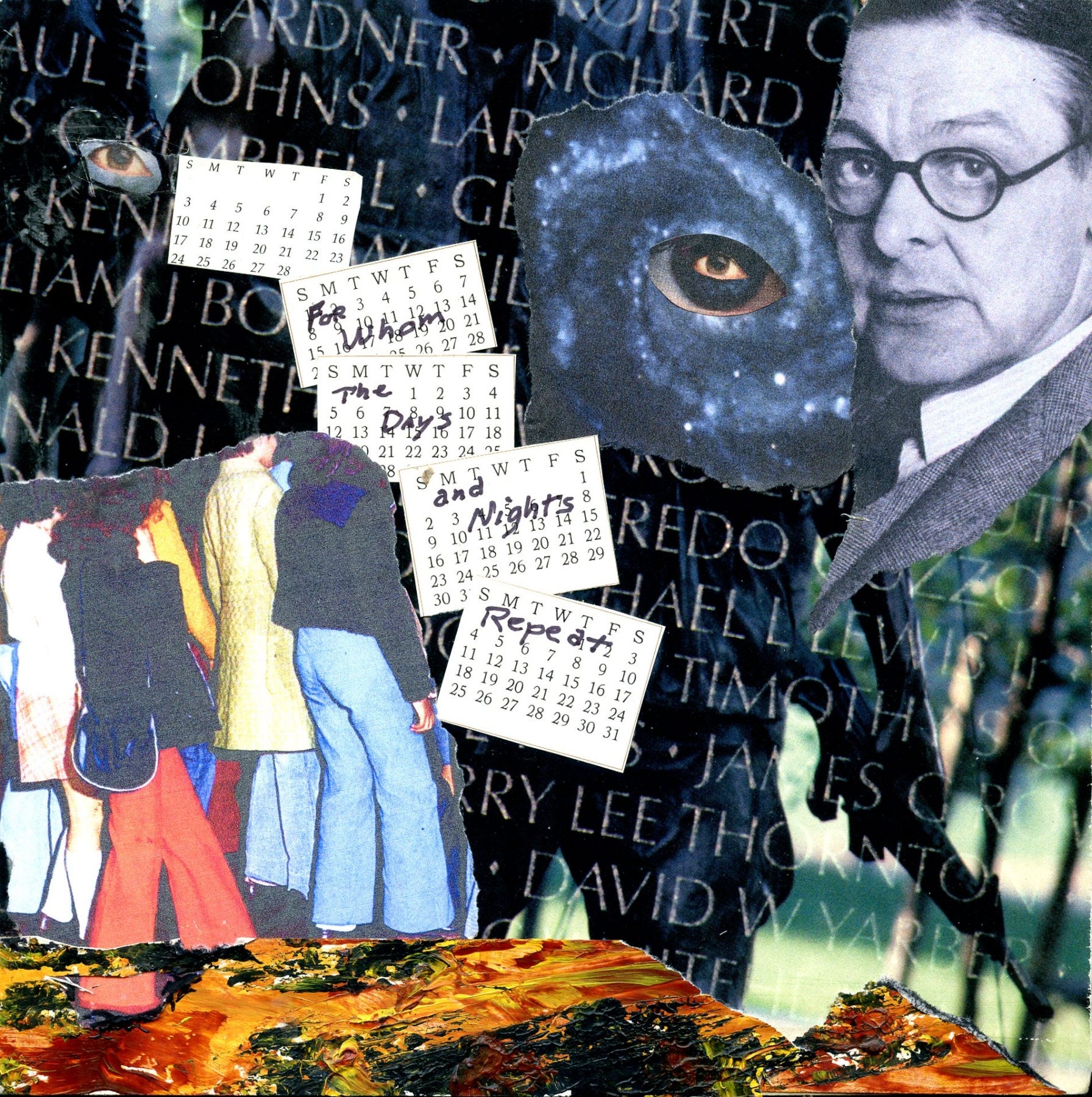
Ok, based on your comments I am going to switch back to posting everything by email as usual instead of the weekly round up newletter idea I was trying out.
Thanks for your responses!
The Only Gatekeeper
In a recent correspondence an artist mentioned: “I’ve often worried that my collages are not as good as they might be.” That led to the following article.
Every collage artist worries about that. Probably every artist who has ever seriously committed themselves to making anything has worried about it. The painter looks at the painting and wonders whether it could have been stronger. The poet rereads the poem and hears the line that might have been better. The composer hears another possibility. The collage artist moves a fragment half an inch to the left, then back again, and wonders whether either position is right.
This worry is built into the practice because the artist can always imagine something beyond what has actually been made.
There is the work before you, and then there is the work you sense might have been possible.
That distance between the two can become a source of anxiety, but it is also one of the engines of artistic development. If you were completely satisfied with everything you made, there would be very little reason to make the next thing. The dissatisfaction is partly evidence that your imagination has moved slightly ahead of your ability to materialize what you can sense.
The difficulty begins when we confuse this internal conversation with competition.
We look around.
We see another artist whose work seems more resolved, more sophisticated, more original, more successful, more widely exhibited, more collected, or more discussed. We begin measuring our work against theirs.
But this is an impossible measurement.
The thing is, nobody else can be you.
That sounds simple, perhaps even obvious, but I think it has profound consequences for an artist.
Every artist arrives at the studio carrying an absolutely unique accumulation of experience. You have your particular history, your particular body, your particular temperament, your particular memories, obsessions, accidents, discoveries, limitations, abilities, failures, intuitions and curiosities. You have seen what you have seen. You have loved what you have loved. You have suffered what you have suffered. You have spent your particular number of years looking at the world through a pair of eyes and a perspective that nobody else possesses nor can posess.
All of that enters the work.
Even the things you cannot articulate enter the work.
Perhaps especially those things.
So when we compare ourselves too closely with another artist, we are comparing two completely different situations. Their work is the consequence of their path. Your work is the consequence of yours.
You can learn from other artists. You can admire them. You can study their methods, borrow strategies, notice possibilities, enter into conversation with their work and allow yourself to be challenged by it. Artists have always done this. Art is a vast trans-temporal conversation in which the living speak with the dead and the young speak with the old and everyone leaves something behind for someone they will never meet.
But admiration is different from competition.
Ultimately, we compete only against our own best efforts.
The real question is not whether your collage is better than someone else’s collage. The question is whether you have taken your own work seriously enough to discover what it is capable of becoming.
That is a much harder question. Because each of us is the gatekeeper of our own work. Nobody is standing outside your studio preventing you from looking harder. Nobody is stopping you from making another version that might be better or just different.
Nobody is preventing you from spending another hour considering the relationship between two shapes, another afternoon studying a color, another month developing a series, another ten years following an idea wherever it wants to go.
There may certainly be gatekeepers controlling galleries, museums, grants, publications, exhibitions, collections and markets. Those gates exist, and they can have real consequences for an artist’s career. But they do not control the most important gate.
They do not control the studio door. They cannot decide what you make tomorrow, cannot determine how deeply you investigate your own ideas, cannot stop you from becoming more perceptive, cannot prevent you from developing your craft or from discovering something.
That gate belongs to you.
This is why the fear that our work is “not as good as it might be” can actually be useful if we understand it properly. It may simply mean that we sense another possibility, another question to pursue.
Good.
Make another collage.
And then another.
Do not demand that every work carry the entire burden of proving who you are as an artist. That is far too much responsibility to place on one small arrangement of paper and glue.
Think instead in terms of a lifetime of work.
One collage teaches you something that becomes useful three collages later. A failed painting contains a gesture that reappears successfully ten years afterward. An experiment that seemed insignificant at the time turns out to have been the beginning of an entire body of work.
Artists rarely know the full significance of what they are doing while they are doing it.
We work forward intuitively and understand backward historically.
That is one reason documentation and preservation of the work matter. Given enough time, what initially appears to be a collection of individual objects begins to reveal itself as a path. Patterns emerge. Recurring questions become visible. Ideas disappear and return. What seemed like failure becomes preparation. What seemed accidental becomes characteristic.
Eventually you begin to recognize that the real artwork may be larger than any individual object.
The real artwork is the practice itself. The individual works are evidence left along the path. And once you begin thinking that way, the question “Is this collage good enough?” changes.
Good enough for what?
Good enough for who?
Good enough to sell?
Good enough for a gallery?
Good enough for a museum?
Good enough compared with the artist whose work you saw yesterday?
Those are downstream questions. They may have practical importance, but they are not the fundamental question.
The fundamental question is whether the work is alive within your own inquiry.
Did you discover something?
Did you pay attention?
Did you push beyond what you already knew how to do?
Did you recognize when the work began asking for something you had not planned?
Did you have the courage to follow it?
Did you give it enough time?
And perhaps most importantly: did you return to the studio the next day?
Because artistic development is cumulative.
Nobody makes your thousandth collage except the person who made the first 999.
There is no shortcut around that.
Your awkward works belong to your accomplished works. Your failures belong to your successes. Your uncertain periods belong to your breakthroughs. They are all part of the same organism developing through time.
The artist’s responsibility, then, is less about becoming “better than” someone else and more about becoming increasingly capable of being oneself.
That takes a lifetime.
The great privilege of being an artist is that there is no final examination. There is no moment when someone hands you a certificate saying that you have finally become yourself. You simply keep working, keep looking, keep noticing, keep refining, keep questioning, keep discovering.
And occasionally you make something that surprises you. Something arrives that seems slightly beyond what you thought you were capable of making.
For a moment you think: Ah. There it is.
Then you live with it for a while.
And eventually another possibility appears beyond it.
You begin again.
So when you find yourself worrying that your collages are not as good as they might be, perhaps you can take some comfort in the worry itself.
It means you can still see farther down the road.
Nobody else can walk that road for you.
Nobody else can make the work that only your particular life can produce.
You are not competing with the thousands of other artists working around you.
You are in conversation with them. Your real competition is much closer to home.
It is yesterday’s best effort.
And tomorrow you get another chance.
See what happened in NOTES
Take a Minute
Do a slow 360 degree scan of where you are right now. In a comment write what you observed.
So much to think about here........I love it! My mind appreciates the stimulation of what you write and ask. I stopped comparing my work to other artists and only compete with myself........that is if I can fall deeply in love with a piece I'm working on as much or more than the last piece or any others that preceded that. And there are those times when I'm in the conception mode of creating a piece where I fantasize having no limits to how I want it to go......like a blink of an eye or a wiggle of the nose I can just materialize exactly what I'm visualizing.......I suppose if I had a huge studio and unlimited funds for the tools to make exactly what I see in my mind's eye.......but then.......there's something that I really love to do and that is in appreciating my limits, finding the creative engineering and ulterior options to make what I need to make. And by embracing those challenges, there's a profound feeling of accomplishing something way better than if I merely had the magic to just pop something into existence. The magic fantasies are fun but the more satisfying feelings of searching for how I can actually do something is the best.
Wow, this was a great perspective. I really enjoy these posts and how thoughtful they always are. Thanks Cecil 🙏