


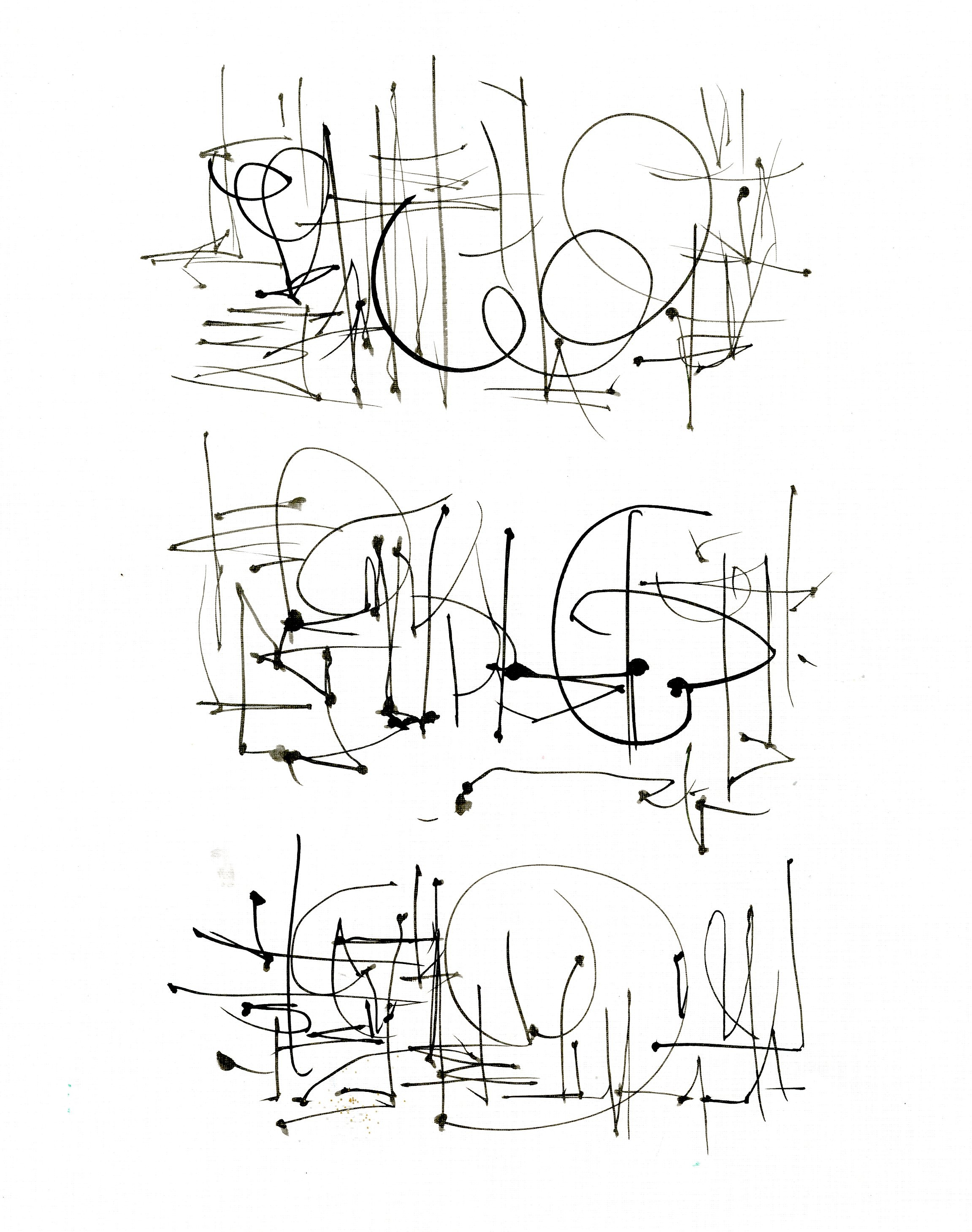
Take the Day Off and Celebrate Life
Today is a Post Dogmatist global holiday. I am 70 years old today. Have a piece of cake and raise a glass in my honor.
I mostly wanted to share this article and list about collage in literature.
The Listening Field
Every fragment is a seed of wholeness.
Every torn letter is still singing.
Long before the page, there was the field: the murmuring ground where sound and silence braided the first grammar of existence. The artist’s task, in this late hour of noise, is not to invent but to remember—to re-enter that ancient conversation where the visible and the invisible still speak through one another.
My work begins there, among the remnants of that forgotten language. The cut paper, the broken alphabet, the scattered announcements of a world that has lost its listening—all of it is gathered again into a living surface. I do not make collage to express disorder. I use it to locate the order beneath disorder, to hear the pulse that continues beneath the static. The letters, once servants of utility, are returned to their original vocation: to embody breath.
This is what I call the sub-literal realm—the place below speech, where knowing arrives as resonance rather than explanation. It is the same current that carries the Root-Tongue, that invisible mother-language flowing through all beings. In the studio, I listen for it. Each cut, each shift of a fragment, is a moment of correspondence. The material rearranges itself until it hums in tune with the unseen.
Out of this listening came the Exquisite Family Records Archives, the Root-Tongue Letters, and the long cosmologies of ZA’AK 777. These are not separate projects but chambers of the same house. Within them, fiction and memory trade places, myth becomes autobiography, and time folds like paper. They are reliquaries of a greater remembering—where the ancient and the future touch across the seam of the present.
The lineage is wide: the modernists who first heard the fracture of language, the mystics who saw letters as living fire, the poets who trusted the silence between words more than the words themselves. Yet my road bends toward reunion. Collage, in my hands, is a contemplative practice, a daily act of attunement. It teaches that the world has never truly been divided, only unlistened-to.
The Touchonian way is not a style but a stance of being: to see the world as a living composition, continually rearranging itself toward harmony. The same principle that orders letters on a page may one day reorder our civic life, our schools, our economies. The same breath that moves through paint and paper moves through a people.
So I cut and join, cut and join, until the fragments begin to glow with their original coherence. When they do, they speak—not to the intellect but to the deeper ear. And in that listening, the many become one again.
Writers who have used collage techniques—assembling fragments, found texts, citations, and juxtaposed voices—span many movements and styles. Here are key examples across eras and forms:
Early and Modernist Roots
T. S. Eliot – The Waste Land (1922)
Perhaps the most famous literary collage: a mosaic of quotations, allusions, multiple speakers, and languages that creates a fractured modern consciousness.Ezra Pound – The Cantos (1915–1962)
An epic collage of history, myth, economics, and personal reflection, layered with quotations in several languages.William Carlos Williams – Paterson (1946–58)
Integrates newspaper clippings, letters, and official documents into poetry about an American city.Gertrude Stein – Tender Buttons (1914)
Uses repetition, fragmentation, and associative logic to deconstruct language itself.
Mid-Century and Postmodern Collage
John Dos Passos – U.S.A. Trilogy (1930–36)
Includes “Newsreel” sections of headlines and popular songs and “Camera Eye” interior monologues—proto-cinematic collage.William S. Burroughs – Naked Lunch (1959) and The Soft Machine (1961)**
Uses “cut-up” and “fold-in” methods developed with Brion Gysin to rearrange text fragments into new forms.Kathy Acker – Blood and Guts in High School (1984)
Radical intertextual collage combining pornography, plagiarized classics, diary entries, and visual elements.Donald Barthelme – Snow White (1967) and short stories**
Uses parataxis, lists, and pop culture fragments in a deadpan collage of American absurdity.
Visual, Documentary, and Hybrid Collage
W. G. Sebald – The Rings of Saturn (1995) and Austerlitz (2001)**
Integrates photographs, travelogues, historical archives, and memory fragments.Anne Carson – Nox (2010)
A physical and textual collage-book made of scraps, notes, and translations as an elegy.Mark Z. Danielewski – House of Leaves (2000)
Layers footnotes, documents, typography, and narrative voices as a spatial text-collage.David Markson – Reader’s Block (1996) and This Is Not a Novel (2001)**
Entirely composed of literary and historical fragments forming an oblique self-portrait.Maggie Nelson – The Argonauts (2015)
Blends memoir, theory, and quotation into a collage of thought and intimacy.
Experimental and Avant-Garde Lineages
Charles Olson & the Black Mountain Poets (esp. Maximus Poems)
Treat the poem as an “open field” collage of maps, documents, and voices.Susan Howe – My Emily Dickinson (1985) and The Midnight (2003)**
Uses archival fragments, typography, and historical quotation as poetic collage.Ken Campbell & Tom Phillips – A Humument (1966–2016)
A painted and rewritten Victorian novel turned visual-textual collage.Claude Lévi-Strauss – Mythologiques
Though anthropological, his method of structural juxtaposition reads as intellectual collage.
Happy YOU day!
Happy Birthday, Cecil. 🎂✨
Thank you for the depth, clarity, and listening you bring into this space. Your work continues to feel like an invitation to slow down, attune, and remember what matters beneath the noise.
Grateful for your voice, your vision, and your being here. Wishing you a day filled with beauty and quiet joy.