


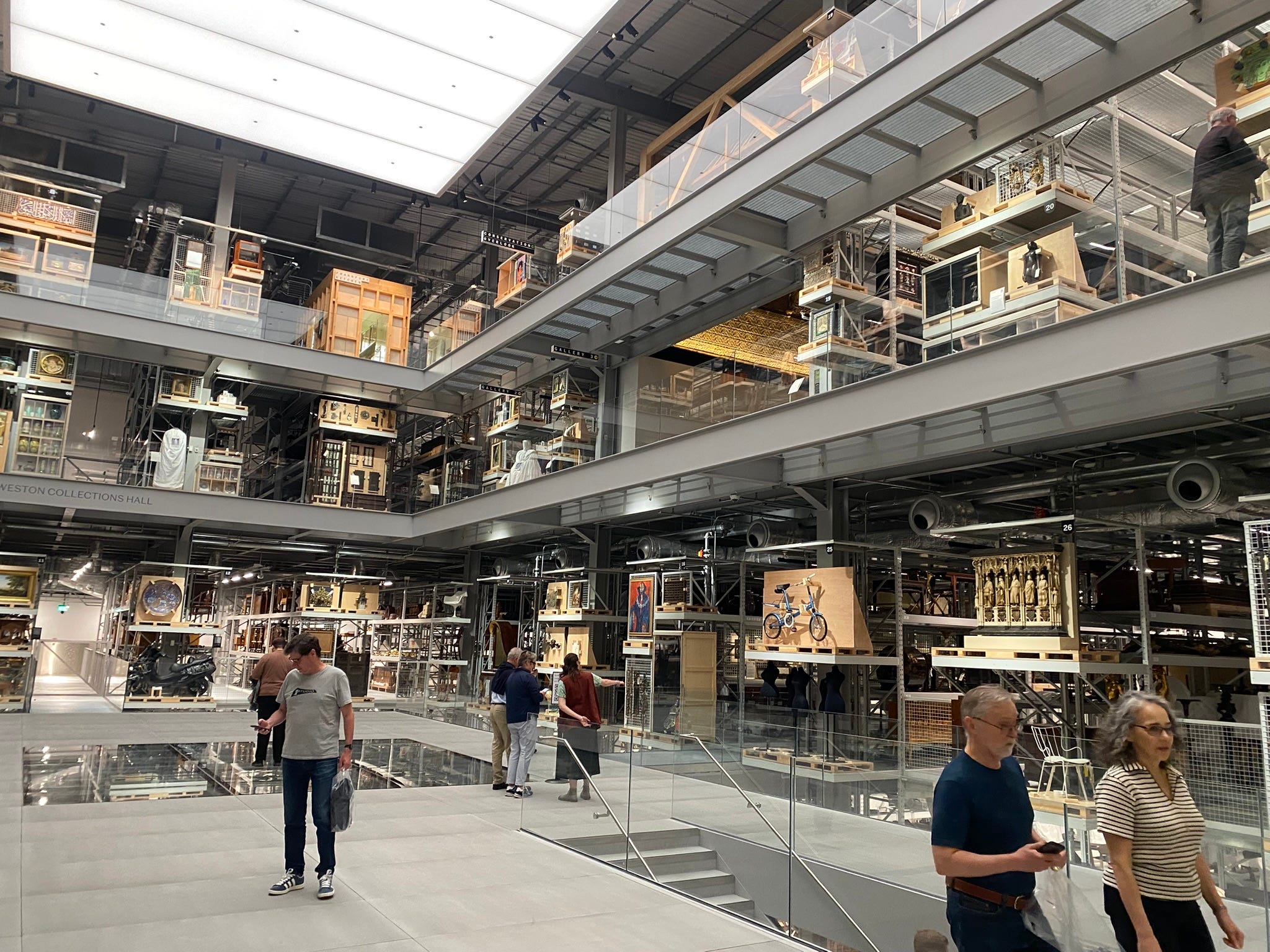
From V&A East Storehouse
“Victoria & Albert East Storehouse has been created to provide unprecedented access to the V&A collections and archives. A unique new museum experience invites visitors behind the scenes to wander amongst half a million creative works, spanning every era, discipline, and corner of the globe. Through an ever-changing programme of displays, events and workshops, V&A East Storehouse will share new discoveries and untold stories and provide new opportunities for everyone to discover and develop their own creativity. Designed by leading architects Diller Scofidio+ Renfro, opened in east London in 2025.”
The Invention of the Public Collection
The movement from private collection to public museum does not occur in isolation, and it does not happen simply because collectors become generous or enlightened. It unfolds alongside a much larger shift in how society understands itself, particularly in the emergence of the public as a political entity. In earlier periods, collections belonged to those who held power, to courts, to aristocratic families, to individuals whose wealth allowed them to gather objects as extensions of their authority, and these collections reflected that structure, not only in what they contained, but in who was permitted to see them. To possess was to control, and to control was to define meaning within a closed circle.
As ideas of democracy began to take form in the 18th century, especially in the wake of political upheavals that redefined the relationship between the state and its citizens, the notion of the public began to expand. The people, once subjects, were increasingly imagined as participants in a shared cultural and political life, and with that shift came the question of access, not only to governance, but to knowledge, to history, to the symbols that had previously been held apart.
The transformation of royal and aristocratic collections into public institutions marks this moment with particular clarity. When the Louvre Museum opened to the public during the French Revolution, it was not simply a change in administration, it was a statement, that what had once belonged to the monarchy was now to be held in the name of the people. The collection did not change overnight, but its meaning did. It became part of a shared inheritance, something to be encountered by citizens rather than guarded as a sign of privilege.
Similarly, the establishment of institutions such as the British Museum reflects a parallel development, where collections assembled through private means were re-situated within a national framework, presented as resources for public education and collective knowledge. The museum, in this sense, becomes one of the cultural forms through which democracy expresses itself, a space where the idea of a shared cultural heritage is made visible.
And yet, this transformation carries a tension that remains unresolved. The collections themselves were formed under conditions that were not democratic. They reflect the reach of empire, the accumulation of wealth, the asymmetries of access that allowed certain individuals to gather what others could not. When these collections become public, they bring those histories with them, even as they are reinterpreted under a different political ideal.
The museum, then, stands at a crossing point. It represents an opening, a widening of access, a recognition that culture belongs to more than a narrow elite. At the same time, it preserves the traces of the structures from which it emerged, carrying forward selections that were shaped long before the public was invited in.
To understand this is to see the museum not as a completed expression of democratic culture, but as an ongoing negotiation between inherited power and shared access, between what was gathered under one set of conditions and what is now presented under another. It is both an expansion and a continuation, a space where the idea of the public is made visible, even as the limits of that visibility remain.