


The Eye Becomes the Performer
On Painting as Score
Cecil Touchon | September 3, 2026
I have long been interested in what happens when ideas belonging to one art form migrate into another. What happens when the theories of poetry are applied to painting? What happens when musical ideas such as rhythm, repetition, variation, counterpoint, harmony, dissonance, tempo, and silence are treated as visual problems? At what point does a painting cease to be simply an arrangement of forms and begin to behave like a score?
A painting presents a curious problem in relation to music. Music unfolds through time. We cannot hear a musical composition all at once. A note arrives, disappears, and remains in memory while another takes its place. Gradually, through repetition and variation, we recognize relationships. Something heard earlier returns in another form. A rhythm establishes itself and then shifts. An expectation is created, postponed, fulfilled, or abandoned.
A painting seems to operate differently because the entire object is continuously present. Yet our experience of it is not instantaneous. We may see the whole painting immediately, but we cannot attend to the whole painting simultaneously. The focal point of the eye must travel.
It moves from one form to another. It pauses. It doubles back. It notices something at the edge of vision and jumps across the canvas. It recognizes a form encountered earlier. It discovers that a shape has returned inverted, enlarged, compressed, interrupted, or partially concealed. What appeared initially to be a field of unrelated events gradually reveals itself as a system of relationships.
In that sense, a painting also unfolds in time.
The duration is supplied by the viewer.
This is where the idea of the painting as a score becomes useful to me. A musical score is an object that contains instructions or possibilities for an event. The notation itself is silent. Music occurs when someone performs it. Similarly, the painting remains physically still, yet the viewer activates it through looking. The movement occurs in consciousness as the eye travels through the work.
The eye becomes the performer and the painting becomes the score.
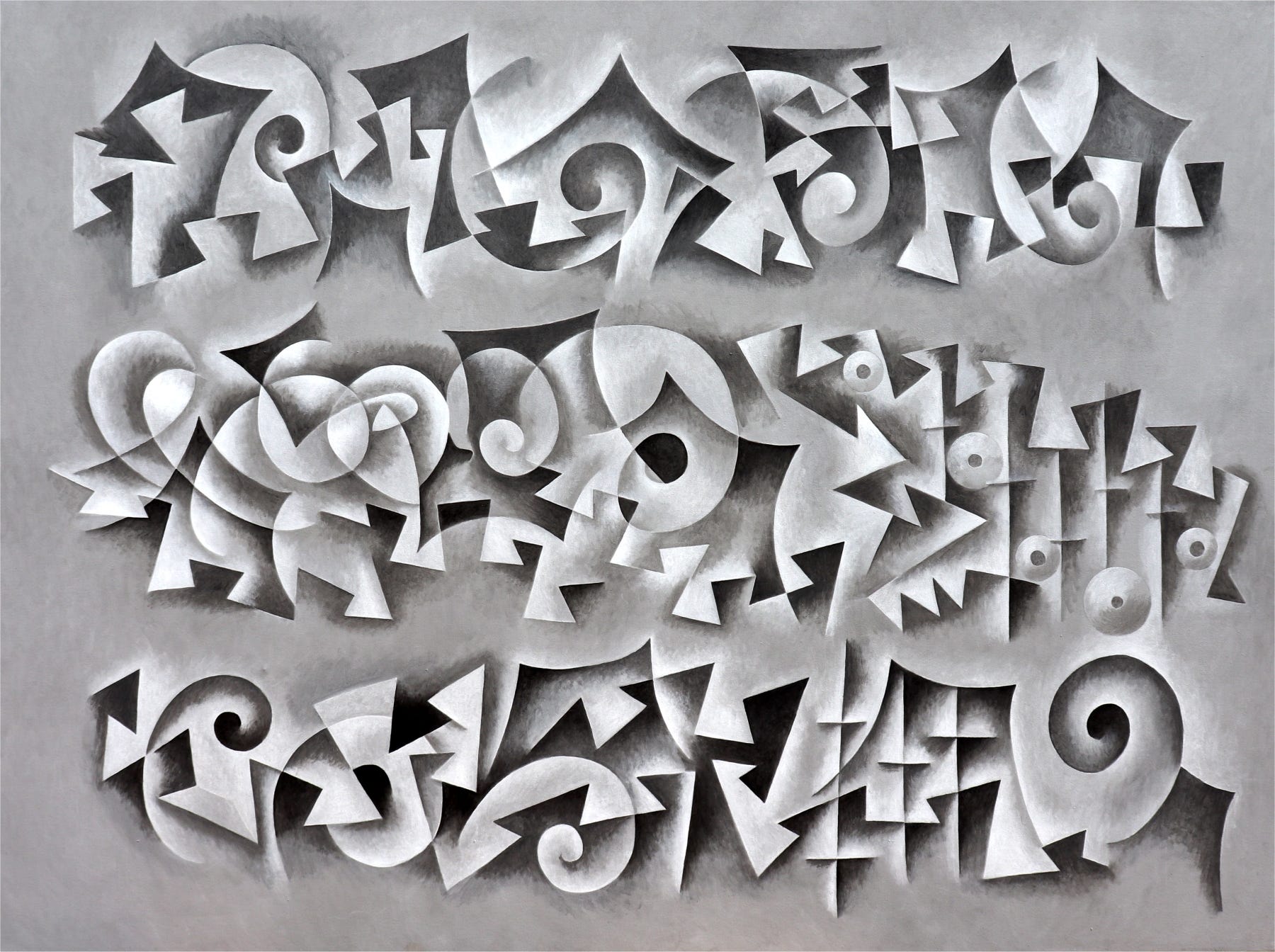
This way of thinking changes my relationship to abstract form. A shape no longer needs to represent an object. It can function as an event.
A pointed wedge can behave like an attack. A long curve can carry the eye like a sustained tone. A sequence of narrow vertical forms can establish a staccato rhythm. A spiral can slow the movement and turn attention inward. Overlapping translucent shapes can create something analogous to chords. Dark forms can operate as accents or interruptions. Open areas become intervals in which relatively little happens, something approaching the function of silence.
I work with a deliberately restricted vocabulary of forms. The limitation is important because recognition depends upon recurrence. A curve encountered in one part of a painting may appear elsewhere at another scale or orientation. Angular fragments migrate through the composition. Spirals return. Shapes reverse themselves. Forms overlap and combine into temporary structures before separating again.
The same few elements can produce an indefinite number of variations.
This brings the work close to musical composition, particularly forms of music constructed through repetition, variation, rhythmic displacement, layering, and counterpoint. I am interested in the way a composer can take a relatively modest motif and discover within it an enormous field of possibilities. Complexity does not necessarily require an ever-expanding vocabulary. It can arise through increasingly subtle relationships among a limited number of elements.
But these forms also occupy another territory that interests me: the territory of writing.
Human beings are extraordinarily sensitive to marks that resemble language. Put several abstract forms beside one another and, almost involuntarily, we begin wondering whether they can be read. A vertical becomes something like a letter. A curve suggests part of an alphabet. Repeated forms begin to imply syntax. Sequences suggest sentences even when no actual sentence exists.
This is where painting, writing, and musical notation begin to converge.
Writing transforms language into marks. Musical notation transforms sound into marks. Painting can make marks without requiring them to refer to anything outside themselves. All three depend upon distinctions, repetitions, intervals, sequences, densities, and relationships.
My forms sometimes resemble fragments of an unknown alphabet. At other moments they might appear to belong to a system of musical notation whose rules have been lost. They seem to promise legibility without ever surrendering themselves completely to reading.
That ambiguity is important.
If the forms became actual letters, the painting would begin directing the viewer toward words and their established meanings. If they became conventional musical notation, they would instruct a musician to produce particular sounds. Instead, they remain suspended between these systems. They possess the atmosphere of language without becoming language and the rhythmic potential of musical notation without prescribing a particular piece of music.
They are readable without being decipherable.
This is closely related to my interest in asemic writing, writing emptied of conventional semantic content while retaining the gesture, rhythm, structure, and expectation of written language. Asemic writing asks us to experience writing before meaning settles upon it. We encounter the movement of inscription itself.
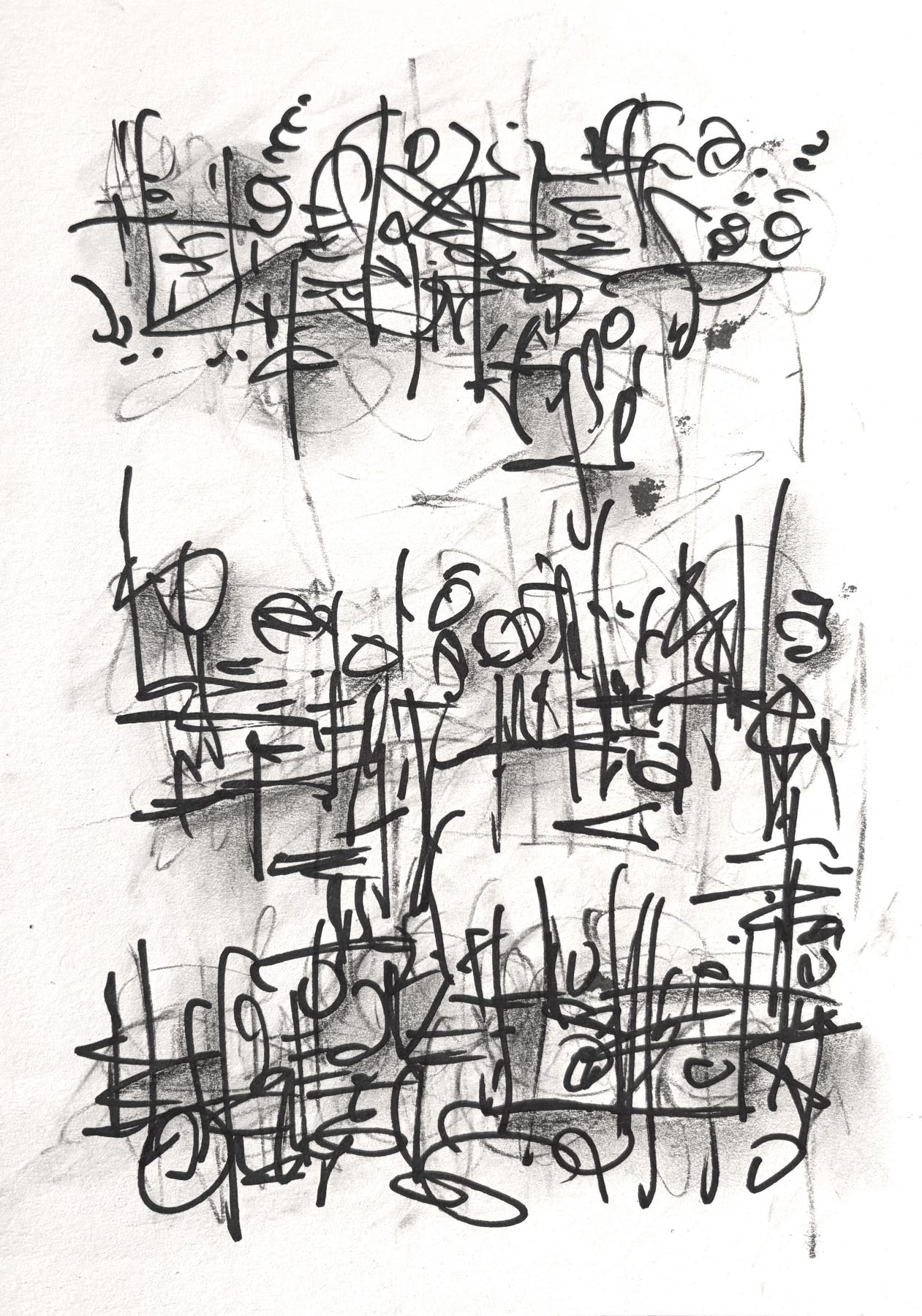
The paintings extend that possibility into a larger visual field. Rather than reading from left to right toward a predetermined conclusion, the viewer can enter anywhere. There is no single correct sequence. One person might follow the spirals. Another might move among the darkest forms. Another might attend to the overlapping tonal passages. Each creates a different temporal experience from the same physical object.
This is where painting possesses an extraordinary freedom that neither conventional writing nor conventional musical notation allows. The score does not prescribe its own performance.
The viewer invents it.
The painting therefore exists in two states. There is the material object hanging silently on the wall, containing all of its forms simultaneously. And there is the painting as experienced, reconstructed moment by moment through attention, memory, anticipation, recognition, and return.
Every viewing becomes another performance.
And because no one follows exactly the same path twice, even the same viewer produces a slightly different version each time.
The painting does not make a sound, yet it can have rhythm. It contains no words, yet it can suggest language. It offers no instructions, yet it can behave like notation.
Somewhere among painting, writing, and music there is a territory where marks cease to belong exclusively to any one discipline. They become gestures waiting to be activated.
The canvas is silent.
The score is waiting.
The eye starts to move.
The performance begins.
This essay written for one of my collectors who is considering acquiring this painting.
This is so beautiful. I’ll continue reviewing it in my mind as I have a felt sense of something deeper. I dream of Asemic writing a language from beyond guiding me. Thank you for this contemplative read.
He’s lucky to have it and this ode to the artwork—what provenance!