


The Creative Superpower of Limits
Disciplining oneself to happily work within limits is a superpower for creative people.
And we all have limits.
We have only so much time. We have only so much money. We have the materials that happen to be available. We have the studio we have, the body we have, the skills we have developed so far, the responsibilities we have accumulated, the place where we happen to live, the circumstances into which we have been dropped. Even the wealthiest and most successful artist eventually runs up against the boundaries of mortality. There are only so many mornings.
So the question is never really whether we will work within limits. We will.
The question is whether we will spend our creative lives resenting those limits or learn how to make them productive.
This is where discipline becomes something much more interesting than self-denial. Discipline is the ability to say: Very well. These are the conditions. What can I do here?
And then get to work.
There is an enormous amount of wasted creative energy in wishing circumstances were different. If I had a bigger studio. If I had more money. If I had better materials. If I had more time. If I lived somewhere else. If I had started earlier. If somebody would give me a grant. If the gallery would call. If people understood what I was doing.
Perhaps all of those things would be useful. But they are imaginary conditions. Creativity can only operate upon what is actually present.
The great transformation occurs when the artist stops experiencing limitation primarily as deprivation and begins experiencing it as definition.
A piece of paper has edges.
A sonnet has fourteen lines.
A piano has eighty-eight keys.
A day has twenty-four hours.
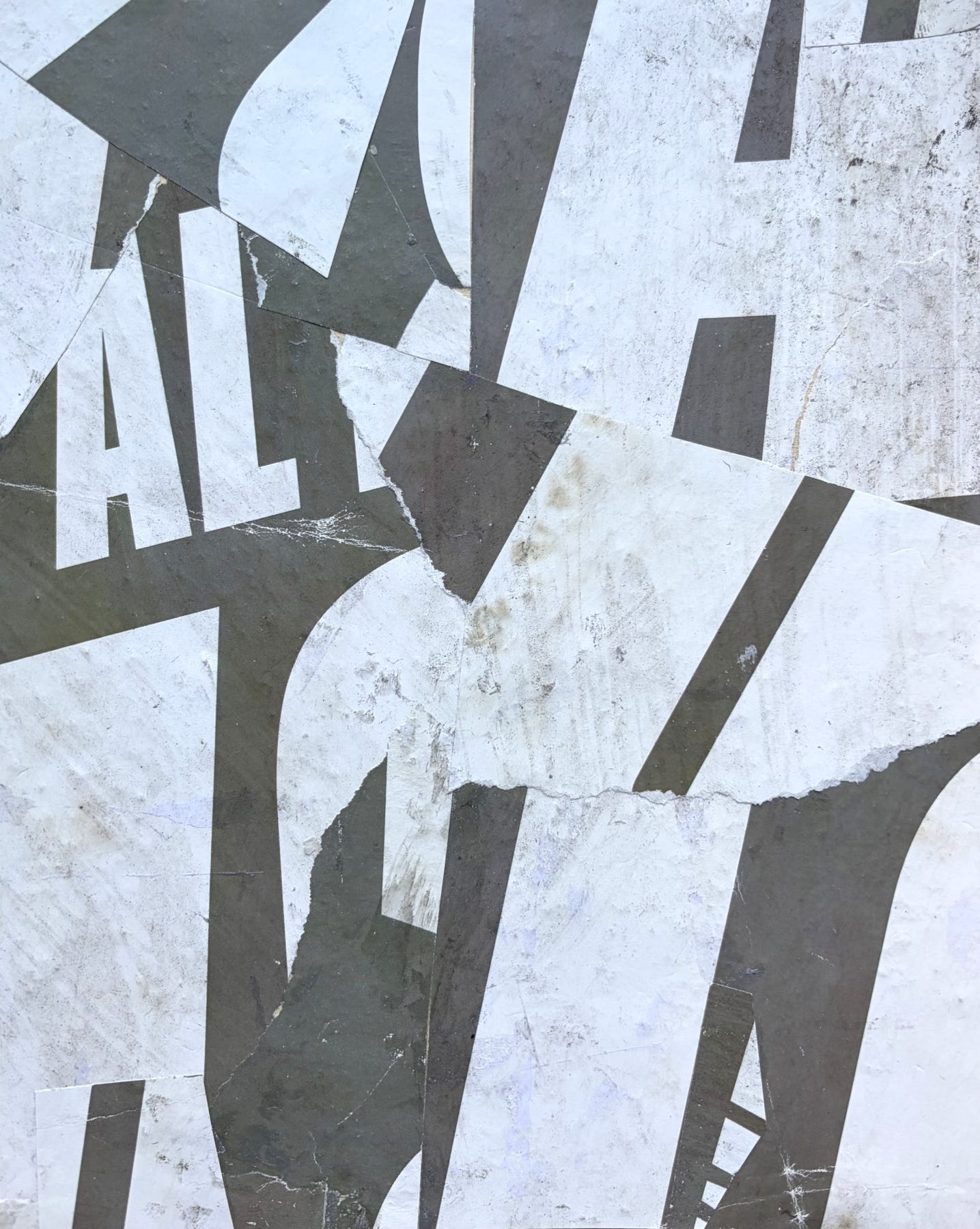
A particular painting might contain only black and white. A collage might be constructed entirely from materials found within a single city block. A composer might spend an entire piece investigating one rhythmic figure. An artist might spend months exploring nothing more than a zigzag, a reversing zigzag and a loop.
At first this sounds restrictive.
Then something strange happens.
The smaller territory begins to become enormous.
You discover variations you would never have noticed if you had been wandering across an unlimited field of possibilities. One line can be heavy or delicate, hesitant or decisive, compressed or expansive. It can accelerate, stumble, repeat, reverse, collide, disappear and return. Put it beside another line and an entirely new universe opens.
This is the principle of the étude. You deliberately narrow the field so that you can deepen your attention. You say: For the moment, I am going to investigate this. And because you have excluded ten thousand other possibilities, you begin noticing the thousand possibilities hidden inside this one.
That is a very different conception of creative freedom.
We often imagine freedom as having unlimited choices. But unlimited choice can produce a peculiar kind of paralysis. If anything is possible, where do you begin?
A limitation gives you somewhere to stand.
The edge of the paper is not merely where the artwork stops. It is one of the conditions that makes the artwork possible in the first place.
The same thing happens throughout an artist’s life.
Perhaps you only have two hours today.
Fine. What can two hours become?
Perhaps you only have scraps of paper.
Fine. What can scraps of paper become?
Perhaps your studio is a hotel room, a kitchen table, an airplane seat or a park bench.
Fine. What kind of work belongs to that situation?
Perhaps circumstances suddenly prevent you from making the work you have been making for years.
Fine. What is possible now under these conditions?
This last question is one of the most powerful questions a creative person can cultivate:What is possible now? It brings the imagination back from fantasy and places it directly into relationship with reality. And reality is incredibly fertile.
The artist who develops this habit becomes difficult to stop.
Take away the large studio and the artist works small.
Take away the expensive materials and the artist uses cardboard.
Take away the printing press and the artist draws.
Take away the brushes and the artist uses a stick.
Put the artist in another country and the streets become the supply cabinet.
Give the artist twenty years and there is a life’s work.
Give the artist twenty minutes and there is a drawing.
The important thing is that the creative relationship with the world remains intact.
This is why the word happily matters so much.
There is a tremendous difference between grudgingly tolerating circumstances and becoming curious about them.Resentment keeps comparing the present situation with an imaginary preferable situation.
Curiosity asks what this situation contains.
That shift is profound.
Once the artist becomes curious about limits, limitation itself becomes material.
Then obstacles begin turning into propositions.
Only three colors? Interesting.
Only one sheet of paper? Let’s see.
Only what I can carry in this suitcase? Good.
Only this one gesture for the next thirty drawings? Now we’re getting somewhere.
The creative person begins treating circumstances almost as a collaborator. Reality establishes certain conditions and the artist responds.
Call and response.
The world says: Here is what you have.
The artist says: Let’s see what I can do with it.
This is one of the deepest forms of creative maturity.
The beginner often imagines that mastery will eventually mean escaping limitations. The mature artist discovers almost the opposite. Mastery increasingly involves choosing limits intelligently and then working deeply within them.
A vocabulary emerges.
Certain materials.
Certain gestures.
Certain scales.
Certain recurring problems.
Certain questions that may occupy decades.
From the outside, this can look like narrowing. From inside the practice, it feels like increasing depth. The territory becomes smaller while the world inside it becomes larger.
That is why an artist can spend a lifetime investigating something that another person thinks could be exhausted in an afternoon.
The outsider sees a zigzag. The artist sees rhythm, direction, reversal, pressure, interval, acceleration, density, counterpoint, interruption, repetition, variation and return.
The limit has become a microscope.
This attitude also provides enormous resilience because circumstances are always changing. Money comes and goes. Studios are gained and lost. Bodies age. Technologies change. Careers rise and fall. Materials disappear. Plans collapse. Opportunities arrive unexpectedly. Entire societies reorganize themselves around us.
Anyone whose creativity depends upon maintaining perfect conditions is in a precarious position.
But the artist who has learned to say What is possible now? can continue. That person carries the studio internally.
This does not mean that every limitation is desirable. Some limitations genuinely damage people’s lives and possibilities. Nor does it mean we shouldn’t try to improve our circumstances when we can.
It simply means that creative life cannot be postponed until all limitations disappear. They never will.
There will always be a frame.
There will always be an edge to the paper.
There will always be only so much time.
Creative freedom is something different from having no limits.
Creative freedom is the cultivated ability to move freely within limits, to press against them, investigate them, play with them, occasionally transform them and sometimes discover that what first appeared to be a wall was actually an instrument.
Then limitation ceases to be the enemy of creativity. It becomes the resistance against which creative strength develops. And the artist who learns to work happily under those conditions acquires a remarkable confidence:
Give me what is available.
Give me the circumstances as they are.
Give me this much space, this much time, these few materials, this particular problem.
I will begin here.
“There is an enormous amount of wasted creative energy in wishing circumstances were different.”
… SO important.
"A limitation gives you somewhere to stand." Yes, this. I've often talked about the concept of how limits provide my lazy self/mind to go beyond and be more creative. Less is more. I've made some of my best work when I thought I desired more or something very specific to a piece and ended up using what I already had or something completely different and the piece because a really great piece. I look at people online who use 3D printers to make whatever they dream up and think how cool would that be to do? But then for me, there's something in the unexpected finding of something unique that fits beautifully in what I need for a piece. And it's also so much a part of my assemblages and the meaning within them to use what I find and create with the objects. I like the outcome when every solid piece of something in an artwork of mine has had a past life before I found it. It adds to the work and I like to think of it as a found gift from The Universe to me.