


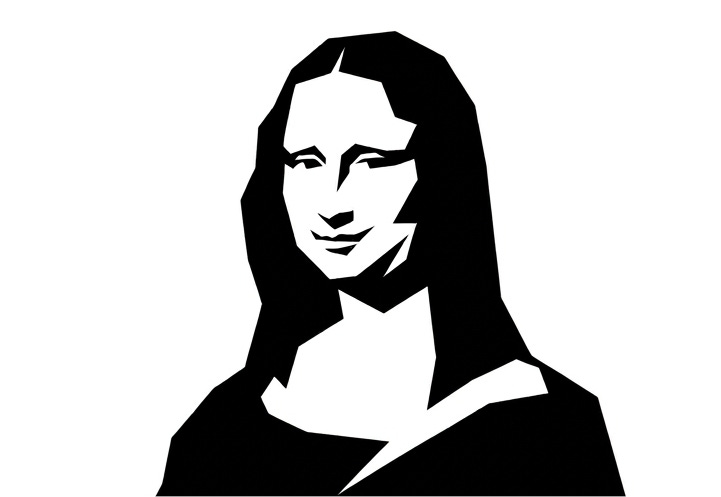
The Contrast Trap:
Why Modern Politics is Killing the Creative Mind
We live in an era of cultural and political reductionism, where the expansive, multi-angle, full-color spectrum of human experience is systematically flattened. To understand why public discourse feels so exhausting - and why meaningful debate has largely vanished - we have to look at the conflict through the lens of art.
Consider the Mona Lisa.
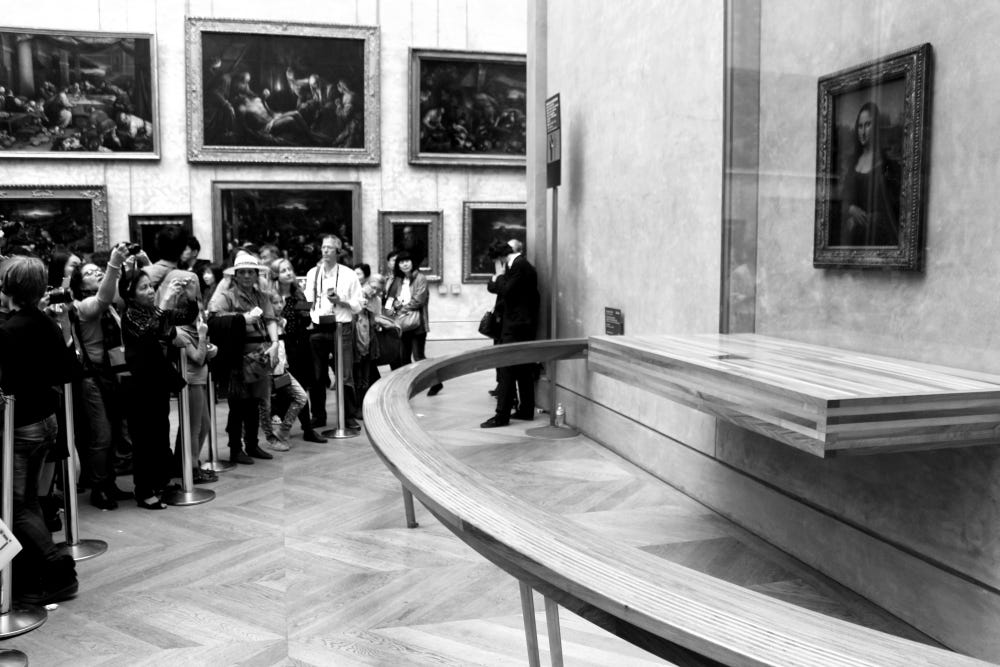
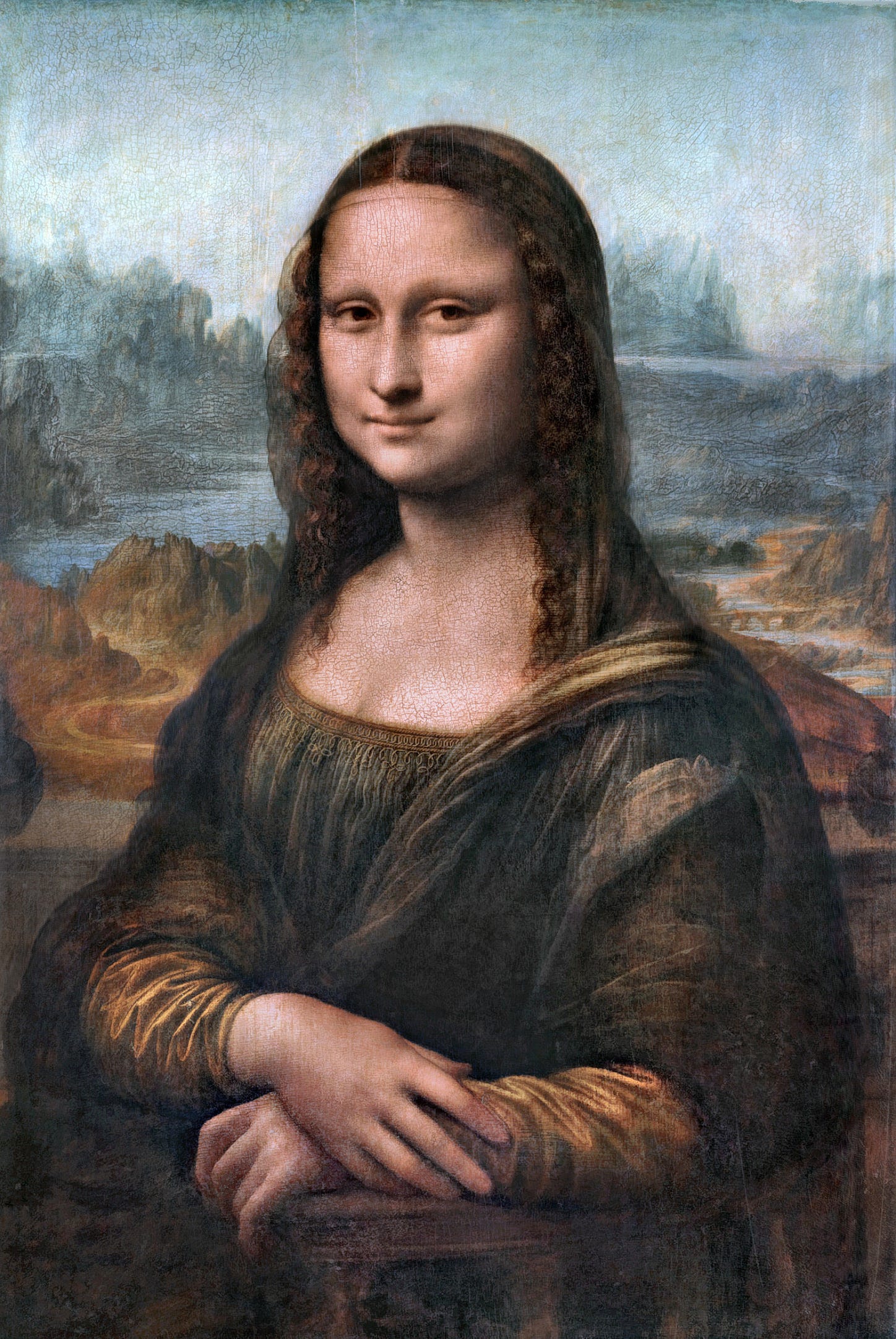
When you stand before Leonardo da Vinci’s masterpiece, (assuming you could get that close) you are looking at an intricate web of sfumato - deliberate, hazy layers of color, light, and shadow that blend seamlessly into one another. It is an exercise in subtlety. Leonardo da Vinci started the painting in 1503 and worked on it, off and on, till 1517. The human expression is notoriously ambiguous; the background shifts depending on your perspective. The artist thinks in multi-angle full color.
Now, imagine that image violently reduced. Strip away the rich pigments. Strip away the delicate brushwork. In fact, strip away the entire grayscale entirely. Do not allow for charcoal tones, soft shadows, or muted silver mid-tones. Reduce the Mona Lisa to a binary image: stark, harsh black and white.
The nuance is gone. The enigmatic smile becomes a jagged silhouette. The depth disappears.
Then, imagine two factions standing in front of this ruined canvas, arguing over its meaning from fierce political stances. That is our current political landscape.
The Geometry of a Two-Tone Mind
This is the exact crisis of modern debate. The political apparatus functions as a binary compressor. It takes the infinite, colorful complexities of human society - economics, culture, ethics, psychology - and forces them through a scanner that only registers two outputs - highly simplified black and white.
For the person trapped in this binary mindset, there is no gray area. There are no gradients. There is only the stark contrast of absolute black and absolute white to defend or attack.
When a person who thinks only in binary terms enters a debate, their entire rhetorical strategy is dictated by the limitations of their palette:
Subtlety becomes invisible: Because their worldview doesn’t possess the vocabulary for nuance, any attempt to introduce context, history, or mixed motives is viewed as a threat or a distraction.
Defense becomes aggressive: Without the cushioning mid-tones of compromise, every disagreement feels like an existential battle. If you aren’t completely ‘with us’, you must be entirely ‘against us’.
The landscape is flattened: Complex systemic issues are reduced to simple, rigid dichotomies: Us vs. Them, Good vs. Evil, Absolute Freedom vs. Total Control. President George W. Bush, in an address to a joint session of Congress on 20 September 2001 said, “Every nation, in every region, now has a decision to make. Either you are with us, or you are with the terrorists.”
The tragedy of this dynamic is that it forces the artist and the creative into a defensive crouch. Creatives natively operate in the spaces between these lines. They understand that two opposing truths can exist in the same frame, that human beings are deeply flawed but capable of grace, and that the beauty of life lies entirely in the details that cannot be easily categorized.
The Art of Political Flattening
When politics dominates a culture, it demands that we abandon our full-color palette and enlist in the binary army. We see this when books, movies, and paintings are judged purely by their ideological alignment rather than their aesthetic or emotional truth.
The binary debater looks at a full-color painting and asks only one question: Which side does this support?
If the art contains subtlety, the binary mind becomes suspicious. It demands clear, distinct outlines. It demands to know exactly where the black ends and the white begins. It demands an immediate YES or a NO, a FOR or AGAINST. But the world is much more nuanced and subtle than that for any intellegent thinker.
And now is the time for intellegent thoughtful consideration not quick to the draw, shoot from the hip bravado as we currently see happening.
True debate - the kind that moves societies forward rather than locking them in permanent, gridlocked warfare - requires us to step back from this false binary stance. It requires us to look at the canvas of public life and recognize that the vast majority of human existence takes place in the rich, messy, full-color space between the extremes.
Until we reject the stark, low-resolution contrast of modern political rhetoric, we will keep shouting at a ruined distorted image, completely blind to the masterpiece that is right in front of us.
De-escalating the Contrast: A Guide for the Individual Citizen
The binary scanner of modern politics is an intentional structural trap, but it is not an inevitability. While we cannot single-handedly rewrite the algorithms of social media platforms or retrain political strategists to embrace nuance, we can inoculate our own minds against the flattening effect.
To preserve the multi-angle, full-color capacity of our thinking, we must intentionally adopt a set of deliberate intellectual habits. Here is how the individual citizen can step away from the stark black-and-white canvas and reclaim the mid-tones and the hues of American life.
1. Audit Your Semantic Intake
If you feed your mind exclusively on a diet of political one-liners, you will eventually lose the capacity to process complex thoughts. Slogans act like intellectual fast food—highly compressed, heavily processed, and designed to trigger an immediate, unthinking reaction.
The Fix: Force yourself to consume long-form, deeply reported material that intentionally refuses to offer easy answers. Read histories, dense policy analyses, and biographies where characters are messy and outcomes are mixed. If an article can be entirely summarized by its headline, it is likely reinforcing the binary trap. Seek out writing that leaves you sitting in the discomfort of unresolved questions.
2. Reclaim the Grayscale Vocabulary
The binary mind relies on a limited vocabulary of absolute terms: always, never, traitor, patriot, pure, corrupt. When we use these words, we actively strip the gray tones out of our own reality.
The Fix: Introduce conditional language back into your speech and thought patterns. Practice using phrases like: “To a certain extent...”, “In this specific context...”, or “I agree with the general premise, but the implementation needs some rethinking.” By refusing to grant blanket statements absolute authority, you force your brain to evaluate the specific gradients of a given situation rather than sorting it instantly into a binary bucket.
3. Cultivate Cognitive Hospitality
The black-and-white debater views an opposing viewpoint as a hostile invasion that must be immediately repelled with a pre-packaged counter-slogan. Reclaiming full-color thinking requires a willingness to host an idea temporarily without immediately adopting it or attacking it.
The Fix: Practice the art of “steel-manning” - the exact opposite of straw-manning. When confronted with an ideological opponent, try to articulate their argument so clearly and fairly that they would say, “Yes, that is exactly what I mean.” Only after you have accurately mapped their perspective in its full complexity can you meaningfully evaluate where it fails or succeeds. This doesn’t mean you must change your values; it means you refuse to fight a caricature of the issue.
4. Disconnect from the Audience Matrix
Performative debate thrives on the presence of an audience. When we post on social media, we are rarely engaged in an honest exchange of ideas; we are sending signals to show our tribe that we are defending the white and attacking the black. But everyone their’s their own side is the right side.
The Fix: Move your most difficult conversations offline, away from the digital coliseums. Complex, nuanced human issues were never meant to be adjudicated in the public comments sections or via brief text threads. A face-to-face conversation over coffee reintroduces the visual and vocal mid-tones—tone of voice, facial expressions, and hesitation—that humanize the speaker and dismantle the binary illusion.
5. Protect the Creative Sector of Your Life
Ultimately, the most effective antidote to political reductionism is art itself. Creative expression—whether reading fiction, viewing complex paintings, listening to intricate music, or engaging in your own creative projects—acts as resistance.
The Fix: Dedicate time to spaces where politics is explicitly banned from being the sole metric of value. Immerse yourself in stories where the protagonist makes terrible mistakes but remains sympathetic, or where the “villain” acts out of deeply human, understandable motives.
By insisting on seeing the world in its original, high-resolution, full-color state, you perform a radical act of civic sanity.
Thank you for this well thought out essay/article. And also thank you for not slanting it towards any specific political stance....much appreciated. By keeping an open mind and practicing critical thinking skills, I have changed my mind, even what I though of as convictions written in stone....into new thinking that made more sense backed up by facts and not merely feelings. I also have not been an in-your-face kind of person/friend who will shove my opinion down anyone's throat as many have done with me. I have lost several friends for their own absolute black & white thinking/feelings as they have not stopped to respect my thinking of several subjects. I can't sit down over coffee with these individuals as they live thousands of miles away from me. I have written well thought out letters to them only to either get ignored, ghosted permanently, and even bullied back as they screamed their feelings back at me via email/text. I have found that trying to have a mature discussing with someone who is adamantly black & white in their views, it is impossible to reach not only any sort of understanding from them to step into my shoes, but they will not even "agree to disagree" and disrespect me as some sort of evil idiot. As for art........the very few pieces I have done which expresses any sort of political concept......it's so subtle on purpose, that like the 'eye of the beholder' they will see what they want to see even though only I know what I truly meant.