


Chapter One continued
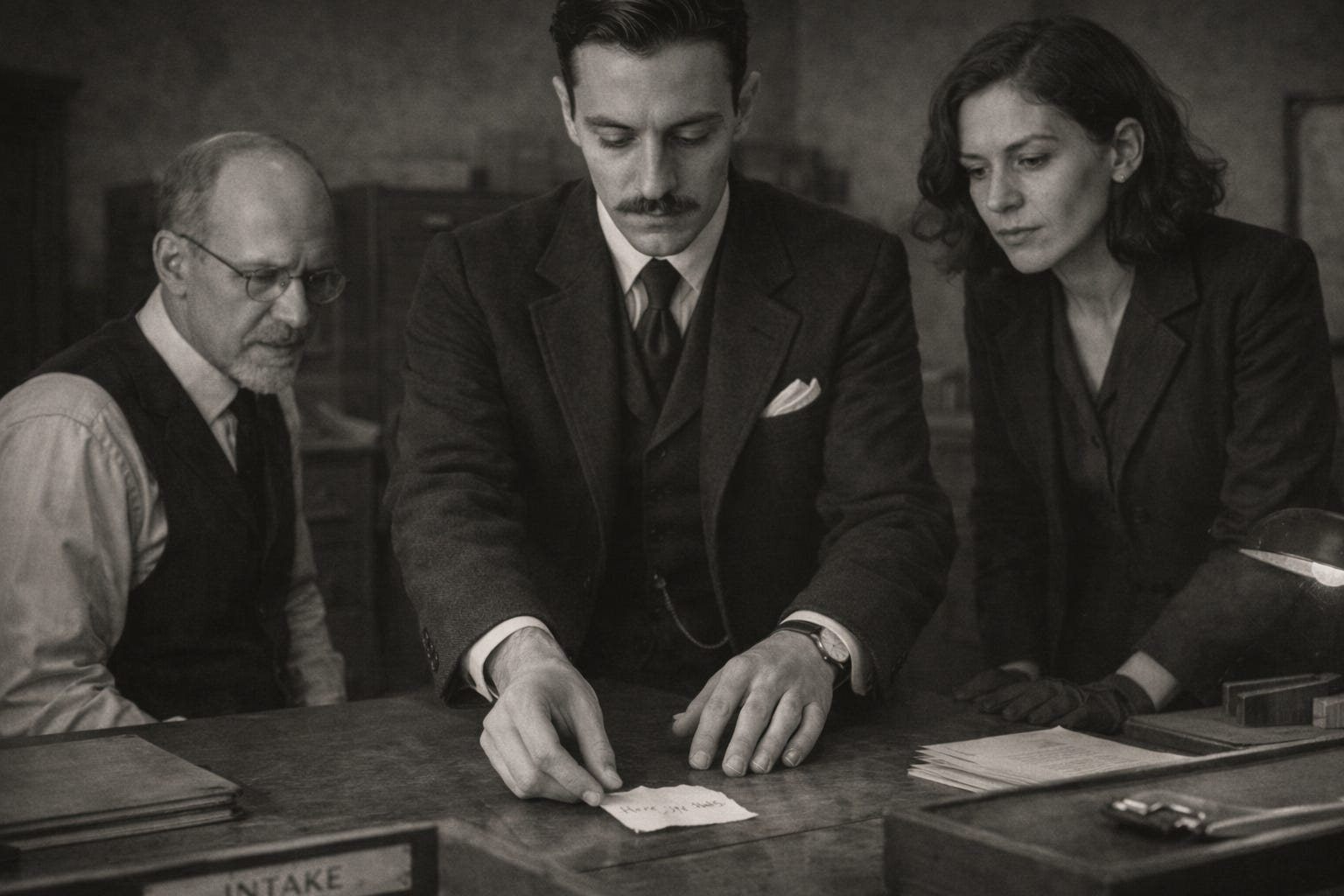
Thessaly looked at Penn. “That phrase - ‘Here, try this.’ - on a scrap appeared yesterday in a tray of unassigned ephemera. I placed on the communal writing desk in the Correspondence Hall.”
He replaced the fragment carefully on the intake surface, aligning its edges with the table’s seam as though it required a stable horizon.
“Where is the scrap? Do you have it?” asked Penn
“I didn’t retrieve it, I assume it is still on the desk.” said Thessaly.
“It might be helpful to examine it.” Penn replied.
“My problem is this document still has no drawer,” Rufus added.
“Then it is without context,” Penn replied.
He straightened, adjusted his cuffs once more, and allowed his gaze to move across the Hall.
“Open a provisional file for now until we can figure this out,” he said. “Unresolved Narrative — Pending Provenance.”
Rufus exhaled softly.
Penn did not smile.
He had not yet formed a theory.
But, with this evidence, he had registered a beginning.
And beginnings, he knew, required endings.
The fragment was placed into a temporary folder.
At 9:43 a.m., a second anomaly registered.
A cross-reference pinged in an unrelated catalog entry. A partial match to the phrase “Here, try this.”
Penn paused at the screen.
“Coincidence?” Rufus asked immediately.
“Perhaps,” Penn answered.
He requested the cross-reference file.
Within it were marginal notations attached to a minor, unindexed draft. Two names appeared only once in the metadata trail.
Frank.
Bob.
They had no biographical file.
They had no drawer.
They were not staff.
They were not historical authors.
They existed only in relation to this fragment.
Penn closed the file gently.
“Begin a trace,” he said.
“For what?” Rufus asked.
“For origin.”
Penn remained by the intake table after Rufus had returned to the console.
The fragment lay under the examination lamp. Its fibers caught the light unevenly along the bottom edge, where the paper had separated from whatever had once continued below it.
Penn lifted the sheet again.
He did not read the lines this time. He studied the margin.
Rufus glanced over from the console. “You’re still looking at it.”
“Yes.”
“Anything new?”
Penn turned the paper slightly beneath the lamp.
“The tear,” he said.
Rufus leaned closer. “What about it?”
“It is not the edge of the page.”
Rufus frowned. “Meaning?”
Penn placed the fragment flat again.
“This sheet did not end here.”
Thessaly, who had been standing beside the provisional trays, stepped nearer.
“You believe something is missing.”
Penn inclined his head.
“The lower portion,” he said. “Removed before it arrived here?”
Rufus crossed his arms. “We have already established that the fragment is incomplete.”
Penn regarded him calmly.
“There is a difference between incomplete and removed.”
Rufus waited.
Penn traced the air just above the torn margin without touching it.
“The dialogue begins. The premise establishes itself. Two figures appear, an offering is made, a question follows. The narrative has only just entered its first movement.”
Rufus looked at the fragment again as Penn continued.
“And let’s examine the spacing of the margins. The top of the sheet and the sides are ample and even, about one inch each. The bottom is torn very close to the end of the last line of text. This suggests that the missing torn section may have contained the continuation of the story.
“You can tell that from the structure?”
“Yes.”
“And?”
Penn straightened.
“And stories rarely tear themselves apart at the moment they are about to begin.”
The intake room grew quiet.
The console hummed softly behind Rufus.
Thessaly looked again at the page.
“So the missing portion would contain—”
“Continuation,” Penn said.
“Or the beginning of one.”
Rufus exhaled slowly.
“You are suggesting that the plot is on the missing piece.”
Penn did not answer immediately.
He replaced the fragment carefully in the provisional folder.
When he spoke, his voice remained even.
“I am suggesting,” he said, “that whatever this is, it has not yet reached the place where stories decide what they are. The question is, was the remainder removed? And if so, what was it and why was it removed.”
Rufus returned to the console and entered a note beneath the intake log.
Status: Fragmentary.
Continuation: Unknown.
Penn watched the entry appear on the screen.
Then he spoke.
“Begin a trace. Have staff conduct a search for the missing piece. Maybe we’ll get lucky.”
Rufus looked up.
“For the missing portion of the page.”
“And if it cannot be located?”
Penn closed the folder.
“Then we will have to determine where the story went.”
Rufus stared at the fragment again.
Thessaly said nothing.
At 10:02 a.m., the provisional file was updated.
Case designation:
UNRESOLVED NARRATIVE EVENT
SUBJECT: MISSING CONTINUATION
Penn considered the title for a moment.
Then he added a second line beneath it.
THE CASE OF THE MISSING PLOT
The folder was closed.
And somewhere, beyond the knowledge of the Archive, Frank and Bob continued sitting at a table with a blank sheet of paper between them, unaware that an institution devoted to the care of unfinished things had just begun looking for the rest of their story.
END OF CHAPTER ONE
Who though? Gone plot.