


The Artist as an Expeditionary Animal
We tend to imagine the artist in the studio.
I have spent most of my working life in studios and have always regarded the studio as one of the great inventions of civilization: a place specifically set aside for taking the time for paying attention to things. I really think of my studio as my hermitage.
But the studio is only half of the equation.
Before anything can be brought into the studio, something has to be encountered.
The collage artist is an expeditionary, hunter/gatherer animal by nature.
I use the word expeditionary deliberately. An expedition is different from a vacation and different from ordinary travel. An expedition sets out with an intention accepting that the territory itself will have something to say about what happens.
You know enough to begin. You do not know enough to know what you will find. That distinction seems fundamental to creative life.
Going Out to See What’s There
As a collage artist, I understand this quite literally.
I am constantly gathering things.
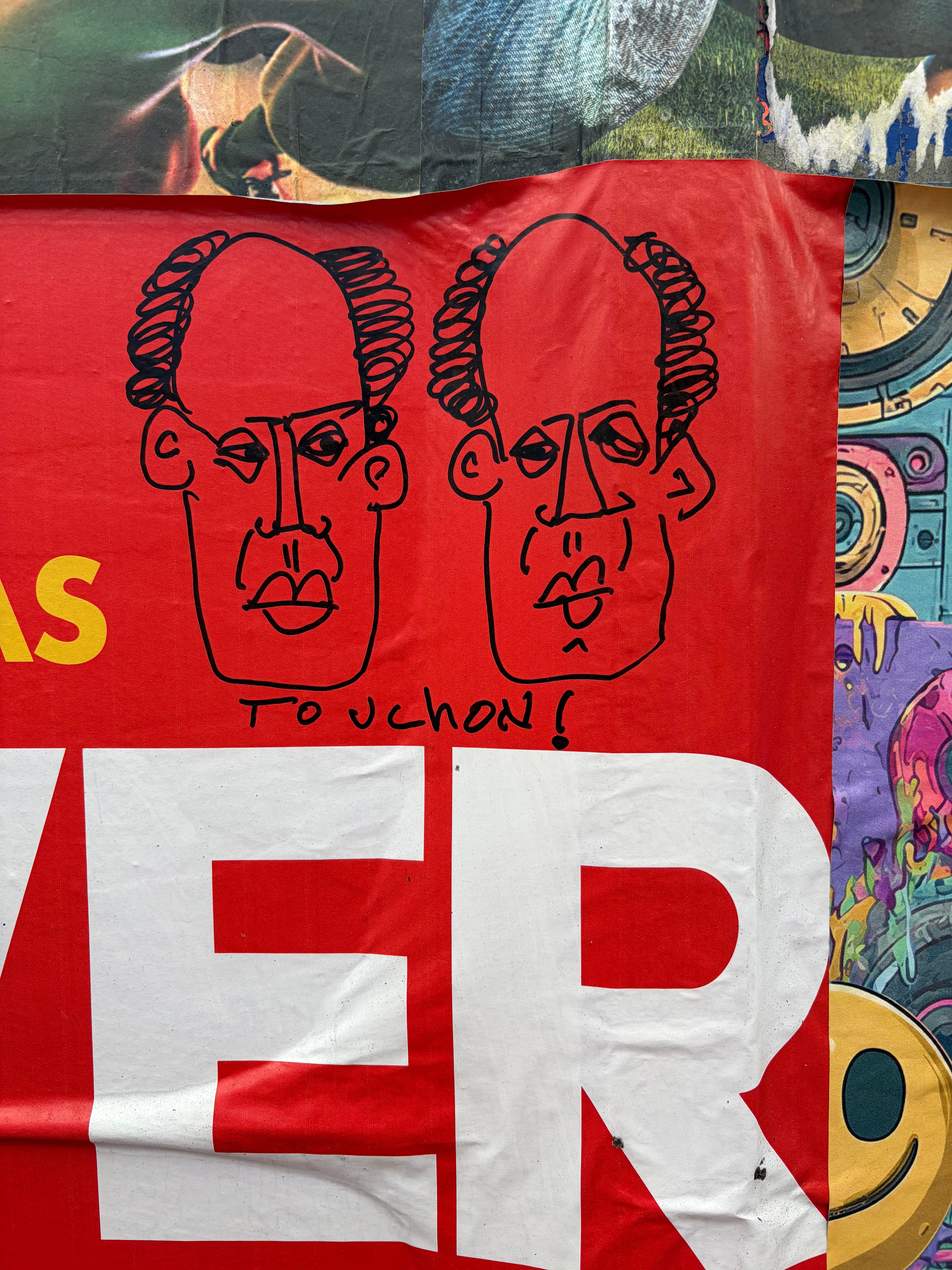
Printed fragments. Bits of typography. Packaging. Old books and magazines. Discarded papers. Photographs. Ephemera. Marks made for purposes having nothing to do with art. Pieces of the enormous visual conversation constantly taking place around us.
Most people walk past these things. I walk toward them.
Not the Average Tourist

I guess I am not the average tourist. I don’t much care about all of the touristy locations and taking selfies in front of stuff. I like to wander around randomly and just look at people and walls and graffiti and collect collage materials and then go back to my makeshift studio and see what I can come up with. To me it is a big achievement to figure out public transportation.
I am not necessarily looking for anything in particular. In fact, looking for something too particular can be a disadvantage. If I decide beforehand what I am searching for, I become very good at overlooking everything else. Instead, I try to remain open and available.
Something catches my attention.
I pick it up.
I photograph it.
I put it in a folder.
I tear something out.
I make a note.
I carry it home.
Often I have no idea what I am going to do with it. That comes later. The gathering and the making are related activities, but they are not the same activity. Gathering requires a different state of mind. It asks me to suspend judgment long enough to recognize possibility before I know its use.
A fragment enters the studio because something about it attracted my attention enogugh to pick it up.
The Portable Studio
Years ago when we first moved to Cuernavaca in Central Mexico in 1998, not realizing it, I began thinking as an expeditionary collage artist. That is where I first began harvesting the city walls. It was also when I started observing and thinking of the local - to me foreign - environment. I began seeing new materials to work with, a new atmosphere to capture and new palettes, textures and compositional ideas to explore.
I went out on daily walks around the city and collected photographs, poster papers and antique papers at flea markets. I examined archetecture, walls, doors and pavement. All of it became new ways to work and eventually lead to the idea of turning the collages into compositions for paintings. I developed a method.
Over time the street became part of the studio. Railway stations became part of it. Museums, bookstores, cafés, flea markets and hotel rooms became temporary extensions of it. Conversations became part of the material. So did photographs, overheard language, printed matter, maps, tickets, packaging and whatever else crossed my path.
Once I began traveling more frequently I figured out how to make the studio mobile - something that would fit in a suitcase and set up temporarily in a hotel room.
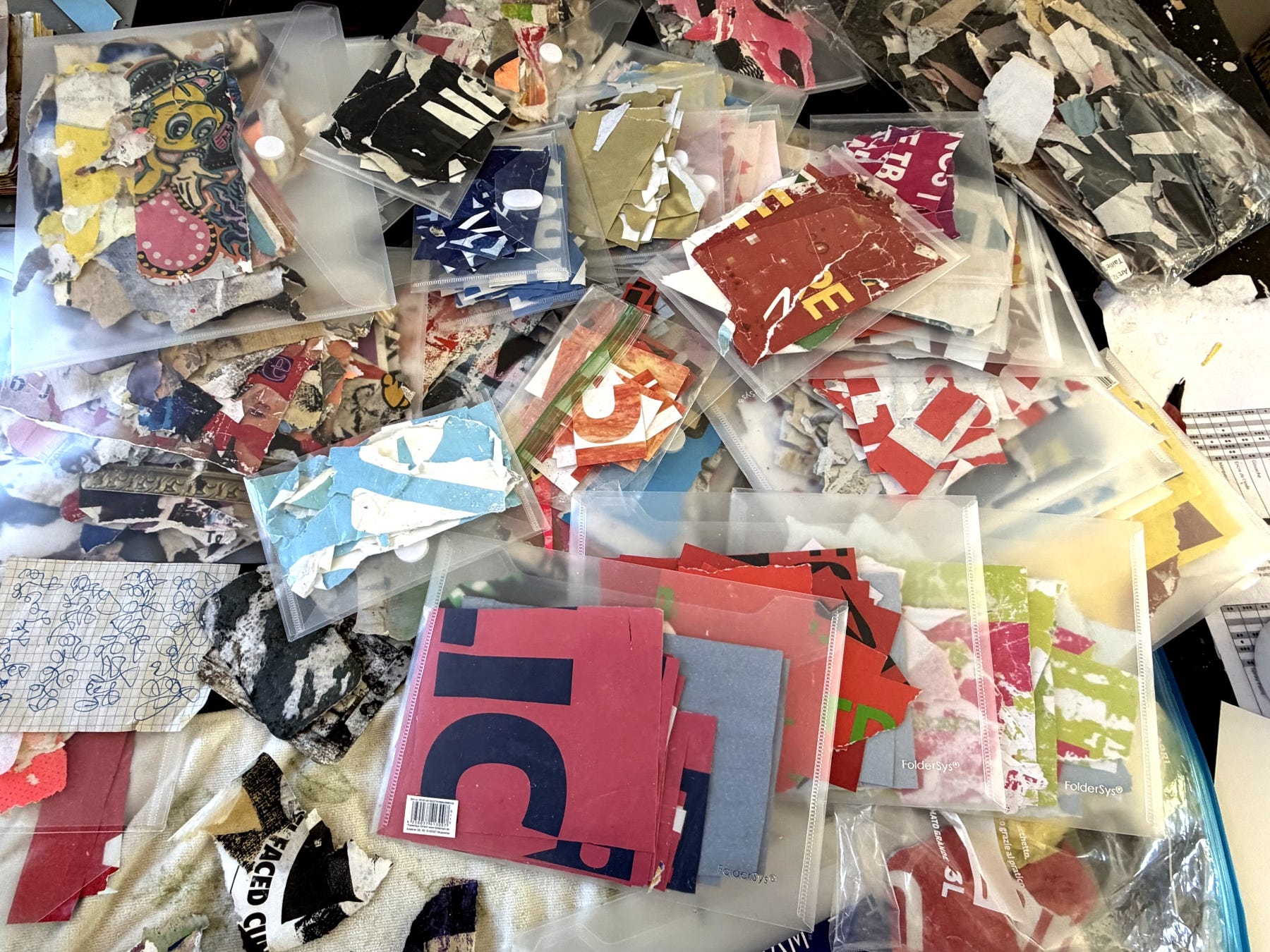
On a recent 49-day collage expedition through Europe and the UK, for example, I could begin a day knowing where I was sleeping that night and perhaps whom I intended to meet, but I could not possibly know what I would encounter or what the actual material of the day would be.
That was the point.
There is a particular quality of attention that develops when you travel this way. You aren’t merely passing through a place taking selfies in tourist locations. You are ‘at work’ in it.
The distinction has very little to do with whether you produce an artwork that day.
The work may simply be looking.
And collecting.
And having a conversation.
And getting lost.
May be sitting somewhere for an hour watching people pass by.
May be noticing one peculiar piece of typography painted on the side of a delivery truck.
You don’t necessarily know which experiences matter while you are having them. But it creates a texture or an insight that you carry with you and synthesize.
Every Artist Is a Collector
Collage makes this gathering process unusually visible because the physical fragments eventually appear in the work. But I suspect almost every artist operates this way.
Writers collect language.
Musicians collect sounds.
Photographers collect moments.
Painters collect relationships of color and form.
Filmmakers collect gestures, faces, locations and situations.
Poets collect peculiar conjunctions of words.
We collect conversations, mistakes, disappointments, jokes, memories, arguments, dreams, accidents and things somebody said twenty years ago that suddenly become useful this afternoon.
The artist is continually converting experience into material.
This does not mean that everything must immediately become art. That would be exhausting. It means that creative people develop a peculiar permeability to experience. The world gets in.
An Expedition Does Not Require an Airplane
There is a danger in talking about artistic expeditions because the word immediately conjures distant places.
Paris.
Berlin.
Bangkok.
Rome.
Some romantic landscape involving a notebook, an old Land Rover and an unreasonable quantity of dust.
But distance has almost nothing to do with it.
An expedition can begin when you walk out your front door.
You could spend an afternoon exploring three streets in your own city that you have never walked before. You could visit the industrial district instead of the museum. You could walk along an arroyo and collect visual forms. You could spend two hours photographing hand-painted signs or graffiti. You could ride a city bus to the end of its route simply because you have never been there.
An expedition is not defined by mileage but rather by intention and defined by attention.
This may be one reason artists sometimes discover extraordinary things in places other people describe as boring. The artist isn’t necessarily experiencing a more interesting world. The artist may simply be cultivating a relationship with the world by paying attention and taking interest in it.
Curiosity changes the experience of reality. The more closely you look, the more there is.
Bringing Something Back
Historically, expeditions were expected to return with something.
Specimens.
Maps.
Drawings.
Measurements.
Stories.
Objects.
Information about the territory.
The artistic expedition has its own version of this.
We return with evidence.
A folder of paper.
A notebook filled with phrases.
Five hundred photographs.
A recording. (for instance of the subway to Heathrow in London)
A sketch.
An introduction to someone we didn’t know before.
A new question.
A changed opinion.
Sometimes we return with almost nothing tangible and discover months later that the expedition altered the direction of the work.
Leaving Room for the Territory
There is another reason I like the idea of the expedition.
An expedition requires a certain amount of preparation.
You need equipment. You need provisions. You need some idea where you are going. You need enough organization to keep practical problems from consuming all your attention.
But at the same time if everything has already been determined, there isn’t much left to discover. The creative expedition therefore occupies an interesting territory between intention and uncertainty. You prepare yourself thoroughly enough to participate and remain open enough to be surprised.
This is also how I think about making art.
A blank canvas contains infinite possibilities, which is another way of saying that it contains no particular possibility or direction. The work begins by making the first move. That move changes the situation. The changed situation suggests another move and the conversation begins.
Eventually something appears that could not have been completely envisioned at the beginning.
An expedition works much the same way. You begin somewhere.
You encounter something. That encounter changes what is possible.
You proceed from there. One step after the other.
The World as Studio
The home studio is a base camp. It is where we return.
We spread our findings across the tables. We look at the photographs. We reread the notes. We sort the fragments. We remember the conversations. We discover relationships between things that seemed unrelated when we first encountered them.
Then the transformation begins.
Something picked up on a sidewalk becomes part of a collage.
The collage becomes the basis for a painting.
A conversation becomes an essay.
An observation becomes a story.
A photograph becomes evidence of something we didn’t realize we were investigating.
And eventually the studio fills again with work derived from encounters that could never have happened inside it. Then, sooner or later, we have to go back out.
This rhythm seems increasingly important to me:
Go out. Pay attention. Gather. Return. Make. Go out again.
The studio gives us concentration.
The expedition gives us collision.
We need both.
Because the artist’s raw material is never merely paint, paper, words, photographs, sounds or objects. Ultimately, the raw material is direct experience. And experience has to be encountered.
By traveling now and then to ‘parts unknown’ an artist gets the experience of seeing the world in a fresh way over and over again and an opportuity be surprised and to bring that adventure back to the studio.
So the next time you go on a trip make it into an expedition.
I love this essay! Has me thinking about the word/meaning of 'Gathering'. You said,"Gathering requires a different state of mind. It asks me to suspend judgment long enough to recognize possibility before I know its use." And I so relate to that statement. When I am thrifting for quality junk for my assemblages and am handling found objects.......there's such a deep connection to the act of fondling said object and what goes on in my mind about what it was/is, how I may end up using it now or later, why I need it, how precious it is to me once I own it and so on. To me such objects are true treasures to me, priceless, beautiful, and within itself has much to tell although so much of those past stories are locked away forever.....only for me to bring it new ones.