


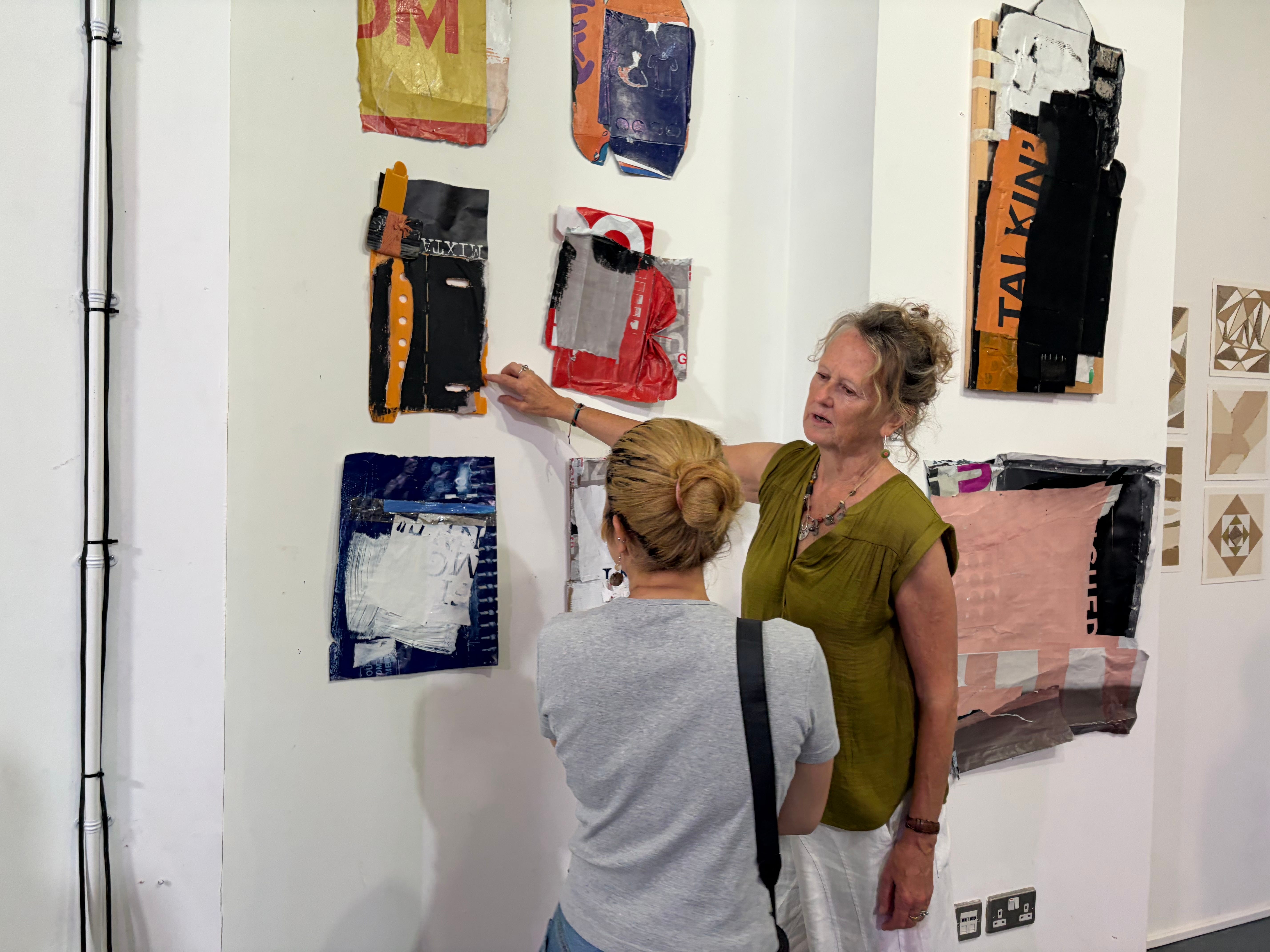
We have come to the end of the London expedition and have set up the exhibit. We calculate about 300 works were made this week by the 14 of us in the crew. It has been a great week of discovery, camaraderie and immersion.
Today, Sunday June 21, the longest day of the year, is the exhibition by a gathering of Big Names in the international collage art community. Don’t miss your chance to catch a plane, train, bus or limo to come rub elbows with the world renowned celebrities who have been excavating the walls and charity shops of London to offer a unique snapshot of the city in collage art. Everybody who is anybody will likely be there or wish they had been.
Here is a continuation of the last article.
The Artist and the Problem of Being Seen


If it is true that wealth and fame both carry hidden dangers, then artists face a peculiar challenge.
Most artists begin with an inward impulse. Something within them insists on making, exploring, experimenting, discovering. In the beginning there is often little thought of recognition. The work itself is enough. The act of making satisfies something fundamental. The studio becomes a place of solitude, discovery, concentration.
But sooner or later another question arrives.
What now?
The work accumulates. The walls fill. The shelves fill. The archive expands. At some point the artist begins looking outward and wondering how this body of work enters the world.
And this is where things can get tricky.
The artist gradually discovers that making art and building a public art life are two entirely different activities.
The first concerns the work.
The second concerns navigating the social structures surrounding the work.
Recognition enters the picture.
Sales and the market enter the picture.
Galleries, collectors, exhibitions, social media, publicity, reputation, positioning, branding, professional identity blah, blah, blah.
And quietly, almost without noticing, the artist may begin shifting from making the work they feel called to make toward making the work they believe will produce a certain outcome.
Approval by imagined others begins entering the studio.
Expectation of success or failure begins entering the studio.
The invisible audience takes up residence in the mind.
This creates one of the central tensions of the creative life.
The artist must eventually learn how to participate in the world without allowing the world to take possession of the work.
This requires a certain inner clarity.
It helps to remember that recognition is not the purpose of the work.
Recognition is simply one possible consequence.
Income is not the purpose of the work.
Income is one of the conditions that allows the work to continue.
Even reputation itself must be understood carefully.
A reputation is merely a story other people tell about you. It does not necessarily correspond to who you are or what your work actually represents to you.
The danger is subtle.
Once the artist begins constructing work around imagined reactions from others, the center of gravity shifts outward.
The artist begins living inside projected assumptions.
What will people think?
Will collectors like this?
Will this strengthen my position?
Should I repeat what has sold before?
Will this increase visibility?


And without realizing it, one begins organizing one’s life around maintaining an image rather than pursuing discovery.
The artist has quietly become an employee of their own reputation.
There is another possibility.
An artist can consciously decide that the primary responsibility is to remain in right relationship with the work itself.
But this raises an important question.
How does an artist know what “right relationship” actually means?
Every artist is different.
Some seek beauty.
Some seek truth.
Some seek experimentation.
Some seek cultural influence.
Some seek spiritual inquiry.
Some seek mastery of craft.
Some simply feel compelled to make because making itself feels inseparable from being alive.
Because artists pursue such radically different aims, each artist must eventually identify what serves as their own internal orientation point.
Their north star.
A north star is not a goal in the conventional sense.
It is not fame.
It is not money.
It is not recognition.
It is the deeper principle that helps the artist determine whether they are moving in alignment with what matters most.
For one artist, the north star may be honesty.
The commitment to making only what feels deeply true.
For another, it may be curiosity.
The desire to continually explore unknown territory regardless of outcome.
For another, it may be service.
Using art as a means of contributing something meaningful to others.
For another, it may simply be freedom.
Protecting the ability to create without compromise.
The important thing is not what the north star is.
The important thing is knowing that it exists it is a point of orientation.
Without one, the artist becomes vulnerable to external forces.
Markets begin dictating decisions.
Audience expectations begin shaping choices.
Trends begin replacing instinct.
The artist slowly loses orientation.
But when the artist understands their north star, decisions become clearer.
Should I pursue this opportunity?
Does it move me closer to what I fundamentally value?
Should I make this work?
Does it reflect what I actually care about?
Should I accept this compromise?
Will it preserve or distort the deeper reason I began making in the first place?
The north star becomes a form of internal governance.
It allows the artist to engage with the world while remaining anchored internally.
This requires thinking differently about success.
Success may simply mean constructing a life that allows uninterrupted continuity of practice over decades.
Success may mean reducing dependency on systems that force compromise.
Success may mean living modestly enough that one retains freedom.
Success may mean building relationships with collectors, galleries, and audiences while understanding that these relationships support the work but do not define the work.
In this sense the artist must become a strategist of lifestyle.
The question is no longer simply how to make art.
The deeper question becomes how to construct a life in which art can continue indefinitely.
This often requires confronting one’s own assumptions.
Many artists secretly carry inherited ideas about success.
The fantasy of recognition.
The fantasy of discovery.
The fantasy of sudden arrival.
The fantasy that external validation somehow confirms internal worth.
But perhaps the wiser artist understands something simpler.
The work itself is the center.
The process itself is the path.
The real achievement is not becoming known.
It is becoming capable of sustaining one’s practice across an entire lifetime.
After all, what does the artist actually want?
To become famous?
To become wealthy?
Or simply to remain free enough to continue doing the work that gives meaning to one’s existence?
These are not the same thing.
Perhaps the healthiest position is this.
Let the world do what it will.
Let people think what they think.
Let markets rise and fall.
Let reputation take whatever shape it takes.
Meanwhile, return quietly to the studio.
Protect the conditions of practice.
Remain loyal to the work.
Remain loyal to the principle that guides the work.
Build a life spacious enough that external forces do not distort internal direction.
In the end, the artist must understand something very few people understand.
You are not building a career.
You are building a way of being.
And the work is simply the visible trace of that life being lived fully.
These two articles are uncannily timely for me. Recently, I've realized letting external validation enter your mind as a motive for the work is to engage in a form of gambling. The reaction of others is a variable reward. Unfortunately, with the way our neurological reward system is built (dopamine, etc.), it can be insidious, addictive, and ultimately a distorting and ruinous force.
That's one reason to limit social media, too, since many such platforms manipulate this reward system subtly with how the algorithm grants and withholds exposure.
Holy cow, Cecil. Gonna have to put a little shrine together to meditate on these Touchon truths. 🔥⚡️