


It is election year folks. There is a lot at stake. It feels incumbent upon me as a citizen to point out a few things for my fellow citizens to consider when it comes time to exercise our duty as citizens to vote in the upcoming election.
I will be posting an occasional article on the topics that seem most concerning under the moniker of General John Quincy Public. I hope you will indulge me.
The Armed Forces’ Unarmed Commander: The Constitutional Paradox of 2025
By General J.Q. Public
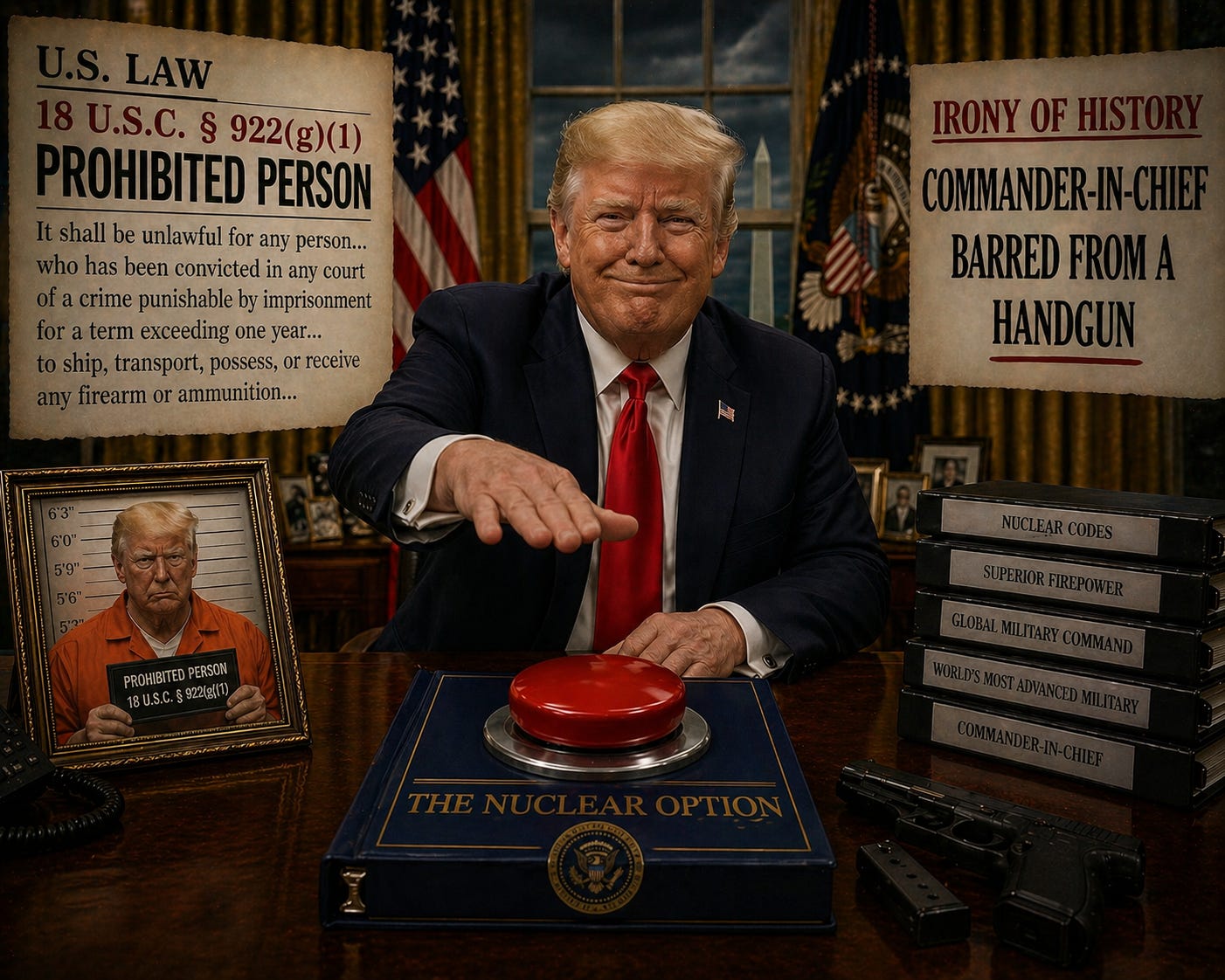
In the annals of American history, we have seen presidents who were former generals, presidents who were pacifists, and presidents who never served a day in uniform. But as of January 2025, the United States entered a legal twilight zone: for the first time, the Commander-in-Chief is a person who, under federal law, is a “prohibited person” barred from so much as holding a handgun.
The irony is as thick as a legal brief. Donald Trump, a man who now oversees the most powerful nuclear triad on Earth and the world’s most advanced military, would technically trigger a felony investigation if he were caught holding a Secret Service agent’s sidearm at a campaign rally.
The Legal Firewall vs. The Red Button
Under the Gun Control Act of 1968, a felony conviction—like the 34 counts handed down in New York—strips an individual of the right to possess firearms or ammunition. Federal law makes no “Presidential Exception.” If any other felon were found with a weapon, they’d face years in federal prison.
Yet, Article II of the Constitution designates this same individual as the Commander-in-Chief. This creates a bizarre cognitive dissonance:
The Individual: Cannot legally purchase a hunting rifle for his own estate.
The Office: Can authorize a drone strike, deploy the 101st Airborne, and verify the launch codes for a Minuteman III missile.
Legal scholars call this a “constitutional override.” The presidency carries inherent powers that federal statutes (like gun laws) generally cannot touch. However, the optics are unprecedented. How does a nation reconcile the idea that a man is “too dangerous” to own a pistol in the eyes of the law, but “stable enough” to manage 3,700 nuclear warheads?
The Burden of the Badge
Beyond the weaponry, there is the question of the “well-being of the general public.” The presidency isn’t just about the military; it’s about being the nation’s “Chief Law Enforcement Officer.”
There is a profound tension when the person at the top of the DOJ hierarchy is technically restricted by the very laws that department is sworn to uphold. It raises a fundamental question of legitimacy: If the President is a “prohibited person,” does that undermine the moral authority of the federal government when it prosecutes others for similar violations?
A Stress Test for the Republic
We are currently watching a live stress test of the American “Rule of Law.” Supporters argue that the will of the voters—who elected a convicted felon—supersedes the statutory restrictions placed on that individual. Critics argue that the presidency is being used as a shield to bypass the consequences that any other citizen would face.
As the administration continues to push the boundaries of executive power, the firearm ban remains a symbolic reminder of a divided reality. One half of the country sees a leader persecuted by a system he now commands; the other half sees a commander who is legally unfit for the very tools of defense he oversees.
In 2026, the question isn’t just whether the President can hold a gun. It’s whether the laws of the land still apply to the person who signs them into being.
The “Crime Spree” Allegations: Collusion and Corruption
Critics and watchdog groups, such as Campaign Legal Center and CREW, have detailed a pattern of behavior they describe as a coordinated effort to dismantle the rule of law.
Mass Retaliatory Firings: The administration has carried out “illegal mass terminations” of career civil servants and FBI officials, which multiple lawsuits allege were politically motivated attempts to remove oversight.
Shadow Administrators: Court filings have surfaced allegations that federal agencies like FEMA are being unofficially run by outside contractors who are themselves under ethics investigations, bypassing standard government accountability.
Self-Profiteering: Reports indicate the President has pocketed an estimated $3 billion from his business enterprises since returning to office, often from foreign entities seeking favor, which critics label as unprecedented presidential profiteering.
DOJ Interference: The Department of Justice has faced complaints for dropping thousands of investigations into corporate misconduct while instead prioritizing “revenge” prosecutions against former political adversaries like James Comey.
Unconstitutional Acts and Legal Defeat
The administration’s aggressive use of executive orders has led to a record-breaking number of legal challenges—over 530 lawsuits in 2025 alone—with several significant rulings against the government:
National Guard Federalization: In Trump v. Illinois, the Supreme Court ruled 6-3 that the President lacks the authority to federalize a state’s National Guard without meeting strict statutory requirements.
Impoundment of Funds: Federal courts have repeatedly found the administration’s freezing of billions in Congressionally approved funding (for programs like the National Electric Vehicle Infrastructure and NIH grants) to be illegal.
Alien Enemies Act Abuse: Attempts to use the 1798 Alien Enemies Act for summary deportations outside of a declared war were blocked, with the Fifth Circuit ruling the administration failed to meet legal requirements.
Birthright Citizenship: The executive order attempting to end birthright citizenship has been met with multiple preliminary injunctions from federal judges who have ruled it likely unconstitutional under the 14th Amendment.
The Maga/Republican “Cabal” and Accountability
The current administration is comprised of high-ranking Republican officials, including Vice President JD Vance, Attorney General Pamela Bondi, and FBI Director Kash Patel, who have consistently defended these actions as “driven by law”.
When the government were to change hands, and it will, proponents of legal accountability argue that the Department of Justice would be tasked with investigating these acts. Proponents suggest this wouldn’t be a partisan “revenge tour” by the democrats but a necessary return to and application of law and order to address what they perceive as a “criminal cabal” that used the presidency and the federal government at large as a shield for a wide-reaching conspiracy against the people of United States (and the whole world for that matter).