


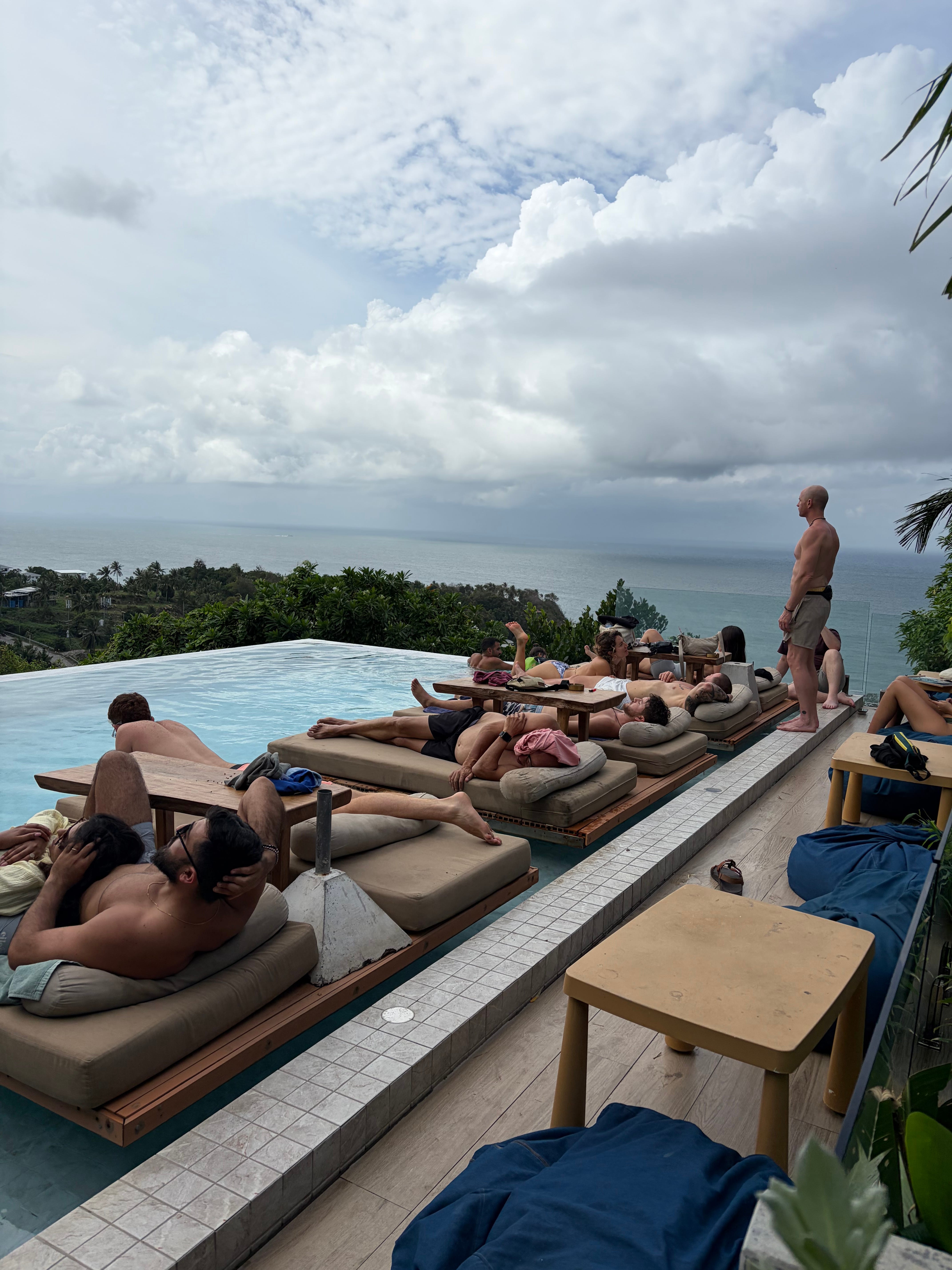
Vacation Mode as a Creative Practice
Having returned from a week long Collage Expedition in Los Angeles with Les Jones followed by a fifteen day trip to Thailand with my son Zach and then coming back to the studio and then hearing, ‘I wish I was still on vacation in Thailand. Now it is back to the grind.” Myself, I don’t feel this way, I am always on vacation.
I would suggest to artists that they stop waiting for the conditions that feel inspiring and begin cultivating the inner posture they associate with being away on vacation. Many people believe creativity blooms only when they are in a romantic place, somewhere like Thailand, where time feels looser and the senses seem more awake. But that state is not produced by geography. It is produced by orientation.
Vacation mode is a way of inhabiting the day. It is the feeling that there is time, that the world is not closing in on you, that you are allowed and have time to notice things. When you go to work, you could do it as if you were going to the beach, the body relaxes. The mind opens. Attention widens. This is not fantasy or denial. It is a practical adjustment is attitude, in how you meet the day. Mentality taking the rat race out of it. Developing inward calm instead of anxiety.
For artists, this orientation matters. The creative life is not built on occasional peaks of inspiration. It is built on daily contact with experience. When you treat everyday life as the site of the adventure itself, the adventure follows you everywhere.
The truth is that the whole planet is a small island village in the middle of the vast ocean of space. Every place is equally strange and equally familiar. Every place contains beauty, boredom, friction, and surprise. Work and rest are not opposites. Neither are joy and difficulty. They are all part of the same field in which creative life unfolds.
An artist who learns to live this way – as if a foreigner on vacation - inspiration does not depend on retreats, residencies, or perfect conditions to feel alive in their work. They carry the climate with them. The walk to the studio, the trip to the hardware store, the conversation overheard at a café, the quiet moment before sleep. All of it feeds the creative life.
Living creatively is not about escaping life. It is about entering it more fully. Once that orientation settles in, everything becomes usable. Everything becomes material. Everything becomes part of the long adventure of making a life through art.
Building a Buffer Between You and the Wolf
The thing about being on vacation is that you have already set the conditions in advance. You did all of the research, set a budget, saved your money, bought your tickets, packed your bags and all the rest. But you could do the same thing with your everyday life.
One thing an artist knows too well is the feeling of the wolf at the door. Bills arriving in their steady rhythm. Rent sitting like a mousetrap on the calendar. The long monthly churn of obligations. Nothing drains creative energy faster than the background hum of financial anxiety. It scatters attention, tightens the mind, and makes every decision feel reactive.
Just like a vacation, a creative life needs room to breathe. It needs space between you and immediate economic pressure. Without that breathing room, the mind becomes preoccupied with survival rather than exploration. Many artists mistake this for a personal failing, as if they should simply be tougher or more disciplined. In reality, the problem is structural. The psyche cannot relax into deep work while the ground feels unstable.
The solution is to create a economic buffer. A small, reliable margin that separates the present moment from the next bill. This buffer changes everything. It gives the nervous system a chance to settle. It allows the inner life to expand again. It creates a sense of time. Doing this one thing is transformative.
For some artists, the buffer is a modest savings account that covers a few months of living expenses so that you are not in a constant scramble every month. For others, it is ongoing part-time work that provides a predictable baseline. Some build it through multiple income streams, each small on its own but steady together. The form matters less than the effect. The goal is to reduce urgency and restore spaciousness.
Once the buffer exists, even in a small form, something subtle shifts. The future stops clawing at the mind. Attention becomes available again. Ideas that were hiding behind stress begin to surface. Studio time becomes a place of inquiry rather than a battlefield.
This buffer is not only financial. It is also psychological. It comes from learning to live within a rhythm that is sustainable. Many artists ruin themselves by swinging between extremes. Months of hustle followed by months of collapse. A healthier approach stays closer to the middle. Regular practice. Regular income. Regular rest. A stable life that still leaves room for the unpredictable nature of creation.
The buffer is a gift you give to your future self. It is a way of saying that your creative life deserves continuity, not crisis. It is also an act of respect toward your own vocation. No one can do their best work while under constant threat.
A little margin, consistently maintained, is enough to shift the entire atmosphere of your days. Once that happens, the wolf loses its teeth. It becomes a distant figure rather than a constant barking and growling presence. And the artist can return to the studio with a clear mind, a calm heart, and the time required to make something worth making.
Dealing with the Economics
1. Building Multiple Streams of Creative Income
One of the most stabilizing moves an artist can make is to develop more than one source of income. A single stream creates fragility. It asks too much of any one opportunity. A creative life becomes more resilient when several channels flow at once, each contributing its part. None of them must carry the whole weight.
These streams do not need to be large. In fact, the most reliable structure often comes from many small tributaries. A modest print shop. A few teaching gigs. Occasional commissions. A newsletter. A small body of works available at lower prices. Consulting, mentoring, design, editing, licensing. Each one modest, each one steady, each one creating a small ring of protection around the studio.
This mosaic of income allows the artist to move through the year with less fear. The pressure spreads out. The wolf does not find an easy entry point. When one stream slows, another may pick up. When all of them hold their line, the artist feels a kind of quiet confidence.
The benefit is not only financial. This structure cultivates a sense of agency. It interrupts the illusion that one must wait for a single lucky break. Instead, it affirms something truer. A creative life is built by many sustained efforts that grow together. When designed wisely, these streams nourish both the artist and the work itself.
But a word of warning. Maintain the central focus which is the studio and the creative life. Do not confuse a successful enterprise with being your main career. This can obscure the artist’s root intention of living out their creative life and soon all of your energy can get misdirected into the side projects that are only intended to support your creative life. Unless, of course, you realize that the successful enterprise was actually what you wanted to do all along once you discovered it and became successful at it. In which case, don’t look back.
2. Budgeting Without Strangling the Imagination
Many artists flinch at the word “budget.” It sounds like a cage. It feels like a constraint placed on a mind that wants to roam. But a good budget is not a cage. It is a boundary that protects your attention.
The point of budgeting is not to reduce life. The point is to simplify your field of activity so the imagination has space to expand. A stable foundation supports the wandering mind. It keeps the floor from falling out.
A creative budget works differently than a corporate one. It does not ask you to squeeze every penny. It asks you to understand your rhythm. How much it truly costs to live your life. How much time you actually spend in the studio. How much energy you expend when you overwork. A budget for an artist is not about denying yourself. It is about clarity and about knowing your limits.
Think of it as a framework for the year. Enough saved to cover the lean months. Enough room for experimentation. Enough honesty to know where money leaks out of your life unnoticed. Once this picture becomes clear, relief enters. You stop negotiating with yourself every day. You stop wondering whether you can afford to take time off or buy materials. You know. And knowing frees you.
The imagination breathes more easily when the practical world is in order. This is one of the great paradoxes of artistic life. Stability does not crush creativity. Stability strengthens it.
3. Designing a Long-Term Economic Ecosystem for Your Studio Practice
A mature artistic life is supported by an ecosystem. Not a hustle, not a scramble, but a living system that grows slowly and endures. This ecosystem is unique to every artist because it arises from the nature of the work itself.
At its heart is the studio. Everything flows outward from that room. The work, the ideas, the writings, the conversations. The goal is to create a structure in which the studio is continually nourished by the world and in which the world is continually nourished by the studio.
The ecosystem includes the people who support the work. Collectors, galleries, students, readers, collaborators. It includes the platforms that carry the work into the world. A website, a newsletter, social presence, exhibitions, publications. It includes the long loop of creation and distribution. Making, sharing, selling, reinvesting, expanding, resting, beginning again.
Most of all, it includes time. A studio practice is not a series of emergencies. It is a long cultivation. Years of patience. Decades of return. An ecosystem thrives when no single moment is asked to carry the weight of the whole story. A slow, steady accumulation of works builds the ground beneath you.
As the ecosystem matures, the need for panic decreases. The wolf recedes. Stability grows. And the artist begins to feel something precious. A sense that the work has a life of its own. A sense that the creative path is not only possible but sustainable.
This is the architecture of a long life of art. A thoughtful arrangement of resources, relationships, habits, and internal practices that support the work without overwhelming it. Once this ecosystem is in place, the artist can walk into the studio each day with a calm mind and an open horizon.
Questions That Build a Practical Strategy for the Creative Life
A stable creative life begins with honest inquiry. Not grand plans, not heroic vows, but a set of clear questions asked without flinching. When these questions are answered with sincerity and precision, a workable strategy begins to appear. The goal is not perfection. The goal is alignment between your life and your art.
Here are the questions:
What are the true costs of my life each month, stripped of fantasy and wishful thinking?
How much time do I need for deep studio work each week in order to grow?
How many hours of outside work or income generation can I sustainably manage without thinning the creative life?
What are the income sources I can rely on right now, even if they are small?
What additional income sources could be added with modest effort or minimal disruption?
Which skills do I already possess that could generate creative income?
What simple offerings could I create that would allow people to support my work at different levels?
Which expenses genuinely nourish my practice and which ones quietly drain it?
Where is money leaking out of my life unnoticed?
How many months of stability would a financial buffer need to cover for me to feel ease?
What structure could I put in place to build that buffer slowly and steadily?
What parts of my practice can be systematized so they demand less emotional energy?
Who are the people already connected to my work and how can I deepen those relationships?
What platforms or paths carry my work most naturally into the world?
What platforms or paths feel forced, joyless, or unnecessary?
How can I create rhythms that stabilize my energy across the entire year?
What predictable cycles do I experience each season and how can I design around them?
Which parts of my life create stress that could be reduced by small, practical changes?
What truly matters to me as an artist and what can I let go of without losing anything essential?
What is the simplest version of a sustainable creative life that I could begin building today?
These questions form a map. Each answer reveals a piece of the landscape. Each insight becomes a step. A strategy built in this way is grounded. It grows out of your actual life rather than an idealized vision. It takes into account your limits, your strengths, your rhythms, and your aspirations.
You can use each one of these questions as a search term on the internet and get some general answers that will give you a fast start.
When the questions are answered patiently and in writing, a surprising thing happens. The path becomes visible. The wolf steps back. The mind relaxes. And the creative life begins to feel less like a precarious balancing act and more like a walk you can take for the rest of your days.
Remember, Life is Just a Big Adventure
Just like figuring out how to cover yourself on vacation or how you are going to make your next artwork, what you will need, how you are going to go about it, what you want it to look like when it is complete, you can approach your creative lifestyle with the same curiosity and experimentation. The same instincts that guide you in the studio can guide you in building the life that surrounds the studio.
Artists already know how to improvise. They know how to adapt when the material behaves differently than expected. They know how to solve problems in real time by staying attentive. They know how to ask questions. This same intelligence applies to your economic and practical life. It simply requires turning the same quality of attention toward the structure of your days.
Think of your life as a long work in progress. A piece that shifts with each season. A composition made of choices, habits, and resources. You can revise it. You can adjust the balance. You can introduce new elements and retire old ones. You can strip it down or build it up. You can test different strategies, observe what supports your art, and discard what does not.
When the creative lifestyle is approached this way, everyday life stops feeling like a burden. It becomes part of the larger practice. The same curiosity you bring to color, line, texture, or form can be brought to money, time, energy, and structure. Instead of dread, you feel inquiry. Instead of anxiety, you feel possibility. It is a puzzle to figure out.
The artist who treats life as a creative medium discovers a quiet freedom. Problems become experiments. Obstacles become puzzles to solve. The larger pattern becomes visible. You begin to understand that the conditions of your life are not fixed. They are workable. And as they shift, the work itself deepens.
I often say I retired from gainful employment in my early thirties. Meaning I never held a job working for others for a paycheck since that time. Instead, I became an entrepreneur forming my own small businesses to help generate income. But beyond traditional employment (gainful work for others) and entrepreneurship (starting your own business), other paths include freelancing/gig work, consulting, social enterprise, portfolio careers (mixing roles), non-profit work, and focusing on passion projects/creative pursuits that generate income, offering varied levels of freedom, risk, stability, and purpose, often blending elements of both traditional paths.
This is the heart of it. Build your life with the same spirit you bring to your art. Let curiosity lead the way. Let the slow evolution of your days become part of the studio practice. A life shaped with intention becomes a container for decades of work. And once that container is sound, the creative journey becomes far more spacious, far more sustainable, and far more joyful.
And remember, life is just a big adventure if you approach it that way.
The last 3 years of when I was working at the bookstore, I was part time and only worked 3 days a week yet still had my full med. insurance. I rarely took a vacation day since I had 4 days of not working there and besides, I really loved my job so it was an ideal setup. Since I've been retired for the last almost 6 yrs, the freedom feels as if I'm on a permanent vacation and have all the time I need to do what I want/need to. Working in the studio on creating my art is such a joy for me and just plain living day to day is a blessing for me. Excellent article, Cecil. I wish everyone was able to just do what they want, when they want and have that freedom from financial worry.
Excellent piece to share and save, thank you.