


A Quiet Act of Hope

Here is a little article developed from a response to a comment by Sunshine to the article On Working Without an Audience.
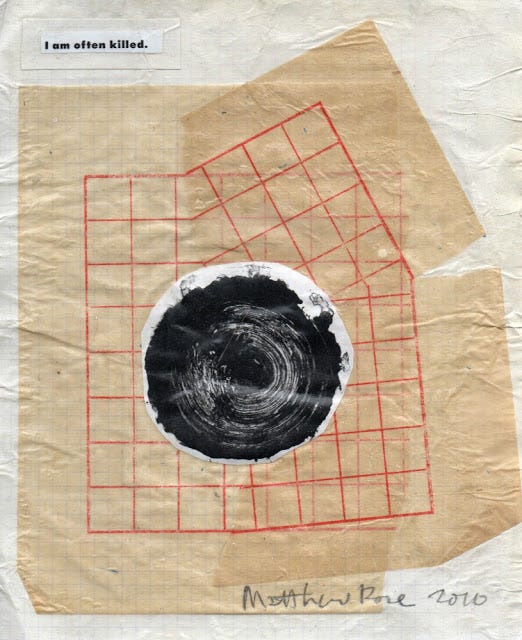
Commenting on the previous article A Quiet Act of Hope, Matthew Rose said:
There’s a parallel to working quietly for a future that might never come, for a world that might never exist - for a humanity that might deploy a scenario that wipes itself out - in what we do for helpless children, older folks suffering dementia or too aged to understand; picking up trash on streets or a bicycle that’s fallen over, or like that kind and smart person who discovered my studio keys outside my door and put them on a ledge for me to discover, untouched and visible, the next day.
Making art is clearly one of the strangest things humanity has fixed on. My thinking has always been “I’m making this to see what it looks like.” But in reflecting on your text I’m a bit more aware that the chasm yawning from creation to perception, whether my awareness or any future audience’s awareness reminds me of how this world got built. As if no one was looking. Matthew Rose
My original response:
That is kind of our joint clandestine project right? Rebuild the trail to the future while nobody is watching through all of the little inconsequential things we do and say, the trail markers we leave behind and how we shape our way of being in the world. Peace starts with peaceful people. Slowing down and becoming inwardly peaceful and aware and listening is a discipline we develop as an ecological signal. We also develop and grow into freedom and dignity and agency. Like Agnes Regina is working on in the story I am telling. Together we shape the general mind world everyone lives in and WILL live in just as we live in the world of our predecessors. What future are we building and pointing toward? Whoever is alive in the present decides. The present is the beachhead of our campaign. We are the Avant guard. Own it. Take the beach. Establish the basecamp of the future.
The following is a more developed essay you might enjoy.
Rebuilding the Trail to the Future
Journal Entry: January 14, 2026
Rebuilding the trail to the future while nobody is watching. That our joint clandestine project, whether we name it that way or not. Not through grand announcements or formal movements, but through the small, seemingly inconsequential things we do and say. Through the trail markers we leave behind without thinking too much about who might notice. Through the way we shape our manner of being in the world, day by day, gesture by gesture.
The future is rarely built in public view. It is assembled quietly, almost invisibly, in kitchens, studios, workshops and laboratories in conversations between friends, in how we listen rather than how loudly we speak. What looks insignificant in isolation accumulates. Over time, these fragments cohere into a direction, a sensibility, a way forward that others eventually step into without knowing who first cleared the brush.
Peace, for example, does not begin as a policy or a treaty. It begins with peaceful people. That is not a slogan but a discipline. Slowing down. Becoming inwardly calm enough to notice what is actually happening. Learning to listen, not as a social courtesy, but as a practiced form of attentiveness. This kind of inward work sends an ecological signal outward. It changes the atmosphere around us. It alters what feels possible in a room, in a community, in a culture.
At the same time, we are not only cultivating peace. We are cultivating freedom, dignity, and agency. These qualities do not arrive fully formed. They are learned, practiced, grown into. They develop through use, through responsibility taken rather than shrugged off. As individuals do this work, something collective begins to form. A shared mental landscape. A general mind world that others inhabit without realizing it was shaped by human hands and small intentional choices.
We are always living inside the world built by our predecessors. Their assumptions, their fears, their courage or lack of it, their unfinished business. In the same way, others will live inside the world we are shaping now. The question is unavoidable: what future are we building and pointing toward? Not in theory, but in practice. Not someday, but now.
Whoever is alive in the present decides. There is no neutral ground here. The present is the beachhead of the campaign, the place where possibility first makes landfall. This is where the future either takes root or is quietly foreclosed. Those who understand this find themselves, whether they asked for it or not, in an avant-garde position. Not the avant-garde of fashion or provocation, but of orientation. Of direction.
Own it. Take the beach. Establish the basecamp of the future, not with banners, but with habits. With ways of speaking. With ways of caring. With the courage to act as if what you do matters, even when no one is applauding.
What remains true in the end; There are those who do. And then there are all the rest who watch them do it.
So, how to go about that work…
Among other things it would be to develop listening, attentiveness, generosity, and hospitality. That is the work and artists already have a leg up on these qualities. These are cultivated capacities, learned over time through repetition and intention. Listening, in this sense, is not waiting for one’s turn to speak. It is learning how to make space for what is emerging, for what has not yet found its words. Attentiveness is the quiet skill of noticing patterns, needs, and tensions before they harden into problems. It requires patience and a willingness to stay present even when nothing dramatic seems to be happening.
Generosity follows naturally when attention deepens. It is not a matter of abundance versus scarcity so much as orientation. Generosity arises from recognizing that we are already embedded in a shared field of life, that what we give circulates back in altered forms. Hospitality extends this recognition outward. It is the practice of making room for others, not by erasing difference, but by holding diversity with care. True hospitality does not demand sameness. It offers a threshold and says, you may enter as you are. It is to develop the practice of being a good host and practicing how to be a good guest.
To be stewards of our immediate surroundings is to take responsibility for the small radius we can actually influence. The home, the studio, the neighborhood, the workplace, the local commons. Stewardship is a form of love expressed through maintenance. It asks us to tend what has been entrusted to us, whether or not we will be the ones who benefit most in the long run. It is to watch over things. Not intrusively or in a judgmental or controlling way. It is not a power play. Just to be aware and available. It is an ethic of harmonious continuity rather than extraction of value.
And then there is the work of gardening community. Not managing it, not branding it, but gardening it. This means preparing soil, planting carefully, protecting what is young, pruning and pulling weeds when necessary, and understanding that growth happens in seasons. Some years are for flowering, others for composting what did not work.
Community, like any living system, thrives on care rather than control. It grows through shared work, shared meals, shared stories, and shared silence. It requires time, trust, and the willingness to stay when it would be easier to turn away. Gardening community is slow work, often invisible work, but it is precisely this kind of work that establishes the basecamp of the future.
To paraphrase JFK; “Ask not what your community can do for you, ask what can you do for your community.”
This is how the trail is rebuilt. Not all at once, and not by decree. It is rebuilt through people who choose to listen deeply, act generously, welcome others, have concern for others, tend what is near at hand, and commit themselves to the long view. These are the quiet architects of what comes next. The ones who do not wait for permission or for someone else to start. The ones who understand that the future does not arrive fully formed. It is grown from the ground up, from the very ground they are standing on.
