


On the Moment of Beauty
There is a familiar phrase that circulates whenever the subject arises, as if it were sufficient explanation: beauty is in the eye of the beholder. It carries a certain truth, but it also stops just short of something more interesting. It suggests that beauty is subjective, which it is, but leaves unexamined the deeper question of how that subjectivity moves, shifts, and reveals itself over time.
What becomes apparent, if one pays attention, is that our sense of beauty is not fixed. It does not sit still, waiting to be consulted. It migrates.
Our sense of beauty moves through us the way weather moves across a landscape - forming, dissolving, returning in altered conditions. What we find beautiful today might have gone unnoticed yesterday. What once held our attention may fall away, only to return years later with a new kind of clarity. There is a continuous repositioning taking place between ourselves and the world.
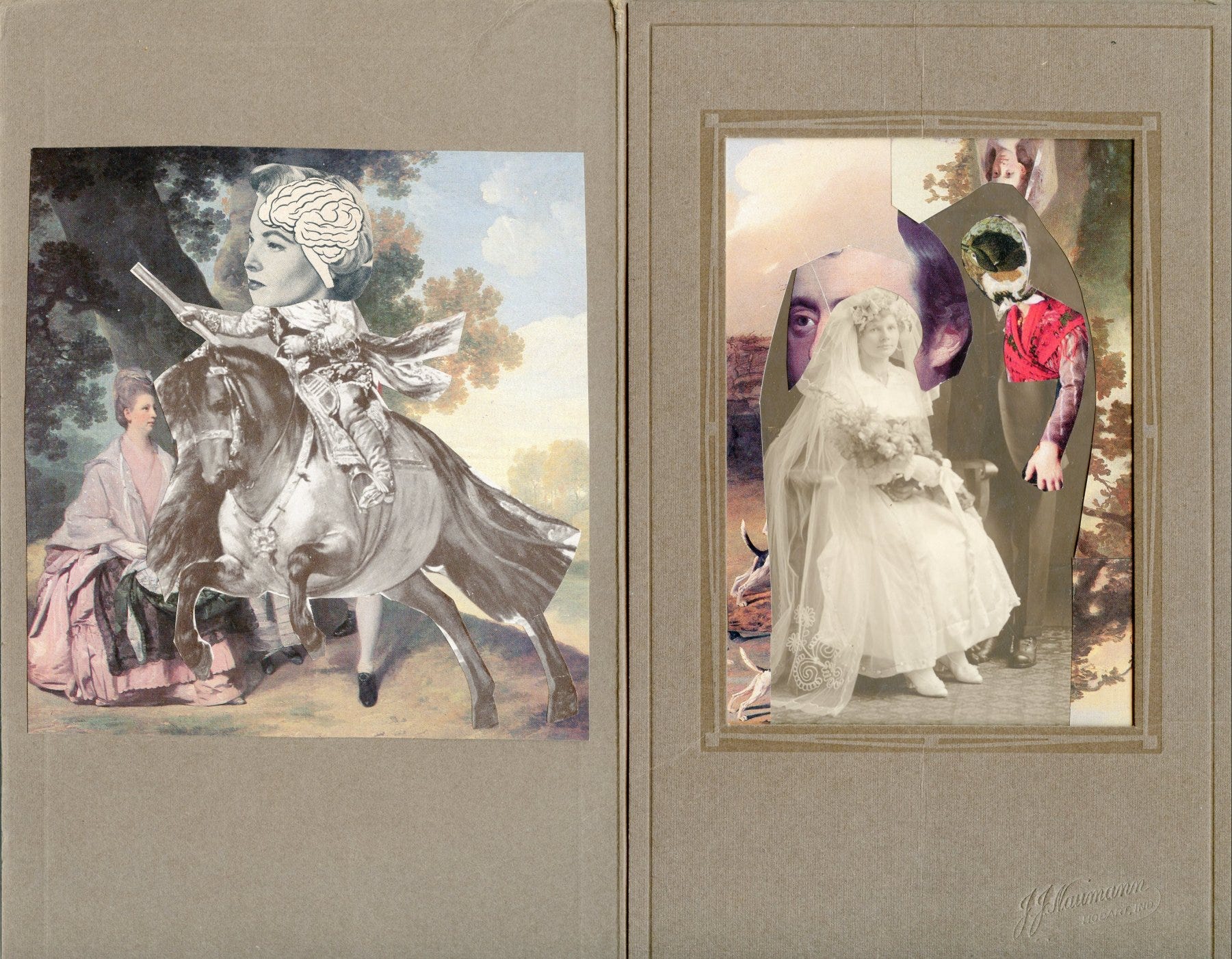
I began to understand this more clearly during the years when the archive was more publicly accessible, when artists would come in and spend time moving through drawers of collages, objects, assemblages, fragments of other’s lives and sensibilities. At first, I assumed the role of quiet curator, believing I had some sense of which works carried weight and which did not. But that assumption began to dissolve in the presence of others.
I remember one artist in particular. She moved through the drawers with a kind of searching attention, then paused, lifted a piece, and held it with unmistakable recognition. There was no hesitation. She had found something that spoke directly to her.
It was a work I had never considered especially compelling.
That moment rearranged something for me. It revealed that whatever hierarchy I had formed in my own mind was only that - mine. It had no authority beyond the boundaries of my own experience. What I might pass over could be, for someone else, the very center of their inquiry.
From that point forward, the idea of curating taste for others began to feel misplaced. Each person arrives with their own internal conditions - their history, their emotional state, their current line of questioning, their sensitivities, their readiness. These conditions determine what can be seen, what can be felt, what can be recognized and what will be ignored.
And these conditions are not stable.
They are in motion, constantly adjusting. One might call it a continuous migration of aesthetic interests. It begins anywhere and moves without any fixed destination. Training influences it, yes. Exposure refines it. Practice deepens it. But there remains an element that cannot be predicted - the moment of encounter itself.
This is where the question of a “universal beauty” begins to shift.
Perhaps the universal aspect is not located in specific objects or forms, but in the capacity for beauty to be revealed at all. Not everything appears beautiful at all times, but anything might, under the right conditions.
Take for example a decomposing rabbit found along a walking trail - carries this paradox clearly. There is sorrow present, even revulsion perhaps, yet also a compelling arrangement, a quiet gravity, a form of alignment that arrests attention. The emotional response is not singular. It is layered, even contradictory. Still, something within that moment insists on being seen, held, even preserved.
It suggests that beauty is not merely decorative or pleasant. It is an event of recognition. Something aligns - perception, feeling, form - and in that alignment there is a sense that this matters, even if we cannot say why nor feel the need to.
At times, this recognition moves us beyond language. Tears arrive without explanation without need of justification. It is complete in itself.
And yet, it remains contingent, depending on timing, context and circumstance. On openness. On the subtle readiness of the one who encounters it. The same object, seen under different conditions, may remain entirely mute.
So the question returns in a slightly altered form.
Is there a universal truth to beauty?
It may be that the only universal truth is this: the potential to experience beauty is everywhere. It is not distributed selectively or according to some standard. It does not belong to certain categories of objects or experiences. Rather, it waits in all things, requiring only the meeting of the right moment, the right attention, the right internal state.
Beauty, then, is less a property and more an encounter.
A crossing point between the world and the one who perceives it.
And because both are in motion, that meeting is never fixed. It is always arriving, always passing, always available again under new conditions.
In this way, the search for beauty becomes less about finding the right objects and more about refining one’s capacity to experience them.
To be present enough. Open enough. Attuned enough.
To arrive at the right moment, when the confluences of these circumstances converge with the encounter.
The migration of aesthetic interests is also discussed in the following essay
A Leaf on a Tree

A couple of weeks ago I posted the article Typographic Abstraction and in the comments Ester Feske wrote the following.
Be a part of the Coffee Club for random ‘coffee house style’ conversation about almost anything that comes to mind just for Coffee Club supporters. And check out the new shop! Click the button to check it out.

Sometimes when I feel the need to be stimulated in my soul and mind, I'll purposefully look for beauty in places that are not right away obvious to me or anyone. It could be in someone's face, the pattern in clothes, or combined with the other senses like sound or touch in something as simple yet profound in the sun in my face and how the colors are behind my eyelids. Speaking of clothes......and how beauty can be changing......I could love love love some piece of clothing I once bought then wear it months later and find it meh and wonder what the hell did I ever see in it and can't get 'it' back to see it again. Another sublime article from you, Cecil.