


On Asking for a Philosophy of Life
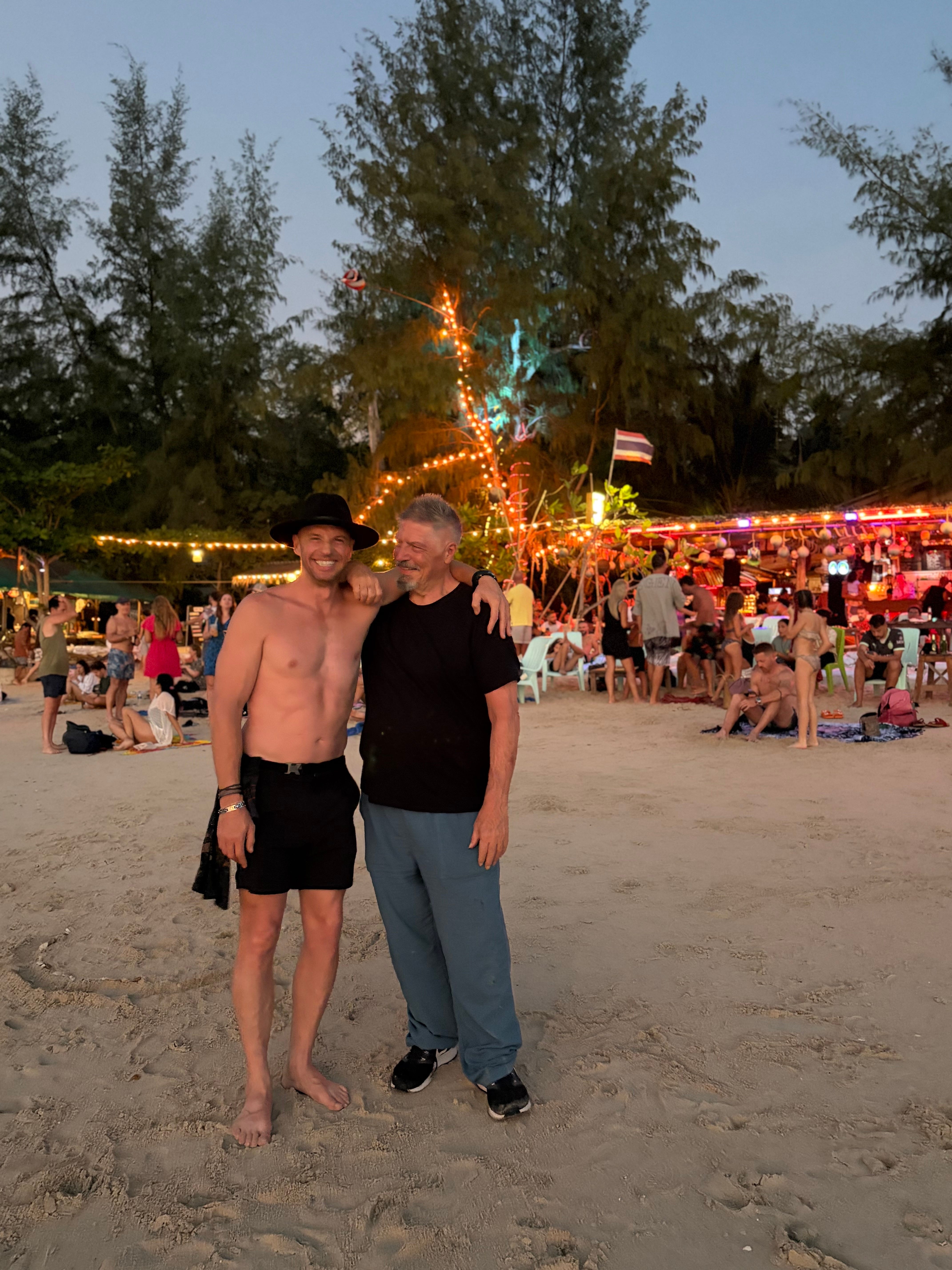
When in Thailand with my son Zach recently, I was fascinated by all of the people from all over the world on the small island of Ko Pha Ngan. Zach is extremely outgoing and starts talking to anybody under almost any circumstances. Because of this, we interacted with a lot of different people during the two weeks I was there. We met people from England, South Africa, Portugal, Indonesia, Spain, France, Switzerland, Isreal, Russia, Belgium, The Netherlands, Germany, Hungary, Italy, Australia, Latvia, etc. and that was just people we happened to talk to.
We were talking to one young woman from England and for some reason a question came to mind that I asked her and then decided to ask other people which is simple on the surface and surprisingly revealing once spoken aloud: What is your philosophy of life?
The responses fell into a few distinct currents.
Some people pause, genuinely startled as the young English woman was. No one had ever asked her that before. The question landed like an unexpected silence in the middle of a familiar room. After a moment she laugh, shrug, and said, “I’ve never really thought about it.”
This is not a failure. It is a diagnosis. It reveals how thoroughly modern life can function without ever asking its participants to articulate meaning. One can work, raise children, consume media, vote, love, suffer, and age without once being required to name the principles guiding those actions.
Others, once given a little time, begin to assemble an answer out of lived experience. They speak about fairness, kindness, survival, curiosity, faith, or doing the best one can with what one has. Their philosophy emerges less as a system and more as a weather pattern shaped by past storms. You can hear where life has pressed on them, where loss clarified values, where joy rearranged priorities. Where an unexpected experience opened a door to insight. These responses are often tentative, spoken as if being discovered and organized in their mind in real time. That hesitation is honest. It signals that the philosophy is alive rather than memorized.
Then there are those who already have a coherent idea. They may not call it a philosophy, but they carry it with some confidence. They know what they believe about responsibility, suffering, meaning, and time. Their answers have edges. They have tested these ideas against disappointment and contradiction. Whether you agree with them or not, you can feel the internal alignment. Their choices tend to be consistent because their orientation is tentatively clear.
What interests me is not which category is better, but what the question itself does. It interrupts autopilot. It asks a person to step outside their habits and look at the operating system underneath. A partial answer reveals something important. Even confusion is informative.
In many ways, asking someone about their philosophy of life is another way of asking who is doing the steering. Is life being navigated consciously, or reacted to moment by moment? Are values chosen, inherited, or accidentally accumulated? Is there a sense of authorship, or only momentum?
This question also exposes a cultural gap. We spend enormous energy teaching people what to do, how to succeed, how to optimize, how to compete. We spend far less time inviting people to articulate why they are doing any of it. Without that inquiry, efficiency replaces meaning, and productivity stands in for purpose. A philosophy of life does not eliminate confusion or suffering, but it provides a compass when maps fail.
I have noticed that once people begin to articulate even a rough philosophy, something shifts. They listen to themselves. They hear where their words ring hollow and where they feel grounded. The act of articulation becomes a form of self-education. It is not about arriving at the right answer. It is about entering into a more honest relationship with one’s own motivations.
For creatives, this question is especially potent. Every creative practice is already a philosophy enacted through material. What you choose to make, how you make it, what you persist with, and what you abandon all express beliefs about time, value, and attention. Naming those beliefs does not limit the work. It often frees it.
I am increasingly convinced that a philosophy of life does not need to be elegant, original, or complete. It needs to be conscious enough to be questioned and flexible enough to grow. It can begin as a handful of sentences scribbled in a notebook. It can change over time. What matters is the willingness to ask the question at all.
So, I think I will keep asking it, gently, without expectation. Sometimes the conversation moves quickly on. Sometimes it opens a long pause. Occasionally it opens a door to hours of conversation and discussion. And in every case, it reminds me that living without a philosophy is still a philosophy, just one written by default rather than by choice.
The Artist Statement as a Philosophy of Life
Most artists actually ask this question of themselves already, often without naming it as such, through the act of writing an artist statement.
On the surface, the artist statement is supposed to explain the work. In practice, it does something more revealing. It asks the artist to articulate how they understand their relationship to meaning, materials, time, attention, and the world itself. It is a philosophy of life expressed through the narrow aperture of practice.
When an artist writes, “I am interested in…,” what follows is rarely only about form or technique. It is about what they notice, what they value, what they resist, and what they feel compelled to return to. Even statements that claim neutrality or process-only concerns still reveal a worldview. To privilege chance over control, intuition over planning, labor over spectacle, or ambiguity over clarity is already to take a philosophical position.
For many artists, the statement becomes the first socially acceptable place to ask questions that are otherwise discouraged. Why do I make things at all? What am I trying to reconcile? What do I believe art is for, even if I cannot fully defend that belief? What do I owe to history, to community, to myself? These questions might never be framed as a “philosophy of life,” yet they operate as one.
What is striking is how often artists treat the statement as a chore rather than as a threshold. It is written quickly, defensively, or in borrowed language meant to satisfy institutions. In doing so, the opportunity is missed. The artist statement can be more than an explanatory label. It can be a provisional manifesto, a snapshot of one’s current orientation toward existence as filtered through making.
Unlike academic philosophy, the artist statement is grounded. It must answer to evidence. The work sits nearby, visible and stubborn. Empty claims are exposed. Pretension collapses under its own weight. What remains, when done honestly, is a lived philosophy tested by repetition, failure, revision, and endurance.
Over time, artists often notice a gap between what they write and what they actually do. That gap is not a problem. It is a signal. It shows where growth is happening, where language has not yet caught up with instinct, or where the work is asking questions the artist did not consciously intend. Revisiting an old artist statement can feel like reading a younger version of oneself. The philosophy has shifted, not because it was wrong, but because it was incomplete.
Seen this way, the artist statement is not a static document. It is a recurring self-interview. It evolves alongside the work and the life that produces it. Each revision asks, again and again: Is this still true? Does this still matter? Am I living inside the values my work claims to explore?
In that sense, artists are often ahead of the culture. They are already practicing what many people avoid, the articulation of a personal philosophy grounded in action. The challenge is to recognize the statement not as an obligation, but as a mirror. Not as marketing, but as orientation.
When taken seriously, the artist statement becomes one chapter in a larger, unwritten bible. A working text. A set of principles constantly tested by the stubborn reality of making something and standing behind it.
Good one Cecil. Creatives can be haunted by it since their much of their process is internal so can always be suspect. But it could be more important for others who might duck the question at their day jobs.
Just that we can, hopefully all of us, have agency to have a philosophy, and so necessarily be alive seems to be priceless.
WOW!!!!! What a fantastic article you have written here! It immediately made me think about so many things. While I've had specific "written in stone" beliefs I realize that that stone can also be at times like styrafoam and I can re-write those beliefs as I learn, do some critical thinking, and keep an open mind and heart to keep educating myself. But still are some non-changing beliefs and truths for me that don't/won't change. In the past week and a half, I've been thinking about not having gone into my studio to create. I've been in tremendous pain in my body, scared what that can be yet too stubborn to not go to my Dr's hoping it'll dissipate. This pain has had me in tears every day and observing myself objectively is an interesting thing. There's anger, frustration, feelings of worthlessness as I fantasize obtaining one of those gentle death pods that Canada is pushing on their citizens. I've broken things in the kitchen, cried out to some god that I question whether or not He's even existing, and crawled into bed to escape the misery and pity party as well as take too many meds/drugs to take that edge off. I've barely given any thought to making art yet there's an underlying missing being in there as when I'm in the studio, all my woes usually leave as I find myself into that beautiful ZONE. Sorry this is so long. I'll get better. I have to. As much as I obsess about death, I know I have a lot to live for as the cliche' goes. Merry whatever everyone. Cecil, you look so happy in that photo. I miss Happy. I'd settle for Contentment again. And less pain would be nice so I could feel gratitude again.