


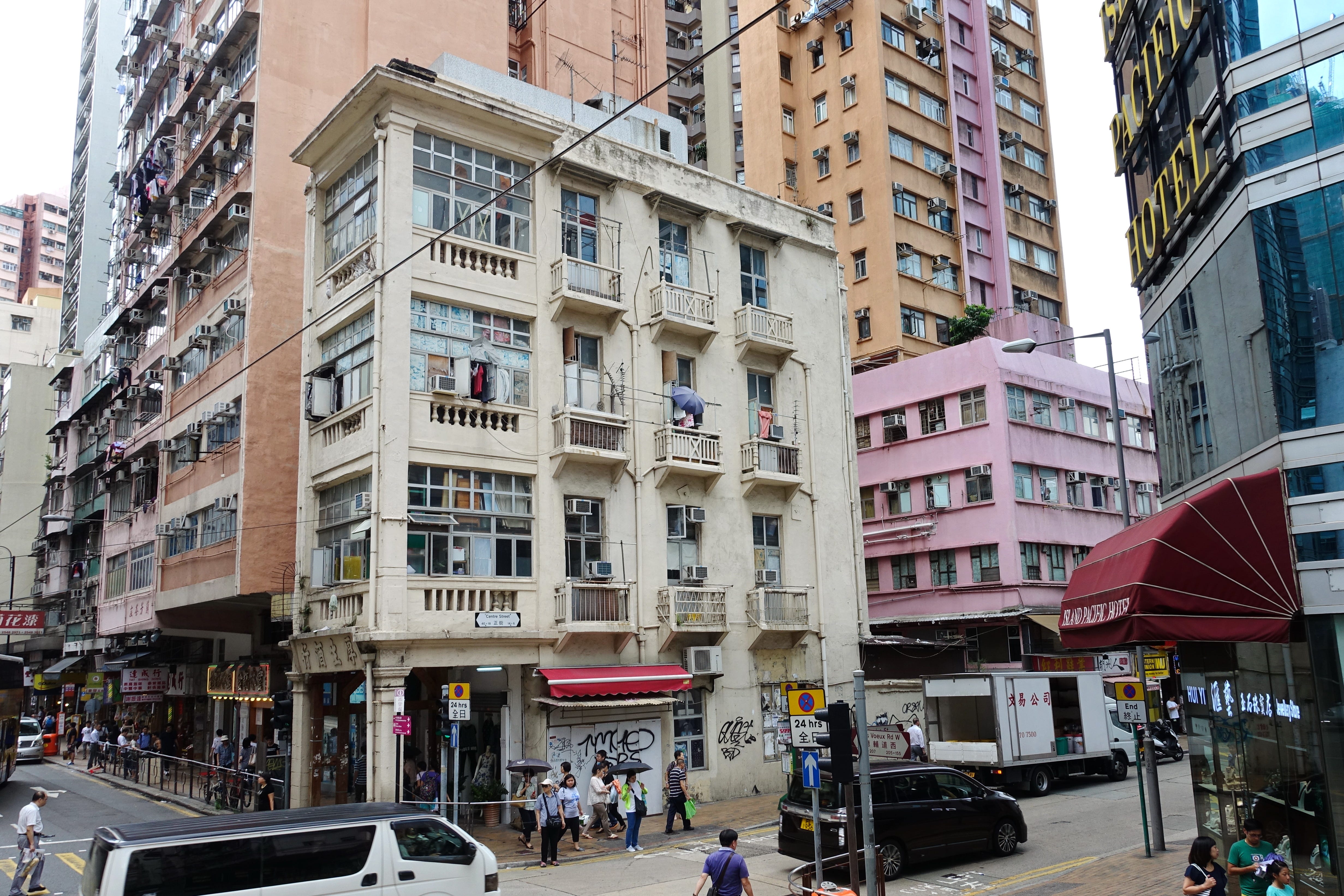
Kai’s Apartment at 207 Des Voeux Road West
Kai often sat on the small curved balcony that wrapped around the corner of the old tong lau, directly above Centre Street where the trams turned and the air smelled of iron and fruit. The building’s pale stucco skin was cracked like porcelain; its veranda railings trembled whenever a double-decker passed. From below came the clatter of bottles from the herbal-wine shop that still occupied the ground floor, the latest incarnation of trades that had lived beneath him for a century.
He would rest his hand on one of the columned piers that supported the arcade - stone rubbed smooth by rain and generations of palms - and feel the faint pulse of warmth that rose through the masonry after sunset. The column seemed to remember things: the press of the crowd when the street had still been waterfront, the laughter of porters unloading junks, the scent of spilled rice wine.
Sometimes, closing his eyes, he could hear it - the slow tide still moving underneath the roadbed, ghost water trapped beneath reclaimed land. The building, he thought, was breathing it back.
At dusk the neon of the dried-seafood shops came on one by one, red light dripping across the cream façade. Kai would switch on the desk lamp in his narrow room, the fan stirring the damp air. The typewriter waited beside an ashtray and a small tin of paper slips. When he began to type, each strike echoed faintly down through the timber joists into the old shop below.
It felt as if the whole structure were answering him - the balcony, the walls, the tiled corridor - humming softly with the vibration of the keys.
Later, in dreams, the building opened itself like a cabinet: the shop signs peeled back, the shutters unfolded, and inside every room a telegraph machine glowed, clicking in time with his heartbeat. Couriers of light moved up and down the stairwell, passing letters through invisible doors, the messages rising like breath through the floors until they reached his hands again.
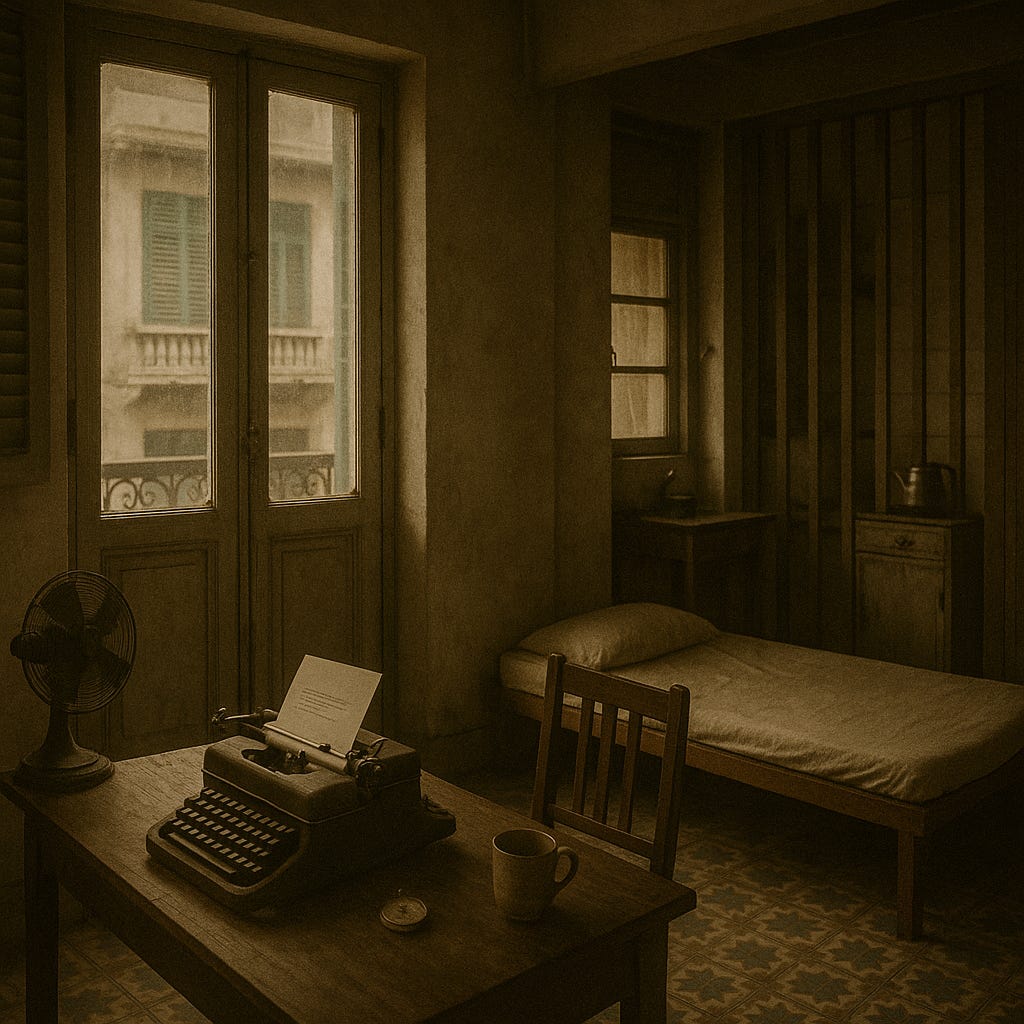
The Interior Rooms of Kai’s Apartment
Inside, the apartment was narrow and deep, like a corridor of memory. The front room opened directly onto the curved balcony, its French doors still fitted with old green-tinted glass that softened the daylight into a perpetual dusk. When the sun struck just right, the walls turned the color of oolong tea.
The floors were tiled in faded geometric patterns—cream, rust, and turquoise—glazed decades earlier when the building was new and the street still smelled of seaweed and ship oil. In the corners where the tiles had cracked, salt had crystallized from the air, white and granular as old thoughts.
His furniture was minimal but chosen with a kind of reverence. A wooden writing desk positioned beside the balcony doors, its surface worn smooth by the ghost of other tenants’ elbows. A small brass fan that rattled and clicked through humid nights. A folding cot draped with a linen sheet that smelled faintly of camphor and sea breeze.
On the desk: his typewriter, a battered Underwood that had come from a pawnshop on Hollywood Road, and beside it, a chipped teacup with a Union Jack faded almost to invisibility. A pocket watch rested open on a coaster—its hands unmoving, frozen at the hour his father’s ship was said to have left port and never returned.
The rear of the flat was partitioned by a thin wall of timber slats that let the light bleed through. Behind it lay a tiny kitchen with a single gas burner, a kettle, and two bowls stacked like parentheses. Beyond that, a washroom with a small iron window that opened onto the building’s airshaft—a vertical canyon where laundry lines and rainwater pipes twisted together like roots. When the wind blew up through it, Kai could hear the voices of unseen neighbors: a radio murmuring in Cantonese, the faint clatter of chopsticks, the hiss of frying garlic.
At night, the sounds of the city deepened into something oceanic. The trams groaned along Des Voeux Road, bells chiming like buoys in fog. From the harbor below, freight horns drifted upward, mingling with the cries of late vendors and the slap of banners in the wind. The building seemed to translate it all into a single breath that expanded and contracted around him—an inhalation of history, an exhalation of neon.
When the humidity grew too heavy to bear, he would open the balcony doors and lean out over Centre Street. The air was thick with salt, exhaust, and night-blooming jasmine from a pot someone kept on the floor below. The sky was seldom dark—only diluted indigo, glowing with the reflection of the city’s sleepless lights.
Sometimes, when he listened closely, he could hear the faint ticking of his mother’s old sewing machine in the back of his mind, though it had been gone for years. The rhythm of it merged with the click of the typewriter keys, the pulse of trams, the slow drip of the airshaft—until all became one continuous sound: the living architecture of Hong Kong itself, humming through him as he wrote.
Letter from 207 Des Voeux Road West
The building breathes differently from the others.
It exhales humidity, plaster dust, and the faint musk of soy and sea.
From the street, you’d think it’s asleep—its paint peeling like old skin—but at night, when the trams stop and the neon signs blink out one by one, it stirs. I hear the beams creak, the pipes sigh, as if something is moving through its bones.
My flat is on the second floor, facing Centre Street. From my balcony, I can see the pink building opposite, a kind of cheerful decay. When it rains, water pours down its drainpipes in steady rhythms, each one a different note. The whole block becomes a percussion orchestra.
Sometimes I imagine that this was once the edge of the sea. The air still tastes faintly of salt on certain mornings. My mother said that her father remembered junks docking here, before the city reclaimed the bay and built streets on top of it. She used to call it ghost water—the sea that hides under the concrete, still dreaming of tides.
Downstairs, the shop sells herbal tonics now, but the painted characters on the wall—Hau Sang Winery—are still there, faded but stubborn. I like that. The past refuses to shut up.
I keep a collection of small objects on a shelf by the window. Each one has its own gravity.
A chipped porcelain teacup with the Union Jack on it, found in a junk market in Stanley—the only piece of England I’ve ever owned.
A pocket watch that doesn’t tick, which my mother said once belonged to my father. I’ve never opened it. I prefer to believe time stopped exactly when he left.
A fragment of colonial stationery, thick paper with a faint green crown embossed in the corner. I use it to draft letters to no one in particular.
A brass tram token from before the Octopus cards came. It still smells faintly of grease and rain.
A typewriter ribbon tin stamped “Made in England” in delicate serif letters. I keep it filled with folded paper slips—phrases I’ve rescued from mistranslations: positive consideration, mutual interest, trusting you completely.
I suppose these are my scriptures, my proof that translation is the true afterlife of meaning.
When I sit at my desk at night, the building seems to lean in closer, listening. The plaster above my bed bears the outline of an old crack shaped like the character 聲—sound. I tell myself it’s coincidence, but I know better.
Sometimes, while writing, I hear the echo of footsteps on the stairs below, though no one climbs them anymore. They stop outside my door, pause, then move away. The air shifts.
That’s when I know another letter has found me.
I write by the light of the streetlamp outside, the same sodium glow that gilds the tram lines and makes the wet asphalt shimmer like a memory. The keys of my typewriter strike softly, rhythmically, as though I am tapping messages into the ghost water beneath the city.
And always, before I finish, I whisper into the room:
You are properly understood.
Then I sign, as always,
Kai Hensley, 207 Des Voeux Road West.
Letter from the House That Listens
Tonight the building spoke again.
Not in words, of course — it spoke the way my mother used to, with her hands. Quietly, precisely. I was half asleep when I heard it: the soft tok tok of the wooden beams expanding in the night heat, followed by a low groan that seemed to travel down through the walls into the earth. Then silence, like the pause before someone answers a difficult question.
I sat up and whispered, “I’m here.”
The wind came through the cracks in the window frame, rearranging the papers on my desk. One sheet — the letter I’d been working on earlier — slid to the floor. It landed upside down.
You are properly understood, it read, but backwards.
My mother would have called that a sign.
She saw signs in everything: loose threads, sudden winds, the way fabric rippled when you held it to the light. She believed the world was constantly stitching itself, and that our work — hers with fabric, mine with words — was to help keep the seams from unraveling.
She had been a seamstress in a tiny shop down the street, near the dried seafood stalls. As a child, I’d sit under her table, playing with scraps of cloth while she worked the pedal of her sewing machine. The sound it made — that rhythmic tak-tak-tak — has followed me all my life.
When she was tired, she’d hum a tune in Hakka. I didn’t understand the words, but I understood the tone. It was the sound of someone making peace with imperfection.
I think of her every time I type. The typewriter keys strike like a needle through paper, pulling the thread of sense through the fabric of the unknown. The words, like her stitches, are not the art — the art is in their spacing, their tension, how they hold the silence together.
I once found a scrap of her sewing pattern tucked into a book I’d inherited after she died. It was covered with faint pencil lines and small Chinese characters that read:
對位 — “to align.”
I pinned it to the wall above my desk.
Now, every time the building shifts, I imagine it’s trying to align itself — with memory, with gravity, with some deeper structure of listening.
Last night, I dreamt the building had threads running through it, red and gold, invisible but taut. Each thread was a sentence, each window a translation. When the wind moved, the whole structure shimmered like silk.
When I woke, the light was dim, and I could hear faint water dripping from the ceiling into a metal bowl. The sound was measured, patient — a metronome for the unfinished world.
I turned to the typewriter and began to write, slowly, deliberately, as though matching the rhythm of the drip.
Dear Elsewhere,
It seems the house has begun to remember its original shape — the shape of water. I, too, am remembering what I was made from: half language, half silence.
If you can hear this, please respond, even if only through the shifting of light.
When I finished, I left the letter on the windowsill. The building inhaled. A draft curled it gently toward the open air, and it was gone.
The next morning, I found a scrap of red thread tangled in the balcony railing. It wasn’t mine.
I tied it around my wrist.
Now, whenever I type, the thread trembles slightly — as if something unseen is keeping time with me.

Gorgeous work on the sensory layering here. The way you weave the building's physical decay with Kai's emotional archaeology is masterful, especially the moment where the typewriter's rhythm merges with the dripping water and his mother's sewing machine. That collapse of past/present through sound feels spot-on for how memory actuallyworks in lived spaces.