


The Letter of Mutual Interest (The Handover)
The Translator lived in a city between calendars.
In the spring of 1997, Hong Kong trembled under the weight of invisible paperwork: new emblems being stamped, old flags quietly folded away. The streets hummed with celebration and unease. Everything was changing, though nothing seemed to move.
He lived in a flat above a printing shop in Sheung Wan. The window looked down on Des Voeux Road, where banners fluttered with phrases like “One Country, Two Systems” - a slogan that sounded to him like an unfinished poem, its rhythm tripping over its own uncertainty.
He spent his days translating government pamphlets, contracts, and ceremonial letters. At night, he wrote his own messages to the unknown “elsewhere,” addressing them simply:
Dear Reader of No Fixed Nation,
He wasn’t sure whether the reader was alive, or whether it mattered.
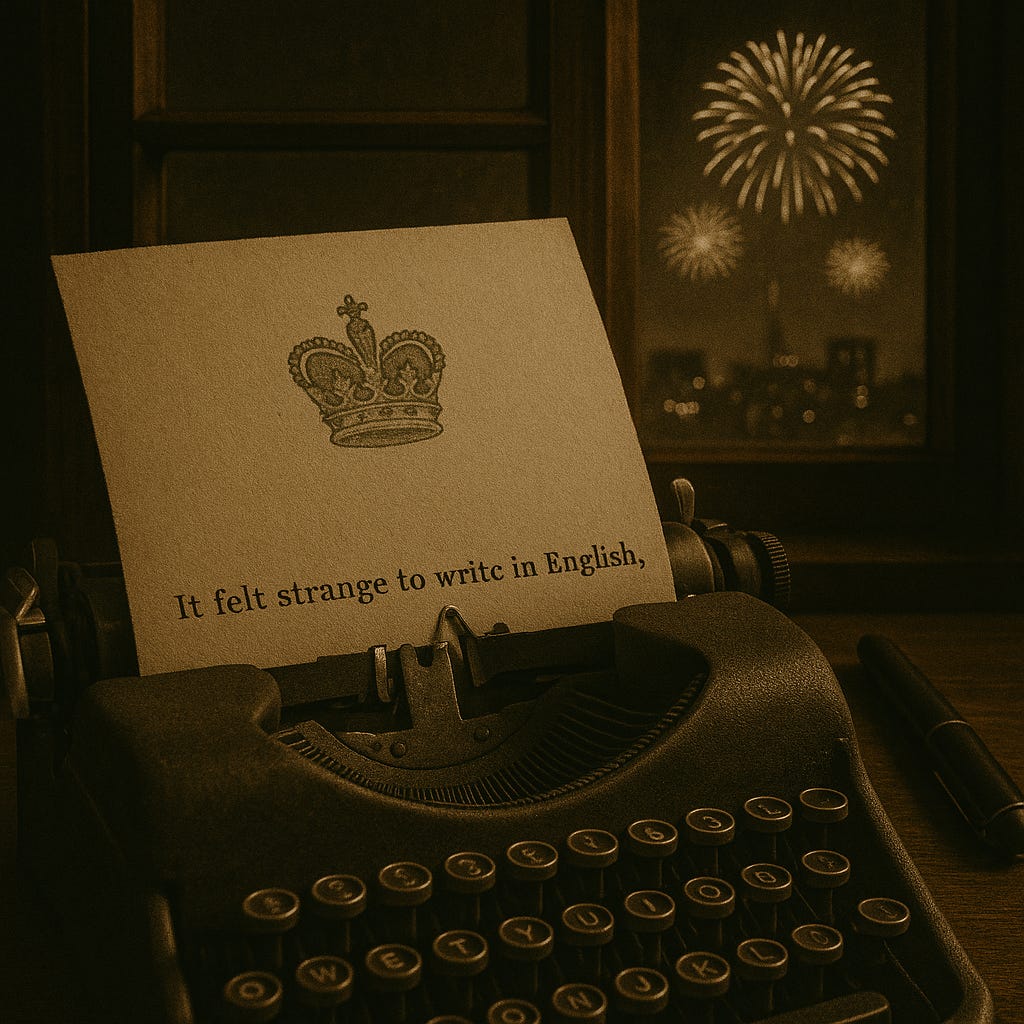
He used the discarded stationery of the colonial offices: heavy paper embossed with faded crowns, the ink slightly greened with age. It felt strange to write in English, the language that had colonized his tongue, yet he needed its distance. Chinese was too immediate, too close to the body. English allowed him to hide inside the act of communication.
Occasionally, while typing, he paused to listen to the faint echoes of celebration outside - the fireworks, the crowds shouting in Cantonese, Mandarin, and broken English. He tried to imagine what kind of language the city itself spoke when left alone at night.
It is my search for you, he typed, because of mutual interest who unfortunately died.
It was an absurd line, yet true. Something in him had died: an empire of certainties, a mother tongue of borrowed grammar.
He began to think of translation as resurrection - the act of giving voice to the unspoken dead. Each letter he sent was a small ritual, part elegy, part experiment in rebirth.
He wrote again:
I am the Bank of China Hong Kong,
executing a special Language Translating machine.
By now the “Bank” was no longer financial. It had become his metaphor for memory - a vault of old words that had lost their currency. And the “machine” was his typewriter, which rattled like a train crossing two eras at once.
In June, the air filled with typhoon rain. The handover was weeks away. He typed through the humidity, sweat pooling on the keys. Each night, he left his letters on the window ledge, and each morning they were gone.
Then, on the night of June 30th, a final reply appeared.
The envelope was blank except for three characters pressed faintly into the paper: 同聲相應 — “voices that respond to each other.”
He unfolded the page. It read:
Your words have reached.
Translation complete.
We will keep your city in the archive of living languages.
The letter dissolved as he read it, the ink bleeding into the paper until it was blank again.
Outside, the first fireworks of the handover began. The sky flickered red and gold over Victoria Harbor.
The Translator covered his typewriter, stood by the open window, and whispered to no one in particular:
“You are properly understood.”
The wind carried his voice across the harbor, mingling with the echoes of the crowd - half cheer, half lament.
And somewhere beyond language, beyond sovereignty,
the correspondence continued.
