


The Letter of Mutual Interest (Part II: The Translator)
Hong Kong at night was a mirror of itself.
The city glowed from within, as if every building contained a small trapped sun trying to remember its original purpose.
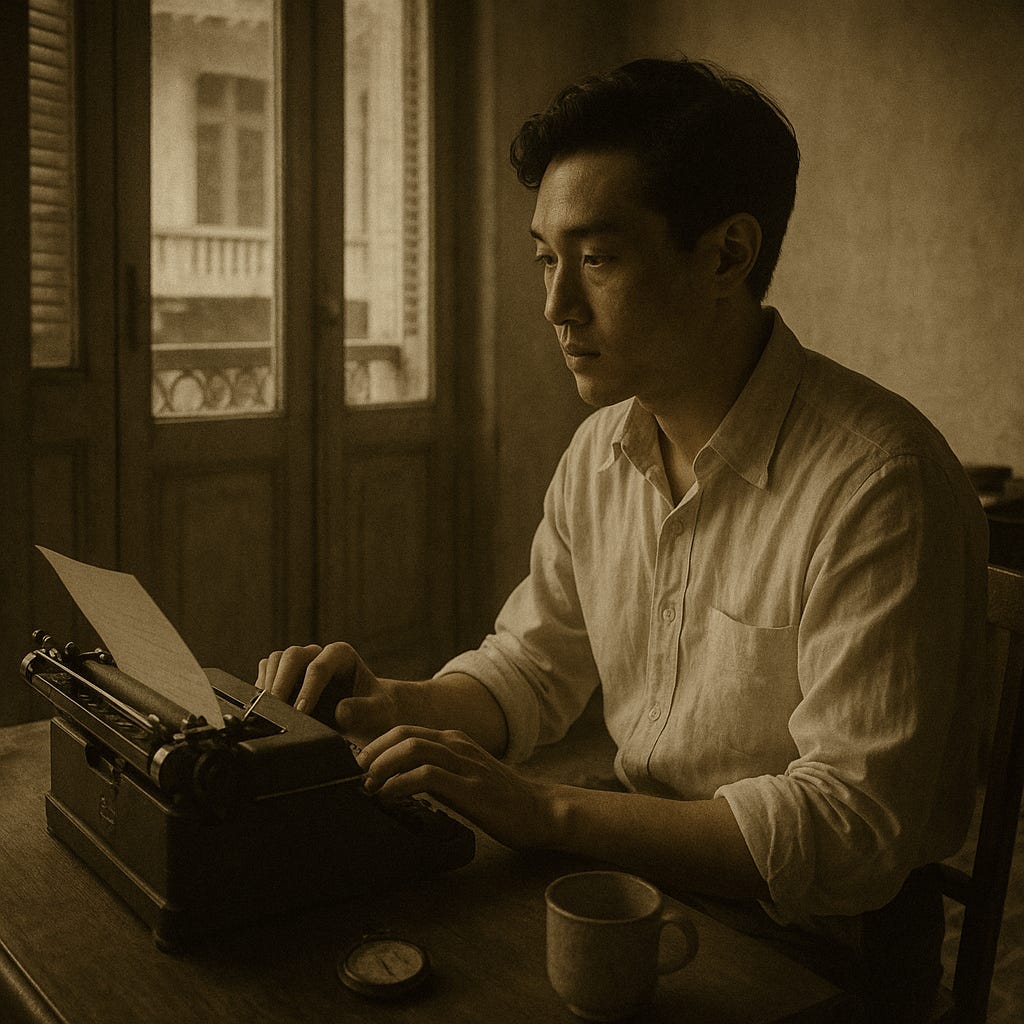
In a small office above Nathan Road, a man sat at a desk cluttered with stamps, envelopes, and the skeletons of old typewriters. He was known, though not to himself, as The Translator. His work consisted of composing letters - letters that never arrived, letters written to “anyone elsewhere.”
No one hired him. He had simply always been there. He is a correspondence poet. His outgoing correspondence a form of publishing, of getting his work out into the world one reader at a time. He had become enamored with Mail Art and what participants called The Eternal Network, an artistic concept representing a global, collaborative, and idealistic network of artists and writers connected through mail art and other forms of communication.
It is my search for you. It is because of mutual interest who unfortunately died…
He typed it again, slowly, with his index fingers, pausing after each word to listen to the faint click inside the machine. The typewriter was older than the internet, yet it hummed faintly when he touched it, as if connected to something vast and invisible.
He knew that every phrase he wrote was a fragment of another language, a syntax from the other side of understanding. He was not translating words, but intentions - the emotional residue of meaning that persisted even after the grammar had decayed.
He sometimes dreamed that his letters were received. In those dreams, an unknown reader unfolded his words in another time zone, feeling the strange pulse behind the nonsense, the urgency beneath the broken grammar. A faint tremor of recognition.
I am the Bank of China Hong Kong, he had written, and reach out to you, TRUSTING that you will give this particular letter.
The Translator had no bank account, no employer. But the phrase felt right. In his intuition, Bank meant reservoir, and China meant the human condition itself, fractured yet luminous. He was translating into correspondence from the margins of bureaucracy among the dispossessed.
Each night, he sealed a letter and left it on the window ledge. In the morning it was gone. Sometimes, in its place, a reply appeared - typed on unfamiliar paper, written in a voice that sounded eerily like his own:
We are in receipt of your urgent transmission.
Please forgive this proposal personally.
Implementation of strategy ongoing.
You are properly understood.
The replies came irregularly, sometimes after days, sometimes after years. He began to suspect they were written by another version of himself, one that existed outside of linear time.
He began keeping two journals: one in Chinese, one in English. Over time, both languages began to blur together, as though a third language were forming between them - a language composed of mistranslations, bureaucratic metaphors, and longing.
One night, during a typhoon, he received a final reply.
The letter had no words, only a watermark of shifting light. When held under the lamp, the words positive consideration flickered in and out like a pulse.
He realized then that he had been corresponding not with a person, but with the echo of human communication itself - the field of language, detached from speakers, trying to remember who it once belonged to.
He left his office and walked out into the storm.
The streets were flooded with neon reflections, each sign vibrating with unreadable messages. He felt them passing through him - advertisements, headlines, names of the dead—all translated into pure light.
Somewhere, elsewhere, someone would find his last letter and understand that it was never about money, never about a proposal. It was the simplest and oldest message ever sent:
Are you there?
And perhaps, faintly, the answer would come back,
Yes. I am here. Properly understood.
I loved this two part communication. Beautifully poetic and, hoping it's ok to say this, I also laughed. Only recently found your Substack and it's feeding a recovered part off myself as well as my creativity. Thank you.