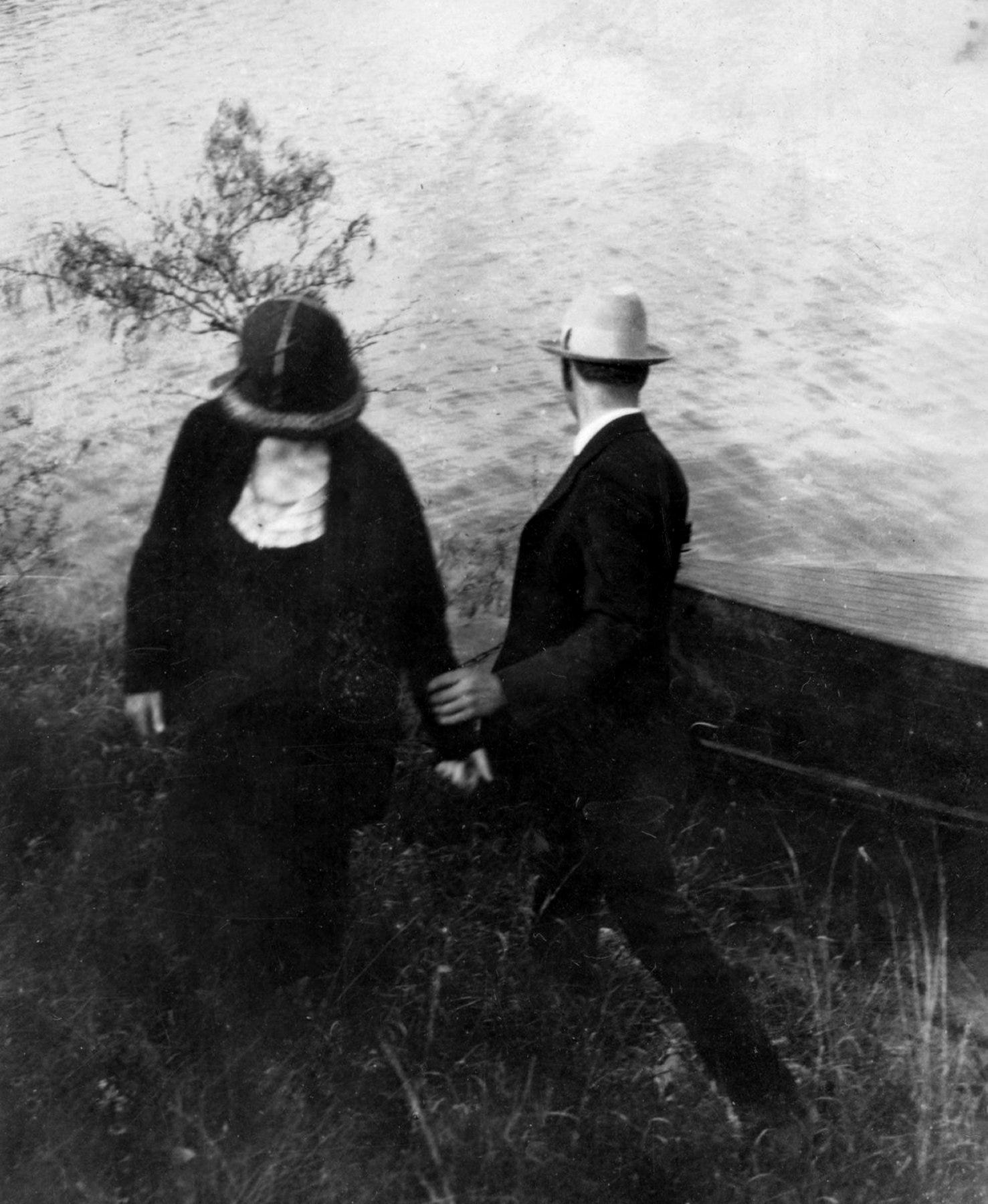
This photograph—grainy, dark, and almost dreamlike—carries the soft blur of memory. A man and a woman, dressed in early 20th-century attire, are captured mid-motion near a lakeshore or riverbank. The woman turns away, face hidden beneath a cloche hat, while the man, wearing a pale fedora and dark suit, reaches for her hand. The water shimmers in the background, slightly blurred, like something half-remembered. Their feet sink into the grass at the edge of perhaps a boat, perhaps a moment.
Where the River Bends the Light
It was October of 1923, the last warm day before the frost took hold of the valley. The townsfolk of Bellweather rarely spoke of the couple in the photograph, though the picture hung for decades in the dusty back room of the old library, behind a locked cabinet marked Private Archives.
They were called Eleanor Exquisite Blythe and Vincent Harrow—schoolteachers once, but by the time the photo was taken, they had become something stranger.
The story went like this:
Vincent had come to Bellweather from the city, a man with secrets folded into the lining of his coat. He arrived in the spring of 1918, when the war had drained the world of color and sound, and the only thing anyone wanted was for time to feel normal again. Eleanor, widowed by the influenza, taught poetry to children in the schoolhouse near the river, and wore black ever after. She was known for her silence, and for staring too long at the water when she thought no one noticed.
They met, inevitably, and were drawn to one another in that way quiet people sometimes are—through glances and pauses, rather than words. For years they simply walked. Every Sunday. Always the river. No one knew what they talked about. Some said they didn’t speak at all.
Then, one day in 1923, they were seen by a boy - Silas Finch - with a camera. He had just been gifted it for his 12th birthday and was trailing the edge of the river to take pictures of birds. He snapped a single photo of Eleanor and Vincent walking hand in hand toward the dock. It was the last time anyone ever saw them.
When the photograph was developed, the boy’s mother—a librarian—was startled. She recognized the couple instantly but saw something else too: the way Eleanor’s head was bowed, the way Vincent turned just slightly, as if hearing something from across the water. And something about the edge of the photograph—the ripple of light behind them, oddly shaped like a figure standing in the shallows.
The town speculated. Some said they’d drowned. Others said they’d run away to Europe under new names. But those who had heard Eleanor read from Rilke or overheard Vincent whispering strange words in forgotten languages began to suspect a different kind of story.
An old journal, found decades later beneath the floorboards of the schoolhouse, told of a pact—a belief that if two people entered the river at the right time, under the right conditions, they could slip through the veil and wake in another world entirely. A world untouched by war or grief. A world made only of water and song.
To this day, the photograph remains. No one can quite remember who took it, or how it ended up in the archive.
But sometimes, late in October, if you walk down to the river at dusk, you might hear voices—not words exactly, but tones and hushes, as if two people are walking just ahead of you, whispering in a language only the water understands.
Excerpt from Eleanor Exquisite Blythe’s Journal – dated October 15, 1923:
There is a silence beneath the current, a hush not of death but of crossing.
We have listened long enough.
The world behind us is fading—familiar, yes, but too full of memory’s weight.
We do not go to escape, but to remember what the soul knew before it was named.
Vincent says it is not a leaving, but a folding of time—like closing a letter you’ve read too many times.
I say: let the ink run. Let the paper blur.
Let the river read us now.
Archival Note:
This journal fragment was recovered from a water-damaged drawer labeled “Blythe / Riverpath / Shared Entry.” The ink, though partially dissolved, re-formed under resonance with Cassiel’s breath and Mina’s brush. It is the first recorded instance of a written piece that reads back. The phrase “Let the river read us now” is now used colloquially among Archive stewards to describe the moment a memory becomes a portal.
—Filed by: The Curator