


Mundus Imaginalis vs. Massurreality: Reclaiming the Sacred Image
How artists can recover their inner vision in an age of simulation
In the age of screens and scrolls, where symbols are brand assets and meaning is mined like data, the artist faces a strange dilemma: how to see what is real when reality itself has become a curated feed?
But there is an older way of seeing. A deeper field of vision. One that predates the algorithm and persists beyond the simulation.
French philosopher and mystic Henri Corbin called it the Mundus Imaginalis—the Imaginal World.
And to step into that world is to begin the long work of reclaiming the sacred image from the mass-produced, mass-mediated spectacle we now swim in—a spectacle I have come to call the Massurreality.
Let’s lay the two side by side for a moment.
Two Worlds That Shape What We See
The Mundus Imaginalis, a concept coined by Henri Corbin, arises from Islamic mysticism - especially the teachings of Suhrawardi and Ibn ‘Arabi. It describes a world that is ontologically real, existing as an intermediary realm between matter and spirit. This imaginal realm is accessed through active imagination, through dreams, visions, and inward attunement. It is a place where symbols are alive, luminous, and archetypal - carrying deep, autonomous meaning. Time in the imaginal is not linear or mechanical, but mythic and sacred, often arriving in kairos - a specific moment in time, often described as the right or opportune moment for something to happen -rather than chronology. The atmosphere of the Mundus Imaginalis is revelatory, initiatory, and participatory. In this space, the artist is not a fabricator, but a seer, a translator, a bridge between worlds.
By contrast, the Massurreality is a term meant to describe the synthetic mental environment generated by mass media, branding, and algorithmic information systems. It is not a real world, but a constructed and performative one - engineered to shape perception, behavior, and belief. Access to the massurreality comes through screens, advertising, social media feeds, news cycles, and other algorithmically filtered content. In this world, symbols are flattened and recycled, repurposed for commerce and trend. Time in the massurreality is urgent, reactive, and hyper-present - always now, always scrolling. The spiritual tone of this environment is distracting, consumable, and ultimately controlling. Here, the artist is not a mystic or witness, but a content provider, a trend-chaser, and - if successful - a brand.
The Imaginal as Sacred Terrain
Henri Corbin’s Mundus Imaginalis is not imaginary in the modern sense. It is not fantasy or hallucination. It is a real world of form and presence - the realm where angelic beings appear, archetypes take shape, and vision carries truth that cannot be expressed by logic alone.
The imaginal is where the soul perceives.
Artists who work from this realm are not inventing, they are listening. They are translating images that arise not from clever ideas but from encounters - with something autonomous, meaningful, and alive.
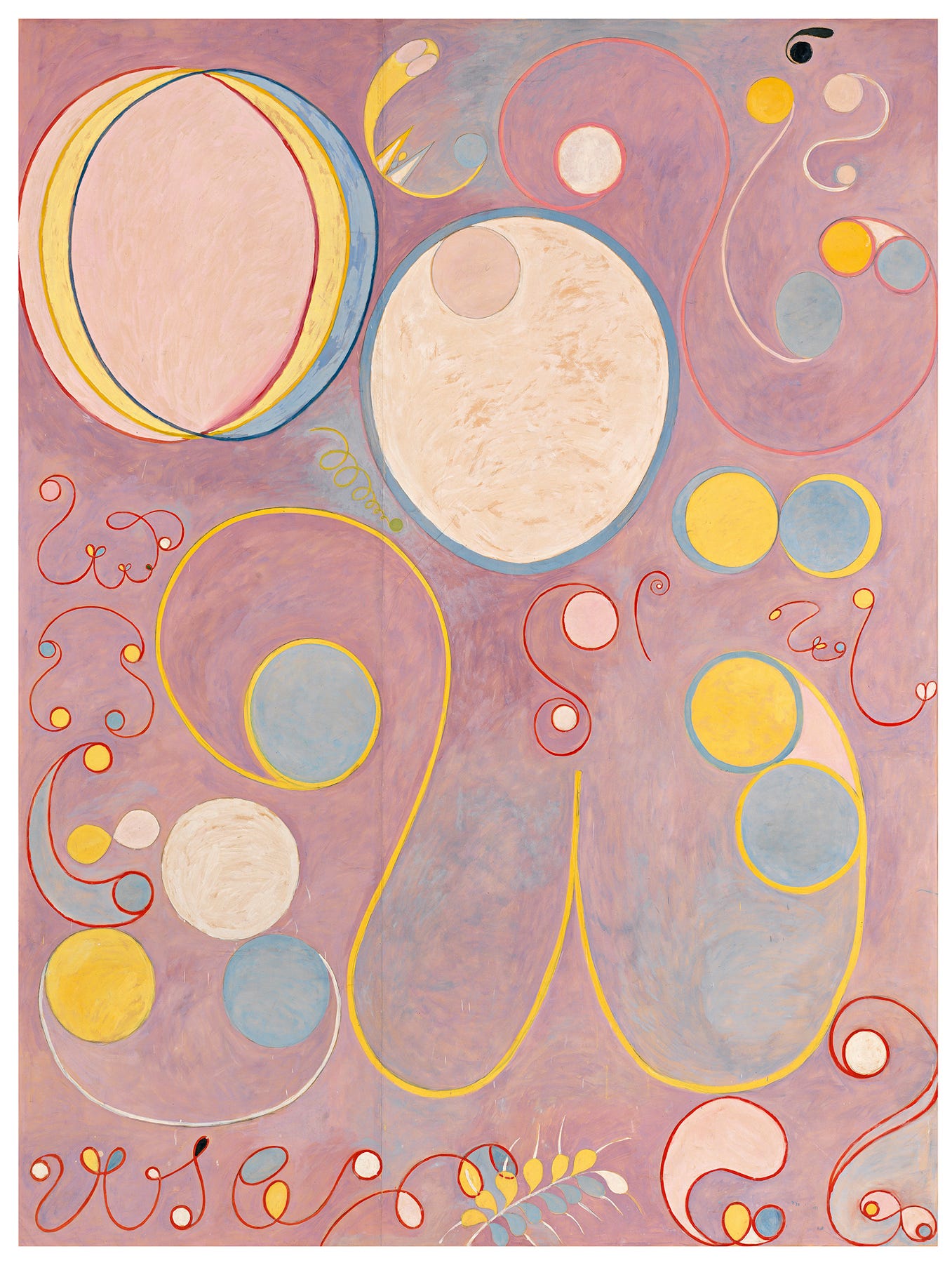
Think of William Blake's visions. Hilma af Klint’s spirals. Leonora Carrington’s dreamlands. These are not concepts. They are transmissions from the imaginal.
The Massurreality as Invasive Simulation
In contrast, the Massurreality is the artificial consensus world we live in daily—shaped by media cycles, branded imagery, predictive algorithms, commercial storytelling, and viral aesthetics. It presents itself as reality, but it is a simulation of meaning, not the thing itself.
It is:
Reality curated for sale.
Myth without mystery.
Archetype reduced to stereotype.
In the massurreality, our symbols are hollowed out and made profitable. The visionary becomes a marketer. The story becomes content. The mystery becomes branding.
The danger is not just distraction, but confusion of worlds. We begin to believe this synthetic mindworld is reality. And worse, we stop remembering how to see anything else.
Why This Matters for Artists
Both the Mundus Imaginalis and the Massurreality occupy the same channel: our imaginative bandwidth. The battleground is the artist’s attention.
The imaginal invites a descent into the depths, toward presence and meaning.
The massurreality pulls us into surface loops, where depth becomes rabbit holes into noise.
If we do not discern between them, we lose the ability to make art that awakens rather than entertains. To make work that participates in the sacred rather than adds to the spectacle.
Practices of Imaginal Resistance
To return to the imaginal is not escapism. It is creative resistance.
Here are ways the artist can reclaim vision from the massurreality:
Create a space of stillness
A studio, altar, corner, notebook - unplugged, unmarketed.
Make it a threshold, not a factory.
Attend to dreams and symbols without rushing to explain
Let meaning come in layers.
Record what arises without censoring.
Practice reverent improvisation
Let the work surprise you.
Follow the image, don’t force it.
Detox from the feed
Fast from media when you can.
Watch what images enter your mind without your consent.
Ask your work to speak back
Not as product, but as companion.
What does it want to become?
The Task Ahead
To work in the imaginal is not merely to make art. It is to unmake illusion. To strip the false sheen from the face of the world and restore the wild light underneath.
We do this not by preaching, but by seeing differently.
By bringing through forms that remember the source.
By creating cracks in the massurreality where the real can seep back in.
Final Thought
The imaginal is not a style. It is a stance.
A way of being-with image that restores meaning. A way of relating to symbol that sanctifies perception. A way of making that begins not with “What will sell?” but with “What is being shown to me?”
In this light, the artist becomes more than a maker.
They become a vessel.
A witness.
A flame.
Let the massurreality flicker. The imaginal endures.
Leave a comment with your own visions, struggles, or rituals for keeping the imaginal alive in a world increasingly made of noise.
There has been times when I have had dreams pertaining to either pieces in a 'half way' point of being made or ones that are just in the idea stage of creation and even ones being created in the dream itself without any conscious thought at all by the wakeful 'me'. Some of these pieces were made, others were too ridiculous to my conscious mind to even think of making. But I welcome all the various stages and see the ones that come through dreams as gifts, not from me but from somewhere else. Great essay with much to think about and a re-read that's necessary. Thanks.
Again I like how you write about making art and the difference between a formuliac approach and letting the piece reveal itself. Attending a reasonably large art fair recently I left feeling underwhelmed and I think what you have said explains why. Almost universally the work looked intended and like other similar pieces both within the individual stands and also by and large when comparing with other similar styles stands. As though before beginning the artist decided how they wanted the piece to end up looking. So there was no mystery and nothing unusual that caught the eye. Too much balance and nothing odd or unexpected. As though the artist were trying to create a certain ‘look’ to which each piece was required to conform. I made a mental note not to put any of my own work into such an environment and I also felt a bit guilty at not being able to find anything more positive to feel about the work I had seen. For me the process is always to start without a plan, to make a few marks or stick down the first piece of painted paper and then to proceed one step at a time to see what comes out and suggests itself as I/we proceed. I expect what is revealed to be different to anything else I have previously made.