


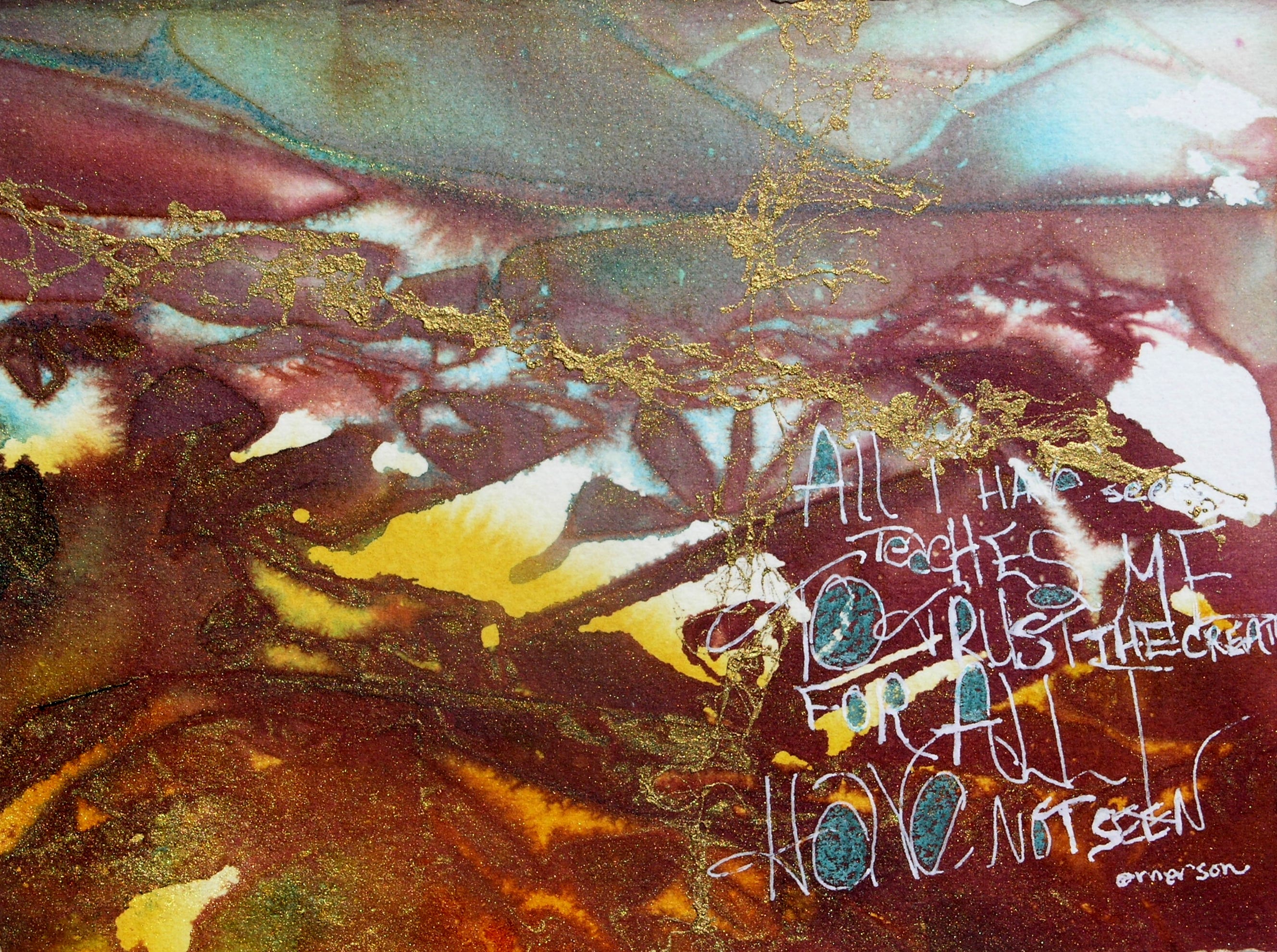
Entering the Mundus Imaginalis: A Guide for Artists to the Realms of the Imaginal
In a world increasingly saturated with images, simulations, and artificially generated content, the artist finds themselves suspended between the real and the unreal, the concrete and the virtual. But what if there exists a third territory - one neither reducible to fantasy nor confined to fact? A place where form breathes soul, and symbols walk with meaning intact? This is the territory Henri Corbin called the Mundus Imaginalis - the Imaginal World.
For artists, poets, mystics, and seers, this imaginal realm is not merely metaphor. It is the very atmosphere in which visionary art is born.
Beyond Fantasy: What Is the Imaginal?
In his 1972 essay Mundus Imaginalis, French philosopher and Islamic scholar Henri Corbin makes a vital distinction between the imaginary and the imaginal:
The imaginary is often dismissed as unreal - fantasy, hallucination, daydream.
The imaginal, by contrast, refers to a real mode of being: a domain perceived by the soul, rich with symbolic reality.
Corbin draws on Islamic mysticism, particularly the Persian philosopher Suhrawardi and the Sufi master Ibn ‘Arabi, to describe the imaginal world as an intermediate realm between the material world of the senses and the intellectual world of pure abstraction. In Arabic, this world is known as ‘Alam al-Mithal’, the world of images, forms, and archetypes.
The imaginal world is:
Perceived through the active imagination, not created by it;
Populated by symbols that have autonomous meaning;
Geographically ordered (in mystical maps and sacred visions);
And experientially real, though not material.
Why This Matters for Artists
Artists are among the few remaining initiates of the imaginal. Whether they realize it or not, those moments of sudden insight, of encountering a form that feels larger than oneself, of being led by a vision rather than inventing it - these are imaginal encounters.
The imaginal is:
Where archetypes arise (the Lover, the Tower, the Pilgrim);
Where myth breathes and symbols shimmer with inner light;
Where the work dreams back at its maker;
Where meaning precedes interpretation.
In Corbin’s framework, the artist is not an inventor, but a seer - one who perceives and renders forms from this third world, giving them body in paint, word, sound, or gesture.
The Active Imagination as Spiritual Organ
Corbin borrows the term “active imagination” from both Sufi thinkers and C.G. Jung, but he insists this is not imagination as escapism. It is not the mind making things up. Rather, it is a spiritual faculty, a way of seeing into the imaginal.
“The organ of this vision is the imaginative consciousness,” Corbin writes, “not the imagination that fabricates, but the imagination that perceives.”
For the artist, this means entering a state of receptivity, not control - where the brush is guided by an inner current, the pen surprises its holder, the form unfolds as if remembered rather than planned.
How Artists Can Cultivate the Imaginal Mode
To work in the imaginal is not a technique, but a posture. Here are practices that may help the artist open toward it:
Attend to Symbols Without Reducing Them
Let the image be itself.
Don’t rush to decode or explain it.
Honor Dream and Vision as Data
Keep a dream journal.
Record fleeting visual or auditory impressions - they may not be “you” thinking, but the imaginal speaking.
Create Sacred Space for Making
Set aside zones where imaginal perception can arise - quiet, ritualized, responsive.
This is the atelier as threshold, not factory.
Practice Reverent Improvisation
Allow the work to move beyond your plan.
Let strangeness come. Follow it.
Trust the Reality of Inner Experience
Stop treating visions, intuitions, synchronicities, or metaphors as “less real.”
The imaginal is realer than real - not measurable, but consequential.
Imaginal Art: Examples Across Time
Artists who have inhabited the imaginal include:
William Blake, whose visionary poetry and paintings channeled angels and cosmic forms.
Hilma af Klint, who painted unseen geometries and spiritual forces before abstraction had a name.
Paul Klee, who wrote: “Art does not reproduce the visible, it makes visible.”
Leonora Carrington, whose dreamlike tableaux feel like transmissions from another world.
Jean Cocteau, who saw the poet as a medium for the mythic.
In each case, the artist is not simply producing artworks, but bearing witness to an imaginal encounter.
The Stakes: Reclaiming a Sacred Function
Corbin feared that the modern world’s reduction of imagination to fantasy would amputate our access to the soul’s true terrain. For the artist, this loss is not merely theoretical - it is existential.
To re-enter the Mundus Imaginalis is to reclaim art as:
A vessel for meaning that is not imposed but revealed;
A bridge between the visible and the invisible;
A participation in the unfolding of a cosmic drama.
A Final Note to the Artist
You are not “making things up.”
You are tuning in.
You are not alone in your seeing.
The imaginal is waiting to be seen - again and again, through each new act of perception and creation.
Let the image appear.
Hold the space for it.
Render it faithfully, as best you can.
That is your offering.
Footer
This article is part of an ongoing series exploring the deeper dimensions of artistic practice. If you find yourself called to this kind of work - half-seeing, half-listening, walking the line between form and spirit - you’re not alone. The imaginal needs its interpreters.
Fascinating post! Its such a common theme amongst creative people that ideas just "arrive" without direct influence, as if you are more like the brush than the painter.
I enter the Mundus Imaginalis daily, however, before it is committed to canvas or paper, my vision dissolves in a puff of air…
Your suggestion to Annette about using the phone to capture notes, is an excellent idea. Thank you.