


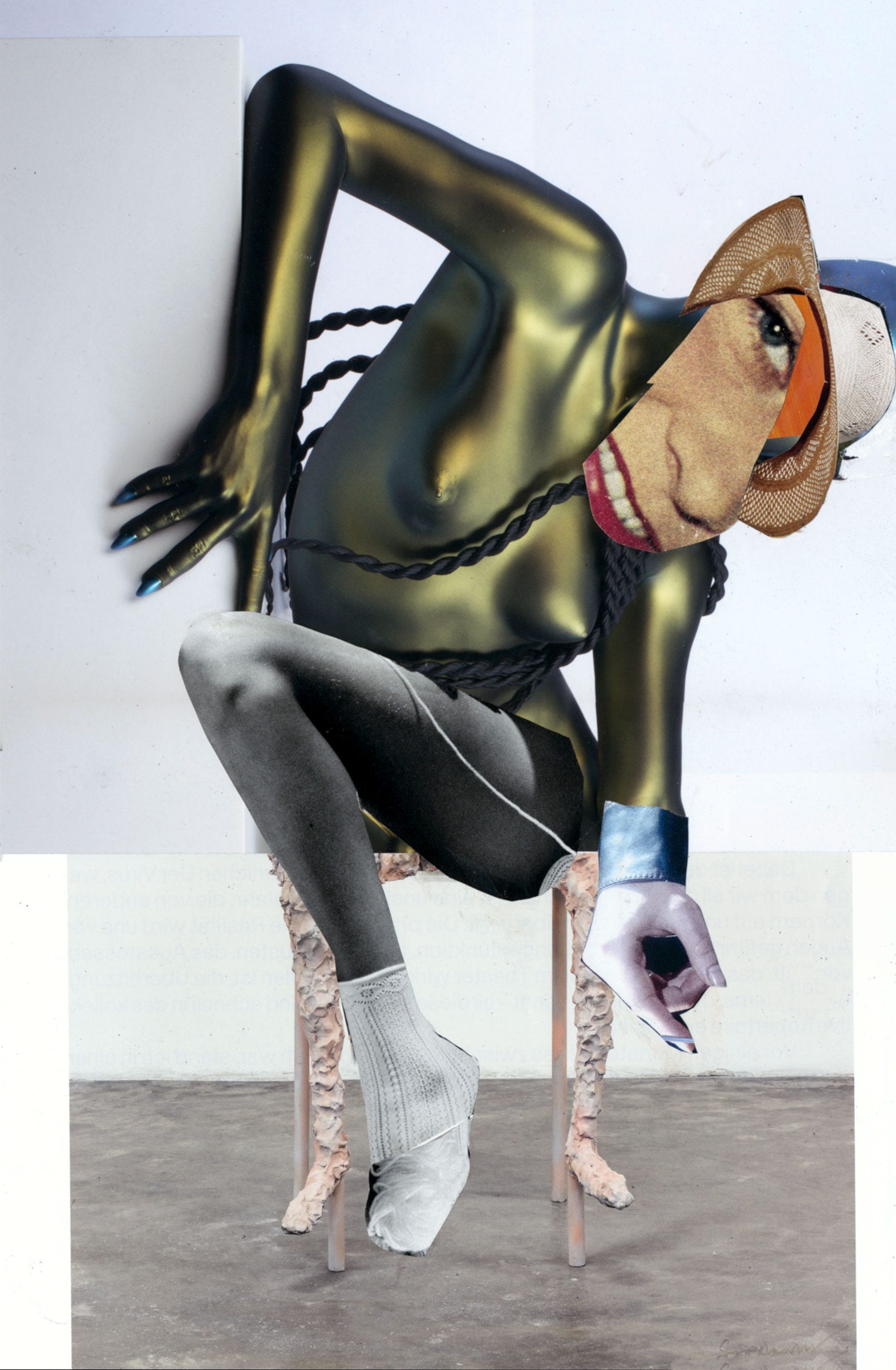
Berni Stephanus, who I visited at his studio in Geneva a few weeks ago, just told me there are some collages on the way to the Museum of Collage Archives and sent me the digitals of what is on the way. The above is one of them.
OM.2026.015
Collage on paper
Berni Stephanus
Switzerland
One of the remarkable qualities of Berni Stephanus’s collages is that they never seem interested in constructing a believable body. Instead, they construct a believable state of mind. The figure in this work is anatomically impossible, yet psychologically convincing. We recognize the condition before we attempt to understand the anatomy.
The body has become a negotiation between fragments gathered from different visual worlds. A mannequin-like torso, photographic limbs, a smiling face split into incompatible perspectives sporting a straw hat, and an improbable pair of animal-like sculpted legs all coexist without apology. Each fragment still carries the memory of its original context while simultaneously participating in a completely new organism. This is one of collage’s unique abilities. It does not erase history. It allows histories to overlap and collide.
What is particularly compelling here is that the work resists the temptation to resolve itself into symbolism. The ropes (or are they braids of hair?) may suggest restraint, the elongated limbs vulnerability, the fractured, oversized face divided identity, yet none of these readings is insisted upon. Stephanus leaves the image open enough that the viewer’s own subconscious begins completing the figure. In that sense, the final act of collage happens in the mind of the observer rather than on the paper.
There is also an unexpected elegance to the construction. The awkward pose becomes almost balletic except no foot touches the ground. The impossible creature appears poised between collapsing and rising. Gravity and grace occupy the same moment. This delicate balance between absurdity and beauty is one of the defining characteristics of Stephanus’s mature work, developed through decades of daily collage practice. His images often arrive with the immediacy of improvisation while possessing the compositional confidence of long experience. Take for instance the relationship of the arms and the leg forming a diamond with triangles, the use of a minimal interior museum environment the figure occupies seeming to be rizing from the stool, the bronze-like hue of the figure as if a statue coming to life.
If asked what the gesture of collage contributes that painting cannot, works such as this offer one answer. Collage reveals that identity itself is assembled from disparate fragments. We are all composites of memory, culture, desire, accident, attention and imagination. Stephanus simply makes visible what has always been true. In doing so, he reminds us that the fragmented image may, paradoxically, offer one of the most complete portraits of contemporary human experience in the collage world we live in.
👏
Well thought out and described essay. I love this piece and can't stop staring at it. It's perfectly balanced not only in the movement it's shown but in color and how each separate piece of the body is merged with such a smooth attachment. I want to see more of this work.