


Location, Motivation, and Objectification
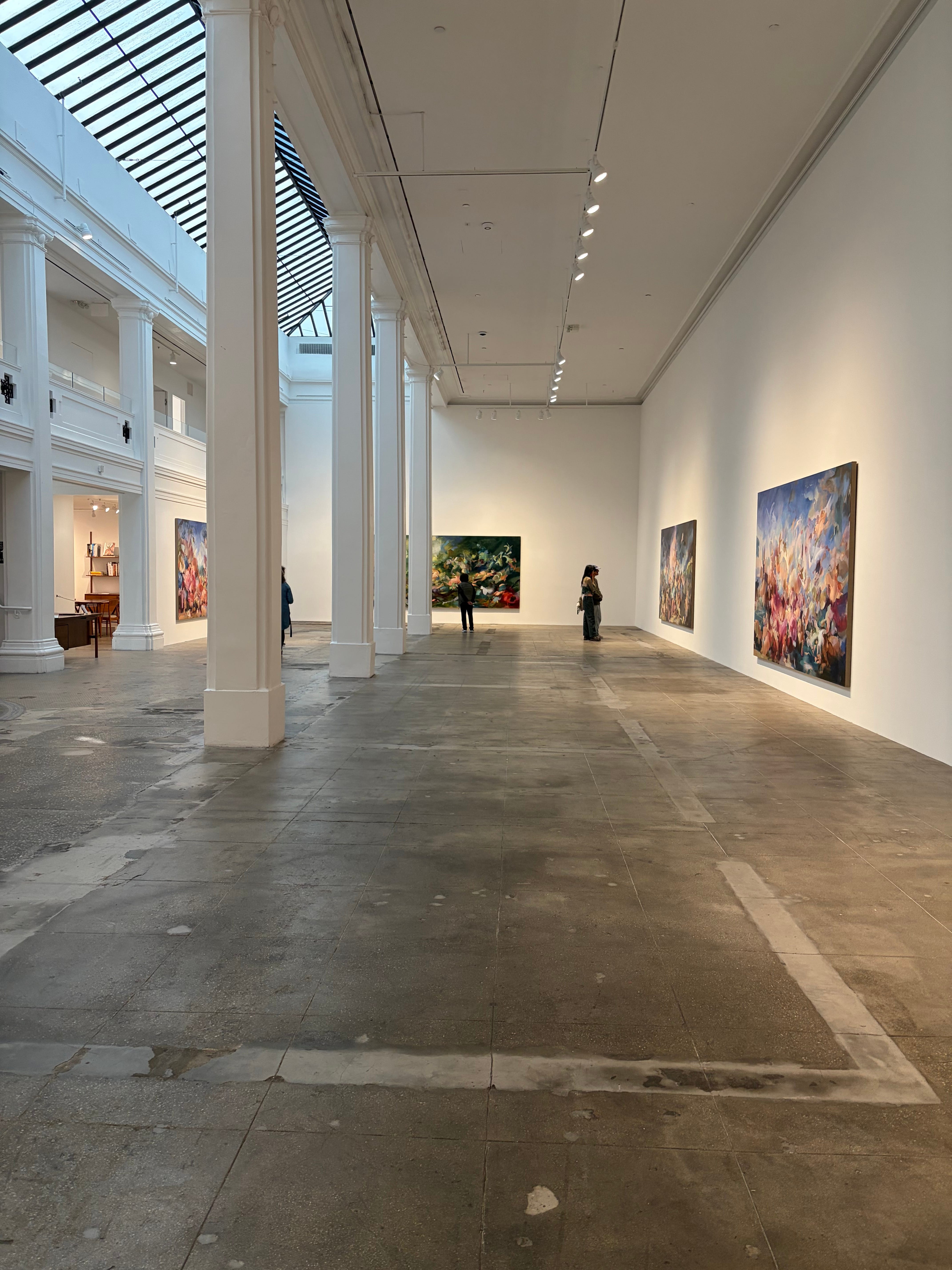
One of the strange things about the art world is that the same artwork can appear to become a different object depending on where it is encountered. The work itself may not have changed at all. The surface remains the same. The materials remain the same. The imagery remains the same. Yet context alters perception so dramatically that it can feel as though the work has undergone a kind of social alchemy simply by crossing a threshold.
A collage pinned to the studio wall feels intimate, exploratory, uncertain. The same collage hung in a respected gallery begins to radiate confidence and authority. The same collage reproduced in a museum catalog acquires the atmosphere of historical importance. The same collage placed in a flea market bin may suddenly appear disposable or overlooked. What changed was not the object itself so much as the psychological framing surrounding it.
This is difficult for many artists to reconcile because artists tend to experience the work from the inside out while much of the public experiences the work from the outside in.
The artist remembers the struggle, the experimentation, the failed attempts, the doubts, the moments of discovery. The collector or viewer often first encounters the work through signals of context: the neighborhood the gallery occupies, the architecture of the building, the lighting, the framing, the reputation of the dealer, the price on the checklist, the names of previous collectors, the social atmosphere of the opening reception. All of these surrounding conditions participate in the construction of meaning.
Location matters because human beings unconsciously absorb environmental cues. A gallery in Chelsea, Mayfair, Berlin Mitte, or the Marais does not merely provide wall space. It functions as a symbolic field. Entering such spaces, people are already psychologically prepared to encounter significance. The environment grants permission to take the work seriously.
This is not entirely false or manipulative. Context genuinely shapes experience in all areas of life. A simple meal eaten at home differs from the same meal served ceremonially in a beautiful setting. A stone found in a parking lot is ignored while the same stone placed on a pedestal in an archaeological museum becomes an artifact worthy of contemplation. Human beings continuously read meaning through framing.
At the same time, the art market reveals how deeply motivation influences perception. Many artworks are not purchased solely because they are loved visually or emotionally. They are also purchased because they function socially, psychologically, or economically.
Collectors often buy artworks for overlapping reasons:
to live with beauty,
to signal taste or education,
to participate in a cultural community,
to support artists,
to preserve wealth,
to speculate financially,
to construct identity,
to surround themselves with symbols of meaning.
These motivations are not necessarily cynical. Human beings rarely act from a single motivation. A collector may sincerely love a painting while simultaneously understanding that owning it places them within a certain social conversation. The emotional and the symbolic often operate together.
What becomes more complicated is the gradual objectification that can occur once artworks enter market systems.
In the studio, the work may still feel alive to the artist. It may carry memories, intuitions, fragments of inner life, years of searching. But once released into the market, the artwork begins to accumulate external identities. It becomes inventory, asset, commodity, cultural capital, investment vehicle, status marker, auction result, insurance value, storage liability, estate holding.
The object slowly drifts away from its original field of human experience and enters the machinery of exchange.
This transformation can produce discomfort in artists because the work often began as an attempt to escape objectification. Art is frequently born from inward necessity, vulnerability, confusion, longing, or wonder. The artist may have entered the studio seeking freedom from the mechanized logic of productivity and valuation only to discover that the artwork itself becomes absorbed into systems of ranking and transaction.
And yet this tension is unavoidable because artworks are physical things moving through the physical world.
The collector who purchases a work is not only buying an image. They are taking custody of an object that occupies space, requires care, carries social meaning, and enters into the architecture of a life. The work becomes part of a home, a conversation, an inheritance, a memory structure. It becomes woven into the identity of the people who live around it.
This is why sales often occur less through pure intellectual analysis and more through emotional recognition combined with contextual trust.
People buy artworks when several things align at once:
the work resonates emotionally,
the environment legitimizes the encounter,
the timing feels right,
the collector trusts the dealer or artist,
the object appears to embody something the buyer wishes to preserve, become, or remember.
Much of the gallery system is therefore not simply about displaying objects. It is about constructing conditions under which meaning can stabilize long enough for commitment to occur.
The gallery creates a temporary zone of focused attention where objects are lifted out of ordinary circulation and granted contemplative space. Ideally, this allows viewers to encounter the work beyond the noise of everyday life. At its best, the gallery becomes less a luxury store than a theater of perception.
Of course, the system also contains contradictions. Expensive locations create prestige precisely because access is limited. Scarcity generates desirability. Architecture becomes psychological persuasion. Price itself becomes a symbolic language. Many buyers unconsciously equate cost with importance because value in capitalist societies is constantly reinforced through economic signaling.
Artists eventually realize that selling art is not merely about making strong work. It is also about understanding how human beings construct meaning socially.
This realization can either become corrosive or clarifying.
If approached cynically, the artist may begin manufacturing prestige signals detached from authentic inquiry. The work becomes optimized for placement, branding, trend, and market compatibility. Art risks becoming luxury décor for identity management.
But understood more deeply, the artist can recognize that context is part of communication itself.
The challenge then becomes learning how to place the work into environments where its deeper qualities can actually be perceived.
A good gallery does not merely sell objects. It creates psychological conditions in which attention slows down enough for the work to reveal itself. It builds bridges of trust between artist, object, and viewer. It frames the encounter in a way that allows emotional and intellectual recognition to emerge naturally.
In this sense, location is not only geography. It is atmosphere.
Motivation is not only commerce. It is desire.
And objectification is not simply corruption. It is the inevitable fate of all things that enter human systems of exchange.
The artist’s task is to continue making work that remains alive even after becoming an object in the world.
Great article. I like that you consider art "alive" as I do. And you're so right on about where the art is located how it takes on that atmosphere of the place, the seller, the eventual buyer, while still retaining the artist's personal intent and meanings. When I have visited places where some of my art had ended up, I too see/feel the mostly subtle changes it takes on. I was thinking about this one piece this man had bought of mine many years ago and how he was taking it via ship to Greece and I tried to imagine the piece (wrapped up in her travels) and where she ended up in his home there. I do feel the life in each piece I've made. As a kid I'd feel the same about my stuffed animals and other toys.......there were very real in my mind and didn't think of them differently. And I feel the same when I pay attention to an object I'll find or buy to use in a piece. My mere attention to something wakes it up, so to speak and all the objects used in a piece are "alive" and join to make this one piece animated to me. Thank you for this article which I will re-read as it's a great subject to dwell on.