


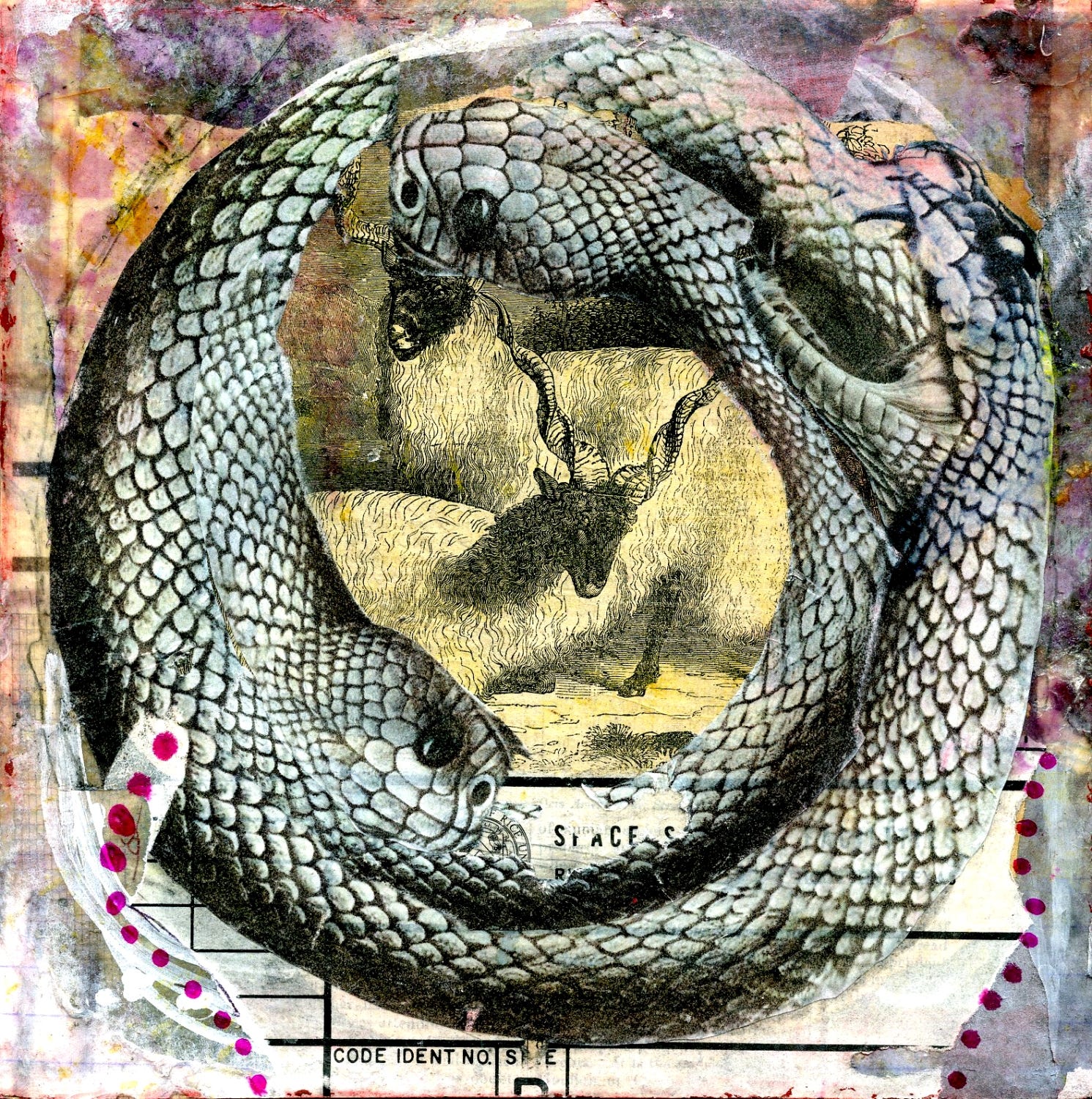
08/16/2025
Last night I watched an extremely disturbing and tragic story on youtube. I won’t share it with you because of how disturbing it was but it involved two dead children found in the trunk of a car, killed by their caregiver, an aunt. I’ll leave it at that.
This was especially disturbing to me having been a foster parent in my early adult life who spent two years living with sexually abused children. I have spent time up close and personal with the results of evil/insane behavior.
I have ever since thought about evil in the world and how to think about it. It is a confounding subject for all of us. One we wish to avoid. So this is the inspiration for this article today.
Live / Evil: On the Mirror Logic of Language
At first glance, the pairing of live and evil looks like a trick of spelling, a curiosity of English orthography. Etymologists assure us that the two words have no ancestral bond - evil comes from the Old English yfel, while live descends from Old English libban. Their similarity is an accident, a quirk of the alphabet’s history.
And yet, accidents in language are rarely neutral. They open a space where imagination rushes in. Across spiritual writing, esoteric speculation, and popular culture, the mirror of live and evil has taken on symbolic weight: a riddle, a warning, and an invitation.
Some traditions seize on the reversal as moral shorthand. To live truly is to choose the path that affirms life. Evil, in this light, is not merely the opposite of good but the negation of vitality itself - a parasitic inversion, a blocking of life’s natural flow. The ancient dualism of life and death is thus echoed, in English, by a playful inversion that feels like destiny’s pun.
Others lean into the ambiguity. On internet forums, people muse that to live fully one must taste both good and bad, suggesting that the mirroring is a reminder that life contains its shadows. Esoteric interpreters fold the word into a larger cluster: live, evil, veil, vile. In this constellation, to live in the material world is to move through veils of illusion, where evil is the distortion of life, and vileness its residue.
Artists and designers, too, have embraced the pairing. The ambigram of live / evil—a word that reads one way upside down and another in reverse - circulates widely in tattoos, jewelry, and graphic design. Here the relationship becomes visual, reminding us that meaning can pivot on perception, that what we see depends on the angle of our gaze.
The poet or mystic might conclude that while philology dismisses the link as accidental, the imaginal ear hears otherwise. For in the Root-Tongue of symbols, accidents are often revelations. Evil may not be the etymological twin of life, but it is its mirror image, showing us how quickly the current of existence can be inverted. The words we inherit contain more than their histories - they carry the shadows and echoes of meanings we cannot quite dismiss.
So we are left with the question: what does it mean to live in such a way that our life does not collapse into its reversal? The mirror of live / evil invites us to treat living itself as an art, an act of awareness, lest vitality be twisted into its own negation.
On Grappling with Evil: A Mystic Survey
The word evil carries a peculiar gravity. It conjures images of cruelty, corruption, and destruction. Yet the mystic traditions, East and West, often resist treating evil as a permanent force. Instead, they interpret it as distortion, imbalance, or ignorance - a shadow cast when the light of Being is blocked. To grapple with evil, then, is not merely to fight an enemy, but to learn how to reorient life toward its source.
Here is a set of inner practices, drawn from Buddhist, Taoist, Hindu, and Sufi mysticism, showing how a seeker might meet and transform the presence of evil in daily life. These are not prescriptions but invitations - field notes from traditions that understand evil not as a permanent enemy but as a veil to be worked through.
Buddhism: Evil as Ignorance and Attachment
In Buddhist thought, there is no eternal Satan, no cosmic principle of evil. Instead, suffering (dukkha) arises from ignorance (avidyā) and clinging (tṛṣṇā). What we call evil is the fruit of minds lost in delusion, inflamed by craving or hatred. The way forward is not to destroy evil as a substance, but to dissolve its roots through awareness. The Bodhisattva faces Mara—the personification of temptation and fear—not by violence but by recognition, saying: “I see you, Mara.” By seeing clearly, the spell breaks.
Buddhist Practice: Naming Mara
When destructive thoughts or impulses arise - fear, anger, jealousy - practice simply naming them. Say inwardly, “I see you, Mara.” This recognition interrupts the spell of identification. Sit, breathe, and allow the thought to pass without clinging. In naming, you refuse to become the shadow; you become the witness.
Taoism: Evil as Imbalance
Taoist sages understand harm and corruption as disharmony, the overextension of yin or yang. Evil emerges when one force overwhelms its complement, producing rigidity or chaos. The remedy is not punishment but restoration of flow. Like stagnant water turning foul, evil dissolves when the current is unblocked. Laozi writes: “The highest good is like water. Water benefits all things and does not contend.” To grapple with evil, then, is to become supple, to return the world and oneself to the Tao’s effortless balance.
Taoist Practice: Returning to Flow
When confronted with harshness, rigidity, or cruelty, imagine the situation as water blocked by stone. Do not strike the rock; instead, become like water. Breathe deeply, soften, and allow your energy to move around the obstruction. Sometimes this means yielding, sometimes finding a new channel, sometimes waiting patiently until the obstacle erodes. The inner practice is to ask: Where is the flow here? How can I align with it?
Hinduism: Evil as the Veiling of the Divine
In Hindu cosmology, evil is often associated with māyā - the illusion that hides the unity of Brahman. The demons of the epics are not separate from the divine but actors in the drama of creation, testing humanity’s discernment. The Bhagavad Gītā frames evil not as an absolute but as the triumph of the lower self (the gunas of inertia and passion) over the higher self. To overcome it is to align with dharma, to recognize the divine play (līlā) behind all appearances, and to act with devotion and clarity.
Hindu Practice: Aligning with Dharma
When evil appears in the form of injustice or disorder, turn to dharma - the alignment of action with truth. Pause and ask: What is my role here? What is the right action that upholds the greater harmony? Chant a mantra, such as Om Namah Shivaya, to still the mind. In the stillness, clarity emerges. Grappling with evil becomes less about reaction and more about acting from devotion, intelligence, and courage.
Sufism: Evil as Forgetfulness
For the Sufi, evil is rooted in ghaflah - forgetfulness of God. The ego (nafs) veils the heart, leading to greed, arrogance, or cruelty. But even this is not outside the divine plan. Rumi writes, “Every storm the Beloved sends is for your washing.” What appears as evil may be the friction that polishes the soul. Grappling with evil, then, means remembering: turning the heart back through dhikr (remembrance), until the ego’s distortions dissolve in divine unity.
Sufi Practice: Remembrance (Dhikr)
When the ego rises with pride, greed, or malice, place your hand over your heart and repeat the Divine Name - Allah, Allah - or a phrase of remembrance: La ilaha illa’llah (“There is no reality but the One”). Let the sound wash over the forgetfulness. Every repetition polishes the mirror of the heart. In this way, what seemed evil is revealed as forgetfulness, and forgetfulness is healed by remembering.
A Shared Thread
Though their languages differ, these traditions converge: evil is not an eternal rival to good but a condition of distortion, imbalance, or forgetfulness. To confront it is not to amplify its shadow but to restore awareness, harmony, and remembrance.
For the mystic, the greatest danger is not that evil exists, but that we mistake it for the final word. The work is to recognize its passing nature, to bear witness without surrendering to it, and to live in such a way that the reversal - evil as anti-live - is continually healed by the deeper stream of life.
The Small Self and the Living Way
Evil, as many mystic traditions remind us, is not an eternal force but a distortion. Often, the distortion begins with how we imagine ourselves. When the ego - the small self - believes it stands alone, surrounded by threats and competitors, the world appears hostile. Every encounter feels like a contest, every difference an enemy. The smaller we are in our own minds, the more we are driven to fight.
This is the tragedy of the isolated ego: it shrinks us into scarcity. Life becomes a zero-sum game. My gain means your loss. My survival requires your defeat. From this vantage, aggression seems necessary, even righteous. Yet it is all born from a fundamental mis-seeing.
Mystics across cultures invite us to step out of this cramped vision. The Upanishads whisper: “Tat tvam asi - you are that.” Rumi sings, “You are not a drop in the ocean. You are the entire ocean in a drop.” The Taoist sage smiles, knowing the same current animates river, cloud, and breath. The Buddhist monk reminds us that there is no separate self, only the flow of causes and conditions.
To see ourselves as connected, as unique expressions of a single living source, is to shift from defensiveness to participation. The world is no longer “against us.” It is with us, in us, as us. Instead of fighting others, we learn to work in rhythm with them, the way voices join in a song.
This does not mean we dissolve into abstraction or lose our uniqueness. Quite the opposite: our individuality becomes more vivid when seen as part of the whole. A flute does not lose its voice because it belongs in an orchestra; it gains its meaning. So too with us.
The deeper self—call it soul, essence, or divine spark - does not need to win or dominate. It only needs to remember. Remembering restores proportion, softens conflict, and opens us to a more living way of interacting with the world. We begin to see that harm done to others reverberates within ourselves, just as kindness ripples outward and returns.
To grapple with evil, then, is also to grapple with the smallness of the ego. The cure is not to inflate the ego but to recognize the deeper self it obscures. When we inhabit that larger self, life ceases to be a battlefield of confrontation. It becomes a field of relationship - an ecology of being in which each of us carries a spark of the same fire.
And so the question turns inward: Will we keep shrinking until everything feels like opposition, or will we widen our hearts and perspective until we see that Life itself is operating though us and all around us?
Thank you for this, Cecil!