


Learning Through Ruin
You have to design failure out of the process.
Not “give yourself permission to fail.” That still implies there was something at stake. That you were risking reputation, talent, identity. I mean something more structural.
Build a practice where failure is impossible.
In my workshops I say this often: If it goes badly, you learned something. The next one will be better.
That is not motivational language. It is mechanical truth. If you make a collage and it collapses, you now know something you did not know before. You learned about balance. About weight. About timing. About when to stop. That information is embedded in your nervous system. The next piece is informed by it. There is no loss. The only real failure is paralysis. High stakes kill creativity.
The moment you believe this piece must succeed, must be important, must justify your talent, must prove something - your hand tightens. Your perception narrows. You begin protecting instead of exploring. Protection produces timid work. Exploration produces living work.
So how do you remove stakes? You increase volume. Make more pieces. Commit quickly. Do the exact next thing. If it goes wrong, keep going to see what happens or start again.
When artists hover too long over decisions, what they are protecting is identity. They are trying to avoid looking foolish to themselves. But foolishness is data. Awkwardness is data. Collapse is data. Ruin teaches faster than caution. This does not mean recklessness. It means commitment.
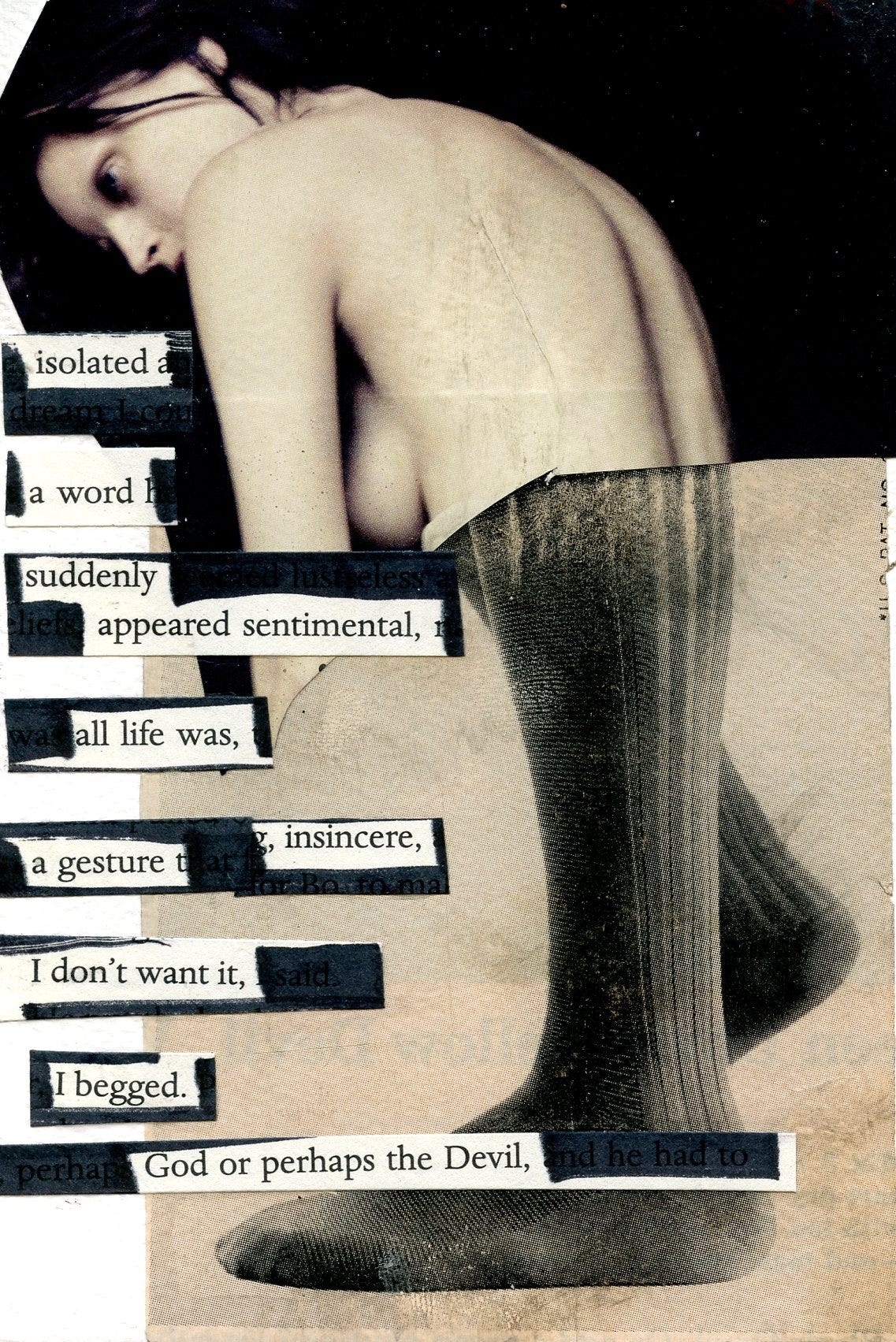
When I begin a collage, I loosely gather materials. I look for an opening move. Then I commit. Each fragment goes down with conviction. No half-pressing. No apology. If I destroy the surface, good. Now I know something. The problem is not making a bad piece. The problem is believing that a bad piece says something about you.
It doesn’t.
It says something about the experiment.
Design your practice so that no single work carries the burden of your worth. Make enough work that each piece becomes a study, not a verdict. The great trap for serious artists is importance. The more important the piece feels, the less alive it becomes.
When you experiment without expectation, perception sharpens. You begin listening instead of defending. You take risks because there is nothing to lose. And paradoxically, the work becomes stronger. Ruin is not the opposite of success. Ruin is instruction. If you are not occasionally ruining things, you are not stretching your capacity. You are repeating what you already know.
The studio should be a laboratory, not a courtroom. You are not on trial. You are gathering information. Make the move. Press the fragment down. If it goes badly, you learned something.
That is enough.
Excellently stated! Oh, the countless errors/failures I've made while creating my art have me smiling as I think back and cursed through those mistakes but I persevered and yes, did learn what went wrong so as to correct them and know the how-tos for the future pieces. I'm always experimenting as I'm doing/in the moment and it'll either work or won't. I've learned which glues are the best for whatever objects, whether or not 2 objects will even be able to be attached and how, which colors work and which make me cringe. I've also learned to use the journal to draw out what I'm wanting and the steps to take so I'm not going back later to undo or try to redo something. All learned from those wonderful teaching failures which at the time had me in tears but with 20/20 hindsight made some crucial realizations.