


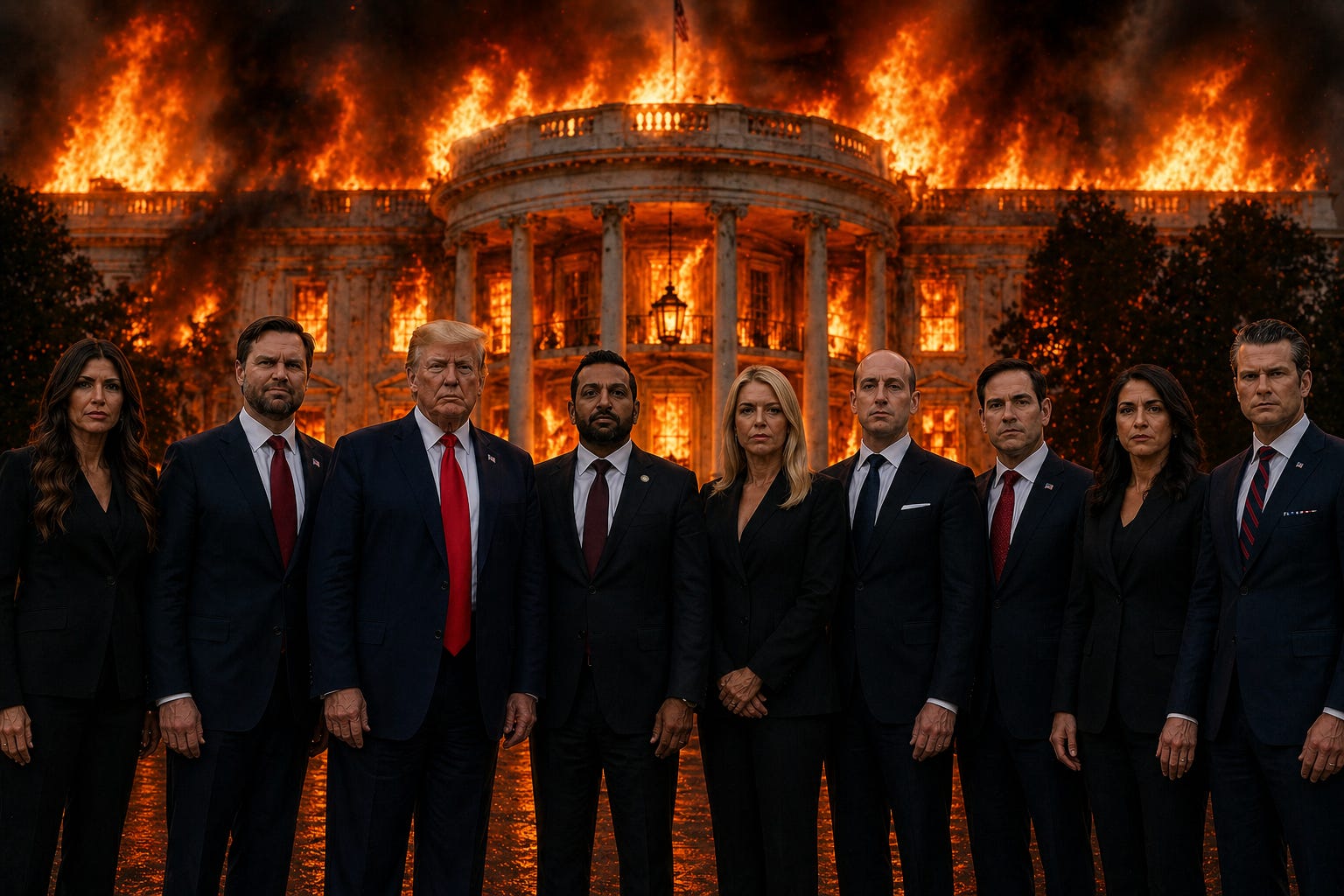
As I have stated previously, Trump Derangement Syndrome is not the general public that does not like D.J. Trump, it is those who follow and surround Trump that suffer from the upside-down, inside-out, topsy-turvy TDS world of Trump.
I am sorry to say that the mayhem we have been witnessing will take at least a generation to recover from if we can recover some semblance of America at all. Let’s take a brief look at the following…
Key Administration Figures and Their Controversial Roles
The administration’s “law and order” agenda has been defined by a select group of loyalists, though their tenures have been marked by rapid turnover and allegations of misconduct.
Attorney General Pam Bondi (Term Ended April 2026): President Trump fired Attorney General Pam Bondi on April 2, 2026. While Trump publicly called her a “great patriot,” sources indicated his frustration with her failure to successfully prosecute political rivals and her handling of Jeffrey Epstein’s investigative files. She has been replaced by Todd Blanche as Acting Attorney General. And the list goes on…
FBI Director Kash Patel: Patel faces intense scrutiny following allegations of personal travel on government aircraft and reports of unprofessional drunken behavior. He is currently suing The Atlantic for defamation over these reports. Additionally, Special Counsel Jack Smith reportedly issued subpoenas for Patel’s personal records as part of investigations into election interference. And the list goes on…
Vice President JD Vance: Appointed as the “Fraud Czar,” Vance leads a task force focused on rooting out misuse of federal funds, a move critics view as a political tool targeting Democratic-led states. On the global stage, his aggressive foreign policy—including publicly berating European allies and advocating for a U.S. takeover of Greenland—has caused significant diplomatic friction. And the list goes on…
The “Trump Docket”: Critical Supreme Court Cases
The Supreme Court’s 2025–2026 term is dominated by cases that will define the extent of executive authority.
Trump v. Cook: A central case questioning whether the President has the unilateral power to fire Federal Reserve Board governors, who are statutorily protected by 14-year terms and can only be removed “for cause”.
Learning Resources, Inc. v. Trump: This case examines the President’s legal authority to impose broad tariffs on foreign goods, a cornerstone of the administration’s economic strategy.
Trump v. CASA: A recent ruling where the Court determined that federal courts cannot issue nationwide injunctions against presidential actions, significantly limiting the ability of lower courts to halt administration policies.
The Shadow Docket: The Court has frequently used its “shadow docket” to halt lower court rulings against the administration - such as the ban on transgender military service - often without providing a written explanation.
Department of Government Efficiency (DOGE)
Led by Elon Musk and originally Vivek Ramaswamy, DOGE operates from outside the formal government structure to provide “advice and guidance”.
The American Presidency Project +1
Massive Workforce Reductions: Since January 2025, DOGE-led initiatives have reportedly resulted in over 320,000 federal employees departing the government. The Department of Veterans Affairs alone lost approximately 50,000 workers, including critical health care staff.
Contract and Grant Cancellations: DOGE claims to have saved over $215 billion through asset sales and the cancellation of federal contracts and grants. However, budget experts and organizations like Citizens for Responsibility and Ethics in Washington (CREW) dispute these figures, suggesting the actual savings may be less than $2 billion due to the economic disruption and loss of essential agency knowledge.
Conflicts of Interest: Because Musk is not a formal federal employee, he is not required to disclose his assets or divest from companies like Tesla and SpaceX, which hold billions in federal contracts.
Termination Date: President Trump has stated that DOGE’s work will conclude by July 4, 2026, coinciding with the 250th anniversary of the United States. And the list goes on…
Vice President Vance’s Fraud Task Force
Established by Executive Order on March 16, 2026, the Task Force to Eliminate Fraud is chaired by Vice President JD Vance.
Focus on “Blue States”: President Trump has explicitly directed the task force to focus its investigations on Democratic-run states, specifically naming California, Illinois, Minnesota, Maine, and New York.
Raids and Arrests: In April 2026, federal prosecutors announced the arrest of eight individuals in Los Angeles for an alleged $50 million health care fraud scheme, which Trump touted as the first of many “raids”.
Minnesota Medicaid Freeze: Vice President Vance froze over $250 million in Medicaid funding for Minnesota, accusing Governor Tim Walz of being “complicit” in widespread fraud—a move Walz described as a “campaign of retribution”.
Anti-Immigrant Rhetoric: Senior advisor Stephen Miller and other task force members have used official meetings to target immigrant communities, specifically Somali refugees in Minnesota, alleging they are exploiting the American safety net. And the list goes on…
As of April 2026, the second Trump administration’s immigration enforcement, led by Immigration and Customs Enforcement (ICE) and Customs and Border Protection (CBP), has been characterized by aggressive tactics and widespread legal challenges. Critics and several court rulings point to a pattern of behavior that they describe as unconstitutional and extralegal.
Kristi Noem & Allegations of Criminal Misconduct and Excessive Force
The administration’s mass deportation agenda has led to numerous violent incidents involving federal agents:
Fatal Shootings: In January 2026, federal agents in Minneapolis fatally shot two U.S. citizens, Renée Good and Alex Pretti, in separate incidents. These shootings triggered national protests and calls from some Republican lawmakers for investigations into federal tactics.
Widespread Use of Force: By early 2026, ICE agents had been involved in 16 shooting incidents, resulting in four deaths and seven injuries. Reports also describe agents using tear gas on protesters and breaking car windows during arrests.
False Assault Claims: An investigation found that in the vast majority of cases where individuals were arrested for allegedly “assaulting” federal agents, prosecutors declined to bring charges or cases were dismissed due to a complete lack of evidence. And the list goes on…
Unconstitutional and Illegal Enforcement Tactics
Federal courts have repeatedly ruled that the administration’s methods violate basic constitutional protections:
Warrantless Home Entries: Despite a 2025 directive from Attorney General Pam Bondi allowing agents to enter homes without warrants, a federal judge and whistleblowers have flagged this policy as a direct violation of the Fourth Amendment.
Suspicionless Stops and Racial Profiling: The ACLU filed a class-action lawsuit in 2026 challenging “suspicionless stops” and racial profiling by ICE and CBP in Minnesota. A federal judge recently found that agents in one operation stopped individuals based solely on skin color.
Violation of Court Orders: In January 2026, a Chief U.S. District Judge found that ICE had violated at least 96 court orders in 74 immigration cases in Minnesota alone.
Redefining “Flight Risk”: A new administration memo redefines “flight risk” so that anyone who asserts their legal right to walk away from a questioning agent can be arrested on the spot without a warrant. And the list goes on…
Systemic “Weaponization” of the Law
Advocacy groups like the American Immigration Council argue that the administration has “weaponized” federal law to treat civil immigration violations as criminal acts.
Targeting Non-Criminals: Arrests of immigrants with no criminal convictions surged by 770% during the first year of the second term.
Aggressive Revocation: The administration has reportedly ambushed legal residents, such as students, with arrest and detention instead of providing notice of status changes.
Retaliatory Arrests: There are documented cases of agents arresting individuals in retaliation for filing lawsuits against the government or for monitoring ICE activities in public.
Expansion of Power and Oversight Gaps
The administration has effectively “blended” federal law enforcement by granting immigration authority to agencies like the DEA, ATF, and even the Postal Inspection Service. Experts warn this realignment undermines public trust and creates a “culture of fear,” with reports of citizens being wrongfully detained or even deported based on their appearance. And the list goes on…
As of April 2026, the second Trump administration has rapidly expanded its immigration detention network, using controversial sites and tactics that have led critics and human rights organizations to characterize them as “concentration camps” or “inhumane warehouses.” This expansion is a central pillar of the administration’s mass deportation campaign.
The “Warehouse” and Tent Facility Expansion
To accommodate a detained population that reached a record high of over 73,000 individuals by early 2026, the administration has moved toward large-scale, unconventional housing:
Camp East Montana: Located at Fort Bliss in El Paso, this is the largest U.S. detention site, with a 5,000-person capacity. A February 2026 inspection found 49 violations of detention standards, including issues with medical care and the use of force. Detainees have reported “psychological torture,” extreme cold, and unsanitary conditions, including dust-clogged airways and leaking tents.
Commercial Warehouses: In April 2026, ICE announced plans to retrofit commercial warehouses across the country—some capable of holding up to 8,500 people each. These plans have faced delays due to legal challenges over lack of environmental reviews and the industrial, non-humane nature of the designs.
Detention in “Unexpected Places”: Facilities now include repurposed hotels, hospitals, and airports, which often lack the oversight and infrastructure necessary for safe human habitation. And the list goes on…
Human Rights and Deadly Conditions
Advocacy groups and government whistleblowers have documented a sharp decline in safety and basic care within these facilities:
Record Deaths in Custody: 2025 was the deadliest year for ICE detention on record with 33 deaths. This trend has accelerated in 2026, with 17 deaths reported in just the first four months, occurring at a rate of roughly one every six days.
Inhumane Treatment: Reports from facilities like the basement of a Los Angeles federal building describe detainees being held in fly-infested hallways, denied medical attention for pepper spray exposure, and fed only once a day at 3:00 a.m..
Abuse of Children: Over 6,200 children have been detained by ICE since the second term began. Reports include children being fed moldy food with worms and being denied clean drinking water or child-appropriate meals. And the list goes on…
The Legal Controversy: Mandatory and Indefinite Detention
The administration has pushed a “radical new theory” of mandatory detention, arguing that any noncitizen who entered without inspection is subject to no-bond detention regardless of how long they have lived in the U.S..
Court Rejections: On April 28, 2026, a federal appeals court rejected this mandatory detention policy, ruling that the administration misread decades-old laws to justify the practice.
Restricting Oversight: The administration has simultaneously moved to gut internal oversight and block members of Congress from conducting lawful, unannounced inspections of these facilities.
Critics argue that these conditions are not a byproduct of poor planning but a deliberate strategy of “detention as deterrence,” designed to pressure individuals into abandoning their legal cases and accepting deportation.
The Architect of the Warehouses: The Rise and Fall of Kristi Noem’s DHS
On March 5, 2026, the “Border Queen” of the second Trump administration was abruptly dethroned. Kristi Noem, once the face of the most aggressive mass deportation effort in American history, was fired by the man who appointed her. While the President cited a need for “new leadership,” the paper trail left behind at the Department of Homeland Security (DHS) suggests a much darker story of ethical rot and legal overreach.
The “Warehouse” Legacy
Under Noem, the term “detention center” became a euphemism. She presided over the rapid expansion of tent cities and repurposed commercial warehouses—facilities that human rights groups have increasingly labeled as “concentration camps.”
The conditions she signed off on were not just spartan; they were, in many cases, lethal. By the time of her firing, 2026 was on track to be the deadliest year in ICE history. Under her watch, reports surfaced of children being held in fly-infested halls and adults being denied water for days. When questioned by Congress about these conditions, Noem’s defense was often a mix of denial and deflection, prioritizing “throughput” over the basic human dignity mandated by international law.
The Shadow Use of Funds: Jets and Personal Interests
Noem’s downfall was accelerated by a series of ethical scandals involving the alleged misuse of taxpayer money.
Luxury Travel: Investigations revealed that Noem frequently bypassed government transport in favor of private luxury jets. These flights, often costing tens of thousands of dollars per trip, were reportedly used not just for official business, but for personal travel that blurred the lines of public service.
The Lewandowski Connection: Perhaps most damaging were the reports of an alleged relationship with Corey Lewandowski. Critics pointed to a pattern of “shadow management,” where Lewandowski—who held no official government rank—was reportedly influencing DHS policy and personnel decisions behind closed doors, often with Noem’s direct authorization.
Potential Criminal Liability: From Shootings to Retaliation
Beyond the ethics violations lies the specter of criminal behavior. Legal experts are now looking at Noem’s role in the “shoot-to-verify” culture that took hold within federal agencies under her command.
Obstruction of Justice?: Following the fatal shootings of U.S. citizens in Minneapolis, Noem was accused of interfering with local investigations. Her immediate labeling of a victim as a “domestic terrorist”—before evidence was gathered—has been characterized by some as a deliberate attempt to poison the jury pool and shield federal agents from accountability.
Contracting Fraud: Her department is currently under audit for awarding multi-million dollar “emergency” contracts for detention services to companies with direct ties to administration donors, often bypassing the competitive bidding process required by law. And the list goes on…
The Shield of the Americas: A New Bunker
In a classic move for this administration, Noem was not truly exiled; she was moved to a newly created role: Special Envoy for the Shield of the Americas.
This position, which lacks Senate confirmation and clear oversight, appears to be a “gilded cage” designed to keep her within the executive inner circle while insulating her from the growing number of subpoenas regarding her time at DHS. For the public, however, the question remains: Will the “Border Queen” ever face the law and order she so frequently invoked for others?
The second Trump administration faces significant scrutiny over a $220 million taxpayer-funded advertising campaign starring Kristi Noem, as well as several high-value DHS contracts awarded to campaign donors and political allies.
The $220 Million “Vanity” Advertising Campaign
During her tenure as Secretary of Homeland Security, Noem launched a massive advertising blitz that featured her prominently, often on horseback near Mount Rushmore.
Shady No-Bid Contracts: The DHS bypassed standard competitive bidding for the campaign, citing a “national emergency” at the border.
Safe America Media, a company created just eight to eleven days before being awarded the contract, received approximately $143 million.
People Who Think LLC, led by a former Trump campaign advisor with ties to Corey Lewandowski, received a separate multi-million dollar award.
Conflicts of Interest: Significant portions of the contract were subcontracted to The Strategy Group, a firm with deep ties to Noem and her senior aides. The firm’s CEO is married to former DHS spokesperson Tricia McLaughlin, who previously served as an aide to Noem in South Dakota.
Wasteful Production Costs: Detailed spending reports reveal tens of thousands of dollars spent on luxury production costs, including:
$60,000 “signing bonus” for the production company.
$20,000 for horse rentals used in the commercials.
$3,781 for hair and makeup.
$500 at a magic shop in Sioux Falls, South Dakota.
Questionable DHS Contracts to Campaign Donors
The administration is also under fire for awarding massive contracts related to its mass deportation and detention agenda to high-profile donors:
Project Homecoming: The Washington Post reported on a $1 billion contract fast-tracked for Salus Worldwide Solutions, led by a donor to pro-Trump groups. Internal investigations found DHS employees shared non-public information with the company to help it win the bid.
Pay-to-Play Allegations: Congressional investigators are looking into William Walters, a donor who contributed to a pro-Noem PAC. His companies landed lucrative deals to assist with the mass deportation agenda.
Shadow Management at FEMA: A contractor with no emergency management experience, Kara Voorhies, reportedly acted as a “shadow administrator” at FEMA, exercising control over spending and targeting federal grants for cancellation based on ideological priorities.
The Fallout and Reassignment
The “vanity” ad campaign and the associated contracting scandals were reportedly the final tipping points that led to Noem’s firing in March 2026. President Trump later contradicted Noem’s claims that he had personally approved the $220 million expenditure. Following her ousting, Noem was moved to a new position as Special Envoy for the Shield of the Americas, which lacks Senate confirmation or clear oversight. And the list goes on…
As of April 30, 2026, Pete Hegseth serves as the Secretary of War (a title officially restored by the second Trump administration) and is currently at the center of the intensifying conflict known as Operation Epic Fury against Iran.
The “Department of War” and Military Leadership
Hegseth has overseen a significant rebranding of the Department of Defense, emphasizing a “warrior mentality” and a “back to basics” approach that critics describe as a purge of senior military leaders.
The Rebranding: The name change to the Department of War reflects the administration’s “peace through strength” agenda.
Chairman of the Joint Chiefs: Hegseth is frequently joined by General Dan Caine, who replaced Gen. Charles Q. Brown Jr. in April 2025.
Operation Epic Fury: The War in Iran
The conflict, which began on February 28, 2026, was launched under the premise that Iran posed an “existential threat” via its nuclear program.
Current Status: Although Hegseth declared a “capital-V military victory” on April 8 after a two-week truce, the conflict has since entered a “new phase”.
The Blockade: The U.S. Navy is currently enforcing an “ironclad blockade” of Iranian ports, stretching from the Gulf of Oman to the open oceans.
Human and Financial Cost: As of late April, the war has cost $25 billion and resulted in the deaths of 14 American service members and over 400 wounded.
Controversies and “Questionable” Conduct
Hegseth’s leadership has been marked by contentious clashes with Congress and allegations of ethical and legal overreach:
Attacks on Critics: In April 2026 testimony, Hegseth labeled Congressional Democrats and some Republicans as the “biggest adversary” facing the U.S., calling them “reckless, feckless, and defeatist” for questioning the war’s endgame.
Civilian Casualties: Hegseth has repeatedly dismissed concerns about civilian harm, including a U.S. strike that reportedly destroyed a school and killed over 100 children. He has stated the U.S. would afford enemies “no quarter”, a statement experts identify as a potential war crime.
War Without Authorization: Lawmakers have grilled Hegseth for waging the conflict without Congressional approval and using “emergency” funding requests that could push the 2027 defense budget to a historic $1.5 trillion.
Global Economic Impact: The ongoing blockade and Iran’s disruption of the Strait of Hormuz have sent oil prices to a four-year high and triggered fears of a global recession. And the list goes on and on and on…
Why Future Historians Will Struggle to Categorize the Trump 2.0 Era
Based on the sheer scale of the shift in American governance by early 2026, historians and authors will likely be filling entire wings of libraries for decades. We aren’t just looking at political memoirs; we’re looking at a total re-categorization of the American experiment.
We are currently living through a period that future generations will not merely study, but struggle to believe. As of April 2026, the American Experiment has been replaced by a “Sovereign Presidency” - a reality where the Commander-in-Chief is legally barred from holding a handgun, yet holds the launch codes for a nuclear arsenal currently aimed toward Tehran.
When the dust settles and the government eventually changes hands, the library of the 2020s will be divided into several grim, yet necessary, categories.
1. The Anatomy of the “Cabal”
The most populated section of future bookstores will undoubtedly be True Crime. But these won’t be stories of street-level heists; they will be post-mortems of executive-level racketeering.
Historians will pore over the $220 million “vanity” ad campaigns starring Kristi Noem, the “shadow management” of FEMA by unqualified donors, and the “pay-to-play” pipeline that turned Department of Homeland Security contracts into a private ATM for the administration’s loyalists. The central question of these books will be: How did a political party transform into a criminal enterprise with sovereign immunity?
2. The Tragedy of the “Warehouses”
In the Human Rights section, we will find the most heartbreaking accounts. Books like The View from Fort Bliss will detail the human cost of the administration’s “concentration camps”—the repurposed commercial warehouses and desert tent cities where thousands were held in conditions that defied international law. These memoirs will serve as a permanent stain on our national conscience, documenting the era when “deterrence” became indistinguishable from state-sanctioned cruelty.
3. The “War of No Quarter”
The Military History section will be dominated by Pete Hegseth’s “Department of War” and the ongoing quagmire of Operation Epic Fury. Analysts will deconstruct how a $1.5 trillion defense budget and an “ironclad blockade” of Iran were used to bypass Congressional approval, effectively ending the era of civilian oversight. They will look back at the “warrior mentality” that led to the deaths of U.S. citizens at home and hundreds of children abroad, questioning how a nation of laws became a nation of “no quarter.”
4. The Restoration: Law and Order Reclaimed
Finally, there will be the Political Science of the “Great Restoration.” This is the category we must write ourselves. It will document the moment when the government transitioned back to a leadership committed to applying the consequences of law and order to this “criminal cabal.”
This won’t be a partisan “revenge tour.” It will be a clinical, necessary application of justice to ensure that the “Sovereign Presidency” is a historical anomaly rather than a permanent precedent.
The Verdict of History
Ultimately, the books written about this period will ask one fundamental question: Was the American public a witness to these crimes, or an accomplice?
When we look at the Republican dominated house and senate during this period we cannot say that they were not complicit and even openly participating in this travesty. An accounting must be taken.
By the time the next administration takes the oath of office, the evidence will be laid bare in the ledgers of DOGE, the manifests of the ICE warehouses, and the casualty lists from the Persian Gulf. The only way to ensure these books stay in the “History” section and don’t move to “Current Events” is a total and uncompromising return to the rule of law.
And we must insist on that from our lawmakers.
Thank you, Cecil, for this. All laid out so clearly. I just hope I live long enough to see the return to real law and order and repair of the damage done to our county.