


NOTE:
Here is the opening of a book project I am working on thinking of my grandson Henry. As you know, I have taken up some writing courses. In the middle of my studies I was inspired to think about the idea of Figures of Speech.
During the Renaissance, scholars meticulously enumerated and classified figures of speech. Henry Peacham, for example, in his The Garden of Eloquence (1577), enumerated 184 different figures of speech. Professor Robert DiYanni, in his book Literature: Reading Fiction, Poetry, Drama and the Essay wrote: "Rhetoricians have catalogued more than 250 different figures of speech, expressions or ways of using words in a nonliteral sense." wikipedia
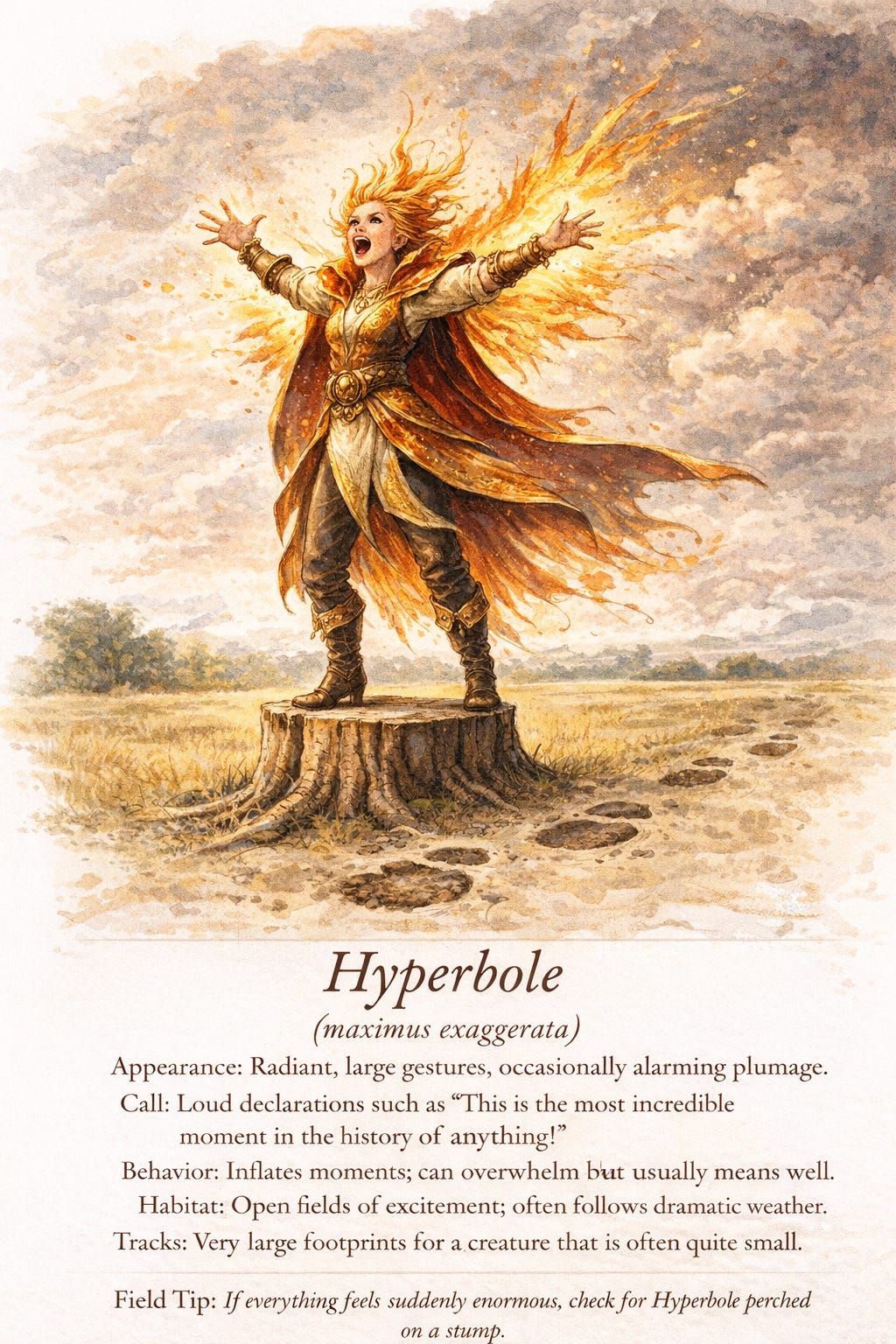
That was an amazing discovery. So I started thinking… Hum… How will I ever keep up with all of those figures and be able to recognise them in the ‘literary wild’ when I am reading? Then I thought, ‘What if I made up a story that identified all of these Figures of Speech and personify them into a story?’ Giving each one an assumed personality based on the kind of figure of speech they are and put them all into a town together with all of the other parts of language. So I came up with the Town of Tongues where they all eventually live together.
Talking about Personification that is a figure of speech which is when human qualities, emotions, or actions are given to non-human things:
The wind whispered through the trees.
Time marches on.
The city slept beneath the fog.
It is one of the oldest and most universal figures of speech, found in myth, poetry, children’s stories, and everyday conversation.
It is closely related to (but distinct from!) anthropomorphism, which gives non-human beings the form of humans, not just qualities.
So I decided to start at the beginning and make an entire mythopoeic world for this community of figures. And off we go… Here is the beginning…
I am hoping you all will be my Beta readers* for this story as it develops and leave your comments and ideas about it in the comment section.
*Beta readers are essential, typically unpaid, test readers who review a near-finished manuscript to provide honest feedback on plot, pacing, character arcs, and overall reader enjoyment before publication. They help identify issues like plot holes and inconsistent world-building. Found through online communities or personal networks, they differ from editors by focusing on the reader experience rather than technical grammar.
Author’s Note
for The Living Lexicon – Book One: How Language Was Born
Every story begins long before its first sentence.
This book grew from a simple wondering:
What if letters had a childhood?
What if vowels learned to sing the way children learn to breathe a little deeper?
What if consonants discovered strength the same way we discover our balance?
What if words, before they knew what they meant, existed simply as little beings trying to find their place in the world?
While writing this, I kept thinking about how each of us begins:
as small sounds,
as bright attempts,
as wobbly first steps.
We grow through curiosity, play, friendship, and the quiet encouragement of those who see a little farther than we do.
Language grows the same way.
This book is the story of that growing -
from the Great Blankness of pure possibility,
into the first glowing letters,
into sounds and structures,
into rhythm and meaning,
until at last the words begin to recognize who they are becoming.
Long before children learn grammar,
they feel it.
They sense the music of vowels,
the steadiness of consonants,
the dance of syllables,
and the gentle guidance of punctuation.
These tales are meant to meet children where they already are:
in the world of imagination,
where letters can glow,
stories can breathe,
and every word has a small heart inside it.
Book One is the beginning of a longer journey.
In the next volume, The Wanderwords, the little words you meet here will step beyond the Meadow and discover the larger world of language - a world full of adventure, mystery, possibility, and the playful peril of the Great Blankness.
As with all beginnings, this book is an invitation:
to listen with curiosity,
to read with wonder,
and to remember that every word you use
was once a tiny spark of imagination
learning how to become itself.
Thank you for joining me on the first steps of this journey.
- Cecil Touchon
Before the First Word
Before anything had a name, before any sound had ever been sung, before even letters knew how to stand or dance or shine, there was only The Great Blankness.
It stretched in every direction at once, soft and endless, bright as a thought that has not yet formed. It had no beginning and no end. It did not move because there was nowhere to go, and it did not rest because it had never been busy.
Yet it was not empty.
Inside the Great Blankness lived a quiet, shimmering feeling:
A longing.
A wish.
A gentle wondering that curled like mist and whispered through its boundless expanse.
The Great Blankness wanted something to be.
It wanted something to happen.
Most of all, it wanted companions - something other than its own endless Self.
For ages beyond counting, the Great Blankness drifted in its own soft glow. But longing gathers itself over time, just as clouds gather rain. And one day - or perhaps not a day at all, for days did not yet exist - the longing grew full enough to spill over.
And when longing spills, it becomes light.
A soft brightness formed inside the vast white, like the very first firefly being imagined into a shining flicker.
Then another brightness.
And another.
Little glimmers, tiny as seeds, twinkled in the quiet. They were not yet shapes. Not yet letters. Not yet anything one could point to nor anything yet to point with.
They were simply desires - the first desires to become.
Some glimmers wished to be steady and strong.
Others wished to move, leap, swirl.
Some wanted to hold meaning like a cup.
Others wanted to sing meaning like a song.
The Great Blankness felt these glimmers and was no longer lonely.
It gathered them gently, as a sky gathers raindrops.
Each glimmer grew brighter.
Each one quivered with possibility.
Each one began to tug itself into form.
And then, like the first drops of rain falling from a cloud of pure wanting, the glimmers softened into little droplets of brightness - tiny luminous seeds of being.
The droplets stretched.
Shivered.
Straightened.
Curved.
And slowly began to take on the earliest shapes of what would someday become letters.
They did not yet know how to sound.
They did not yet know what they meant.
They did not yet know if they were nouns, or verbs, or something else entirely.
They only knew one thing:
They wanted to become something.
The Great Blankness watched them tenderly, full of wonder. It had wanted companions, and now companions were forming right inside its boundless heart.
The droplets glowed.
The shapes steadied.
Desire condensed into form.
Possibility began its long journey toward meaning.
And so, in the quiet light of longing becoming shape, the very first letters were born.
They were still soft, still shimmering, still half-dreaming - but they were no longer nothing.
They were the first beginnings of something.
The first sparks of becoming.
The first tiny sparkling lights in the endless white.
And the Great Blankness, for the first time in its existence, whispered to itself:
“Yes…
This is how a story begins.”
Wonderful!