


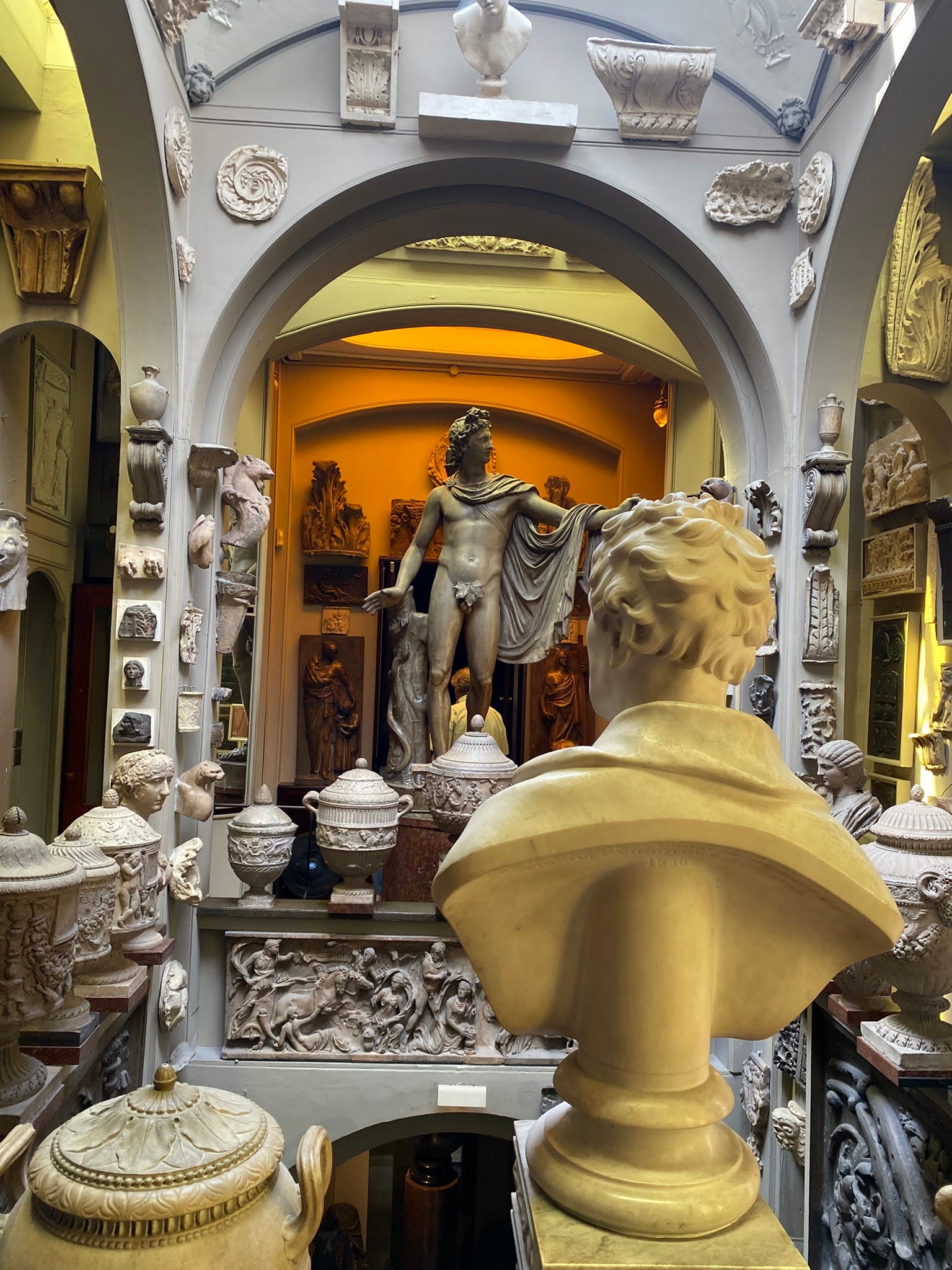
Sir John Soane’s Museum is essentially a “time capsule” of a 19th-century collector’s home. It’s famous for being incredibly cramped and atmospheric, with every inch of wall space covered in art, antiquities, and curiosities.
Unlike a typical modern museum, nothing has been moved since Soane’s death in 1837. You’ll find narrow hallways, hidden spaces, and ingenious architectural tricks—like the Picture Room, where the walls literally fold out to reveal three times as many paintings. It’s an eccentric, must-see treasure chest right in the middle of London.
From Patronage to Platform
The history of the Western art world is often told as a story of great works and great artists, moving from one period to the next in a kind of unfolding progression. But beneath that familiar surface runs another story, quieter but more structurally decisive.
It is the story of how art moved from being embedded in systems of power, to being collected, to being institutionalized, and now to being circulated through platforms.
At each stage, the question of value shifts slightly, and with it, the relationship between the artist and the world.
Before there was an art market, there was patronage.
Artists worked for the Church, for royal courts, for powerful families. Their role was not to express an individual vision in the modern sense, but to fulfill a function within a larger symbolic and social order. The work had a place before it was made. Its purpose was understood in advance.
In this setting, the artist was not competing for visibility in an open field. They were embedded within a hierarchy. Their livelihood depended on proximity to power, not on public recognition.
This arrangement limited certain forms of freedom, but it also carried a kind of stability. The artist did not need to invent a market for their work. The structure was already there.
During the Renaissance and into the early modern period, something began to shift.
Wealth accumulated in new ways. Merchant classes rose alongside older aristocracies. Art began to move, slowly, from commission toward collection.
Works were no longer made only for specific locations or functions. They could be acquired, owned, displayed, and compared. A painting could leave its place of origin and enter a private collection, where it would exist alongside other works, forming part of a curated environment of taste and status.
This marked a subtle but important change.
Art became portable.
And once portable, it became accumulable.
Collectors emerged as a new kind of intermediary. They did not produce the work, but they determined which works would be gathered, preserved, and shown.
Their decisions were shaped by many factors - personal inclination, social signaling, access to artists, advisory networks. These were not neutral selections. They were situated choices, made within specific social and economic conditions.
Yet over time, those choices began to carry weight beyond the moment of acquisition.
As collections grew, they began to formalize.
Private holdings became public institutions. Museums emerged, often built upon the foundations of aristocratic or state-controlled collections. What had been gathered as a sign of private distinction was re-presented as a form of public culture.
Within the museum, the artwork took on a new role.
It was no longer simply an object of possession.
It became an object of history.
Placed in sequence, categorized, interpreted, the work entered a narrative. It was given context, meaning, and position within a larger story of artistic development.
But this story was constructed from what had been collected.
The field of living artistic production was vast. What entered the institution was a small portion of that field, filtered through layers of selection. Yet once inside, these works began to stand as representatives of the whole.
The institution, by necessity, reinforced its own importance. Its collection justified its existence. Its existence validated its collection.
A loop formed.
And within that loop, a quiet assumption took hold: that what is preserved is what matters most.
This assumption is difficult to examine because it feels natural.
The museum is where one goes to see “the best” work. The canon is understood as a record of achievement. Art history appears as a lineage of significance.
But the pathway into that lineage has always been narrow.
Many works never entered collections. Many artists worked outside of the networks that led to acquisition. Many practices did not align with the tastes or interests of those making the selections.
What we inherit, then, is not the full record of artistic life, but a shaped and partial one.
This does not mean the works that remain lack value. Many are extraordinary. But their presence tells us as much about the systems that selected them as it does about the culture that produced them.
In the present moment, this structure has not disappeared.
It has multiplied.
The traditional pathways of collector and institution still operate. Works are still acquired, preserved, and elevated through established channels. The museum continues to hold authority.
But alongside this, a new system has emerged.
Platforms.
Where the museum selected through acquisition, platforms select through visibility. Where institutions built narratives over time, platforms generate them in real time through amplification.
The criteria are different, but the effect is similar.
A vast field of production is filtered.
A small portion rises.
That portion comes to represent the whole.
Once again, the majority of creative activity remains outside the dominant narrative, not because it lacks substance, but because it did not pass through the mechanisms of selection.
There is, however, a crucial difference.
The earlier system depended on scarcity.
The current system depends on abundance.
There is now more art, more expression, more production than at any previous point. The field has expanded beyond the capacity of any single structure to contain it.
And yet, the impulse to define value through narrow channels persists.
If there is a question for artists within this history, it is not only how to enter these systems, but how to understand them in proportion.
To see that the museum is not the whole field.
That the market is not the measure of all value.
That visibility is not equivalent to significance.
And further, to consider whether new forms might emerge that do not rely on such narrow gates.
Forms of circulation that do not require extraction.
Forms of preservation that do not depend on institutional validation.
Forms of recognition that arise within the living culture itself.
The history of the Western art world is not only a story of creation.
It is a story of selection.
And we are now living in a moment where the means of selection are shifting again.
The question is whether this shift will widen the field of what can be seen and remembered, or simply produce new gates that function in more subtle ways.
Most of the culture, as ever, exists outside the frame.
The work of the future may lie in learning how to see it without first reducing it.
There was a time when I had not only collectors who bought my art, but some owned several pieces. And if I got the chance to visit their homes, it was always a treat to see one of my pieces in their environment and how it seemed to take on a whole new vision as the piece would often feel "at home" in it's space. I'd go over to it as telepathically "speak" to it, telling it hello and that I was happy that it seemed "happy" to be there and still looked good to me. Now my art fills my home and has its place on just about every available surface and I still greet them (sometimes out loud) and enjoy seeing them. Maybe someday they'll end up somewhere else but for now.....their home is with me. I like visiting museums as I can see whatever is displayed there and imagine how it may have looked in someone's studio in the various processes of being created.