


Childhood Fragments in the Shadow of History
Journal Entry: May 18, 2026 – 8:07 PM
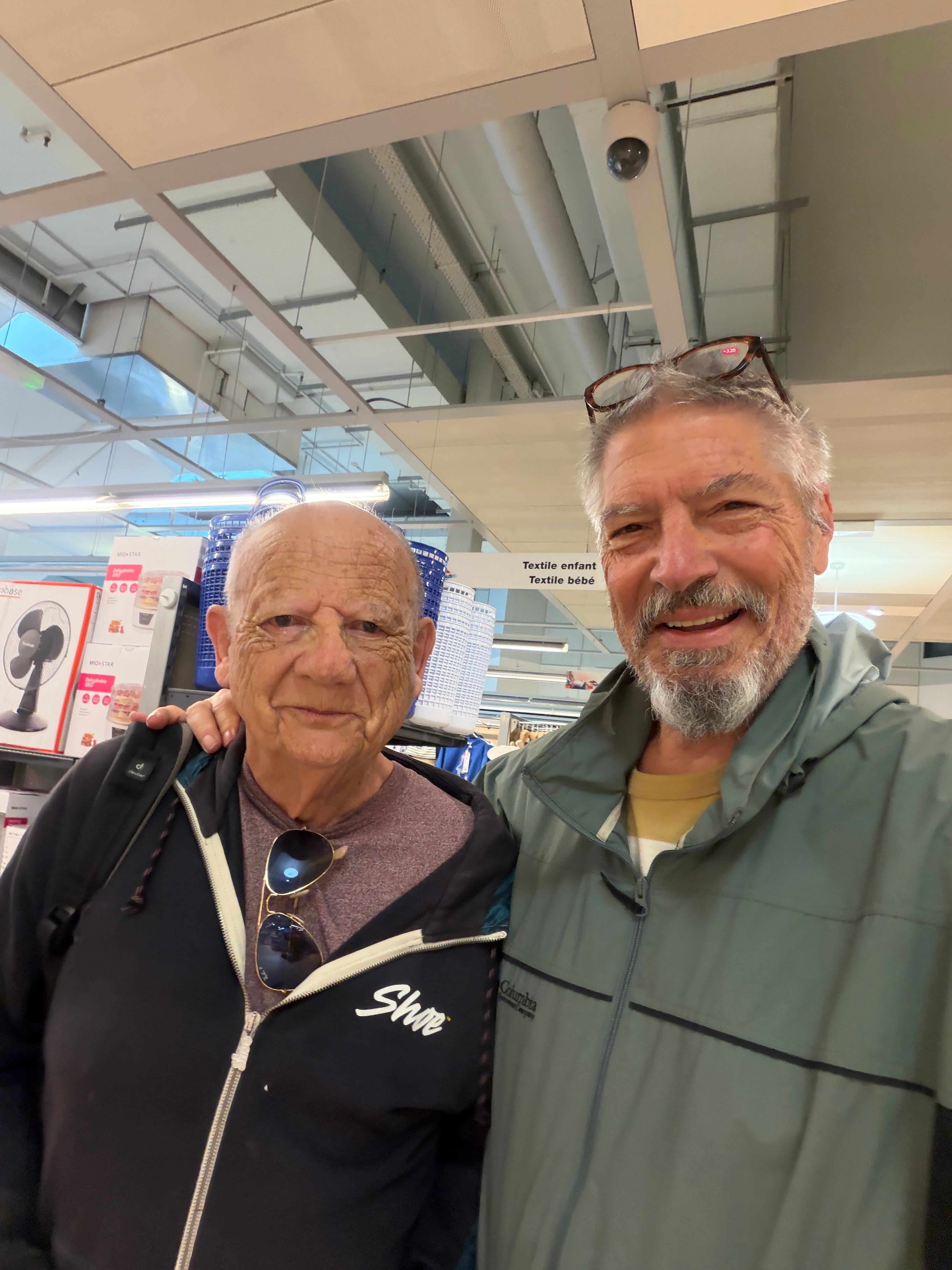
Recently, while visiting my friend, the undisputed greatest living collage artist in Switzerland, Berni Stephanus - age 85 - in Geneva, we spent several days together exploring Geneva, having meals together and discussing his massive body of collage art numbering around 10,000 works of collage since the 1960’s. We also discussed the growing role of artificial intelligence, especially LLMs, in the studio and, more specifically, how tools like ChatGPT might function not simply as generators of text, but as conversational partners capable of helping artists reflect on and articulate the deeper psychological and historical dimensions of their work.
Berni shared one of his recent collages along with a remarkable exchange he had with ChatGPT concerning the image. What interested me was not only the analysis itself, but the way the conversation gradually opened a pathway back into personal memory. The collage became less an isolated artwork than a doorway into lived past experience.
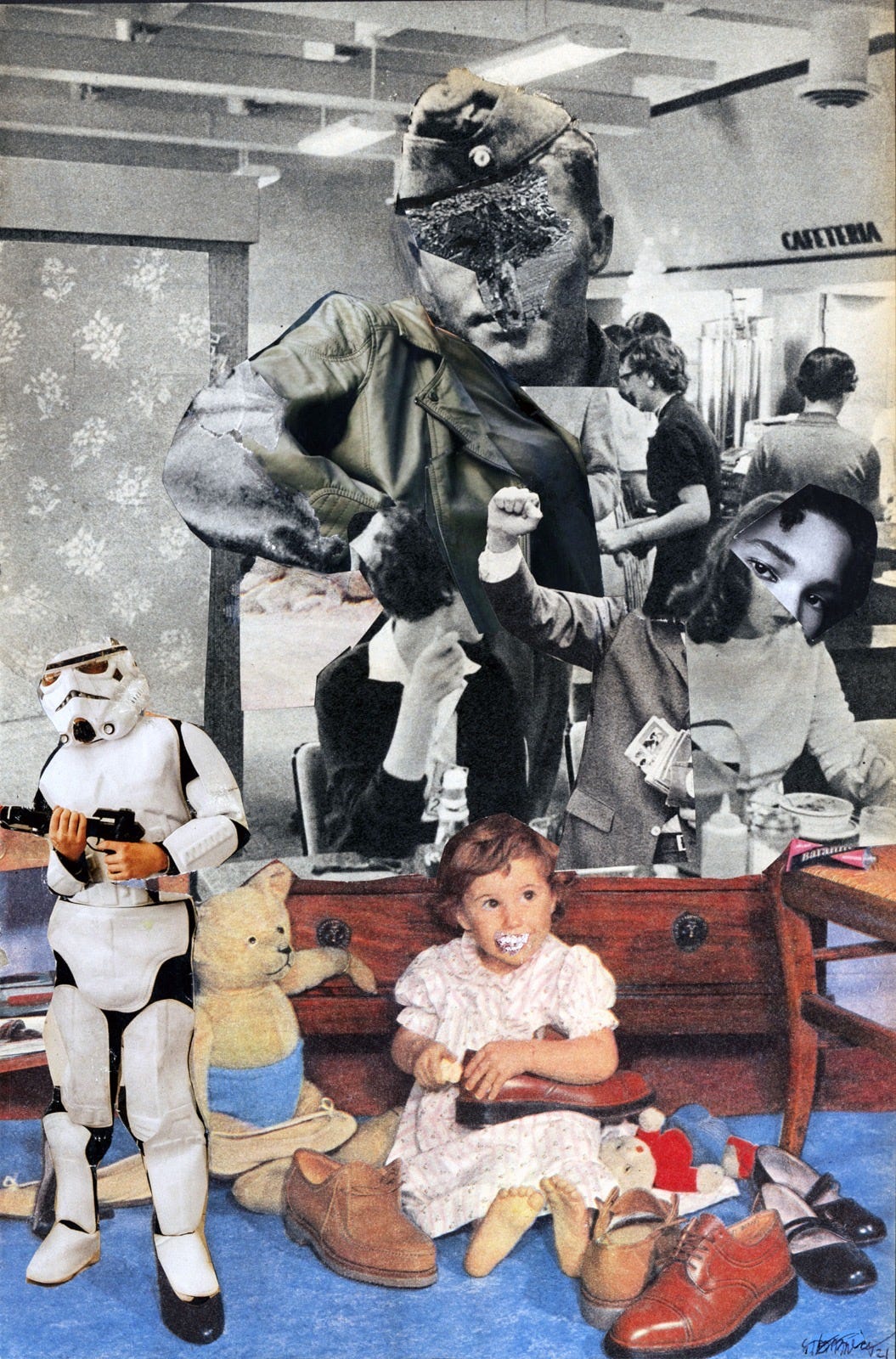
The work immediately presents an atmosphere of unease. A child occupies the lower center of the composition surrounded by toys, parents’ shoes to fill as the child polishes one of the father’s shoes, and other domestic fragments while, looming above, are damaged and fragmented adult figures, one wearing a military cap, another partially erased into metallic textures that feel both human and machine-like. A toy stormtrooper suggesting empire stands nearby like an absurd emissary from the world of spectacle and normalized violence.
What is striking is that the child does not appear frightened. She remains absorbed in her own world. That emotional tension becomes the psychological center of the work.
As the AI analysis observed:
“The collage is not meant as an illustration of one event.
It functions more like a dream or fragmented recollection, where innocence and menace coexist without clear explanation.”
What began as a discussion of composition and symbolism slowly moved toward autobiography. As I often say, everything an artist makes is autobiographical in some way or other.
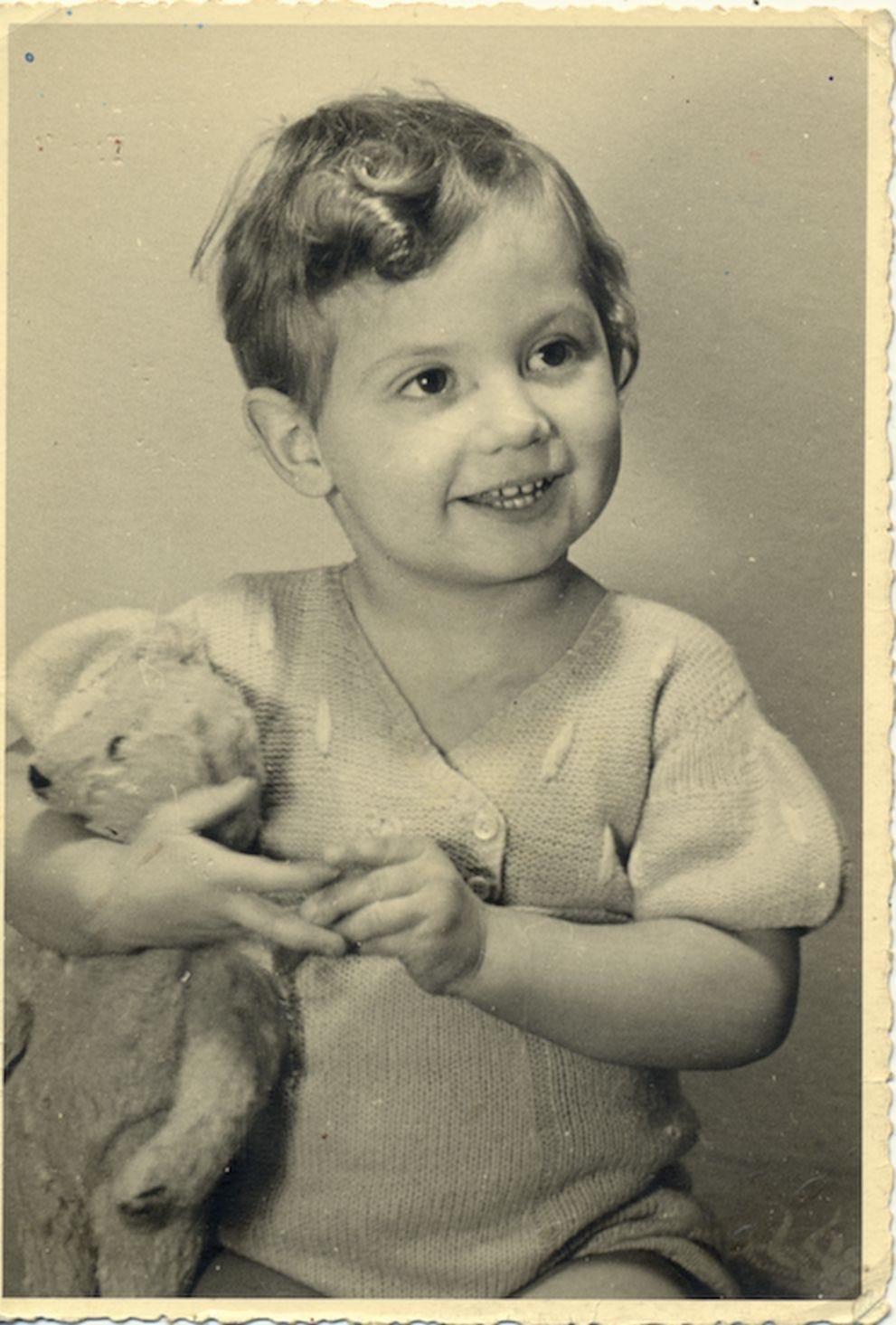
Berni then uploaded a childhood photograph of himself holding a teddy bear during the war years in Germany. Suddenly the teddy bear within the collage was no longer simply symbolic. It became a surviving trace of childhood memory itself.
Berni wrote:
“I should add that this collage also reflects my own childhood in a village near Hanover, Germany, between approximately 1941 and 1945. My parents had retreated there because of the bombings and because my mother was Jewish. The presence of the teddy bear comes from a personal memory - I had one myself as a child.”
The emotional force of the collage deepened considerably once this connection emerged. The image no longer functioned solely as political commentary or cultural critique. It became anchored in lived history while still retaining ambiguity and poetic openness.
One of the more insightful observations generated during the exchange was this:
“The same teddy bear becomes a fragile bridge between private memory and historical violence.”
I think this touches on something important about collage itself.
Collage often works precisely because it resembles memory. Human memory is rarely linear, stable, or complete. It arrives in fragments, dislocated images, emotional residues, flashes of detail disconnected from chronology. A face, a shoe, a toy, a gesture, wallpaper, uniforms, cafeteria lighting, a child’s expression - all of these survive differently within the mind. The collage process mirrors this condition naturally.
What fascinated both of us during these conversations was the way AI could sometimes function as a reflective surface, helping an artist hear echoes already latent within the work. The machine was not “explaining” the collage so much as tracing pathways through its emotional architecture.
At its best, this kind of exchange resembles a studio dialogue. The artist discovers what the work knows before the conscious mind fully catches up to it. This intuitive form of encounter is central to Bernie’s approach to constructing his collages.
Berni was amazed by how closely the interpretation matched his own intuitive decision making. Berni has always avoided intellectualizing his work in order to maintain a clear connection to his intuitive impulses allowing the deeper non-linguistic creative synthesis to dominate.
Berni’s collage remains powerful because it refuses certainty. It does not collapse into propaganda or fixed interpretation. Instead it preserves the instability of memory itself - where childhood innocence and historical catastrophe exist side by side in uneasy and ironic proximity.
The child remains seated among scattered shoes and toys while above her the adult world fractures into masks, uniforms, spectacle, and authority.
History hovers overhead.
But the teddy bear survives - an imaginary companion, confidant and protector.
Observing the collage we can see how the compositional structure works in a very classical way in terms of placement and scale of the various elements.
While skeptical of verbal explanation and Bernie’s insistence on ambiguity and intuitive understanding on the viewer’s part, we discussed the possible use of an LLM to provide textual context for Bernie’s sophisticated works that might help viewers to understand, at least in part, his recurring iconography which is constantly exploring and commenting on society, the human condition and the circumstances we all find ourselves in no matter who we are or where we live.
I suggested that, like all lifelong artists, we are constantly wandering around in the chambers of our own hearts, our own house where we know every nook and cranny and it is difficult to point out to others in language all of the wonderous things that could be discovered by visitors if invited and given enough instruction to find their way around and have an inkling of what they are seeing.
I am looking forward to what Bernie comes up with related to this new collage tool and how it might enhance the viewers understanding of his massive body of work.
See more work at Stephanus.com
What a fantastic interaction of collage making, process& memory (&AI?).
Bravo!
I so love to see what other artists create and your writing about Bernie's work was quite intriguing to me. I believe true artist such as yourself and Bernie will integrate their pasts (and present) into their work even within the abstract as well as the a composition with obvious symbols and recognizable objects. We create what we know and are instead of merely having a blank mind and just sticking objects together as in assemblage or putting pieces of paper onto a backdrop just because in a robotic way, I don't see doing any of that with a blank mind.....thoughts, feelings, meaningful opinions, choices, all affect the art from the subtle to the obvious. As human beings, we're creating and expressing what matters and not just because the finished product is a pretty thing that matches the colors of the sofa.