


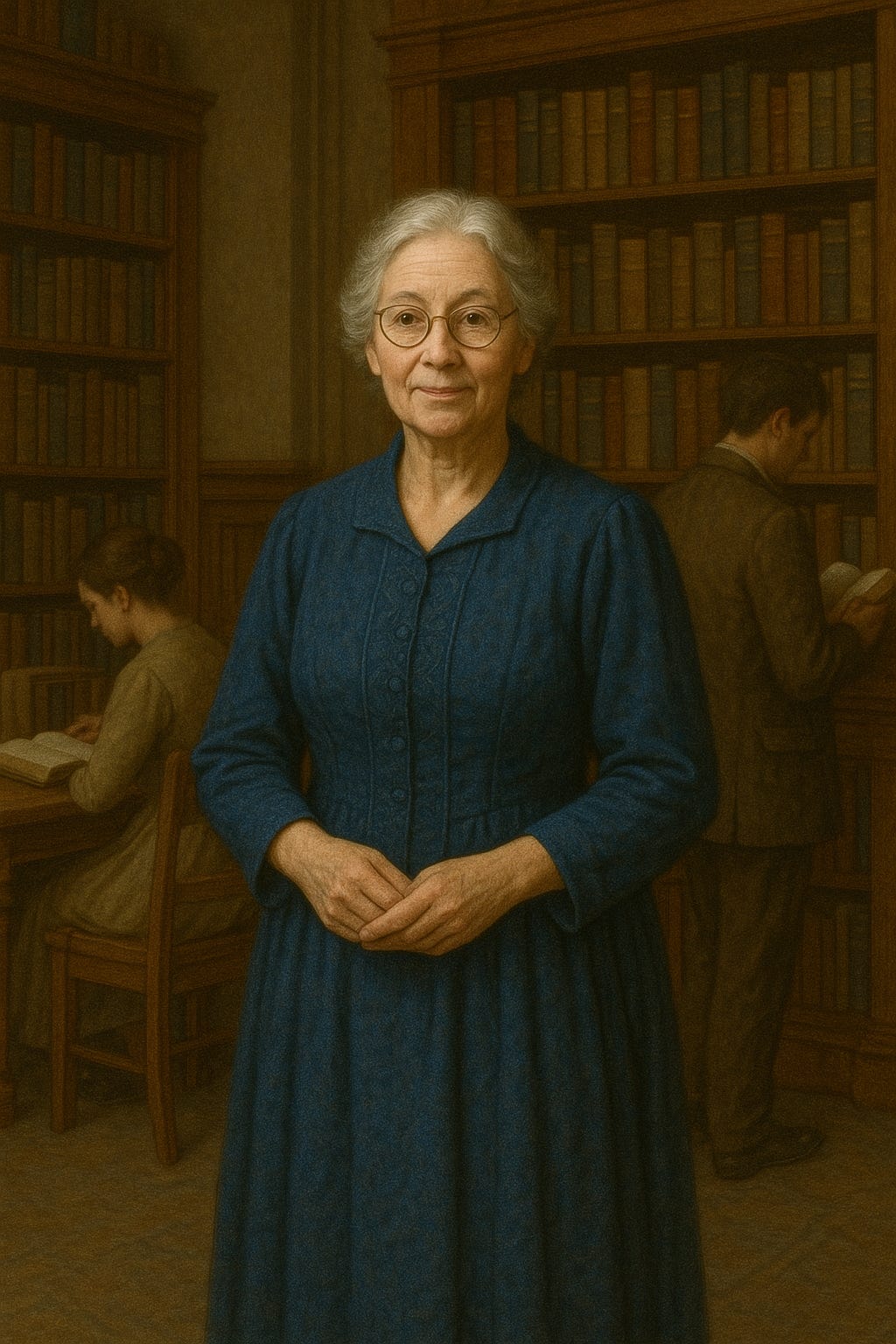
Chapter One: The Librarian’s Decision
Rain fell in steady threads against the high windows of St. Edda’s Municipal Library, a sound like distant applause. Agnes Whitcombe, its chief librarian for nearly twenty years, sat at her oak desk cataloguing the latest donations: a box of forgotten sermons, three romance paperbacks, and a leather-bound curiosity with gold-flecked edges titled On the Art of Reigning Well.
The book smelled of dust and lavender. Its title alone stirred something dormant in her—a strange mixture of amusement and ache. She turned the first brittle pages and found the opening line underlined in a faded hand:
“To rule oneself is the beginning of ruling wisely.”
Agnes closed the book and stared into the gray afternoon. Outside, umbrellas drifted past like slow-moving petals. Inside, the library was nearly empty—only the soft hum of the heater and the occasional flutter of pages from the reading room below.
It had been another day of small irritations: a patron arguing about late fees, a teenager sneaking coffee into the archives, the city council announcing budget cuts “for efficiency’s sake.” Agnes had smiled politely through it all, her patience polished by years of quiet service. But lately, a weariness had begun to settle in her bones, a sense that the world beyond the library had forgotten the art of reverence.
She looked again at the phrase in the book and whispered it aloud.
“To rule oneself…”
The words felt oddly right in her mouth, like a forgotten prayer.
That evening, after locking up the building, she carried the book home in her satchel—technically against policy, but librarians are the most courteous of thieves. Her small flat above the greengrocer smelled faintly of rain and peppermint tea. She hung up her coat, fed her cat, a portly creature named Milton, and opened the book once more at the kitchen table.
It was a curious manual of conduct for imaginary monarchs: instructions on posture, ritual, mercy, and restraint. But beneath the antique language Agnes sensed something timeless—the idea that dignity is a kind of inward choreography, a deliberate ordering of thought and gesture.
“Very well,” she said to Milton, who blinked at her from the counter. “Let us reign.”
And so it began.
She formed the habit of taking tea at four precisely, stirring clockwise three times “for fortune’s favor.” She curtsied to the morning sunlight as she drew the curtains, addressing it as “Our loyal subject, the Day.”
At first, she treated it as a private joke, a small rebellion against the creeping coarseness of modern life. But soon she noticed the effect it had upon her. When she held herself like a queen, her thoughts slowed; her speech grew kinder; even the cat seemed to regard her with new respect.
Every evening she studied the instructions in the book, and then one by one, day by day, she practiced them. She analyzed them and studied the effect on herself. She considered the philosophy and psychology of the practice. Over time they became embodied in her every thought, movement, response.
At work, she began speaking with a calm authority that startled her colleagues. When two patrons quarreled over a computer terminal, she merely lifted her hand and said, “Peace in the realm,” and somehow, absurdly, they stopped.
Her assistant, young Mr. Dallow, whispered to a co-worker, “She’s gone a bit eccentric.” But by the following week, he found himself unconsciously bowing as he entered her office.
The change in her was subtle yet undeniable. She dressed more neatly, listened more attentively, laughed more freely. The patrons noticed. “The library feels different lately,” one remarked. “Peaceful. Like someone’s in charge again.”
Agnes smiled. Someone is, she thought.
In the quiet hours between shelving and closing, she wrote new decrees in her journal:
All citizens of the library shall be greeted with kindness, even the impatient ones.
Tea breaks are matters of state.
Order is beauty in repose.
One night she dreamt she stood on the library steps wearing a paper crown, the townspeople below her bowing not in submission but in relief, as though someone had remembered how to be kind on their behalf.
When she woke, she laughed softly. “Imagine, Milton,” she said. “A queen without the bother of a kingdom.”
Milton yawned, unimpressed.
But as she left for work that morning, a thought occurred to her—quiet, thrilling, and slightly absurd: Perhaps the kingdom is imagination itself.
She locked the door, straightened her posture, and set out into the rain as if into ceremony.
Thus began the reign of Her Majesty the Queen - Sovereign of Elsewhere, though the world had not yet been informed.

Looking forward to next adventure💕
The power of gratitude.