


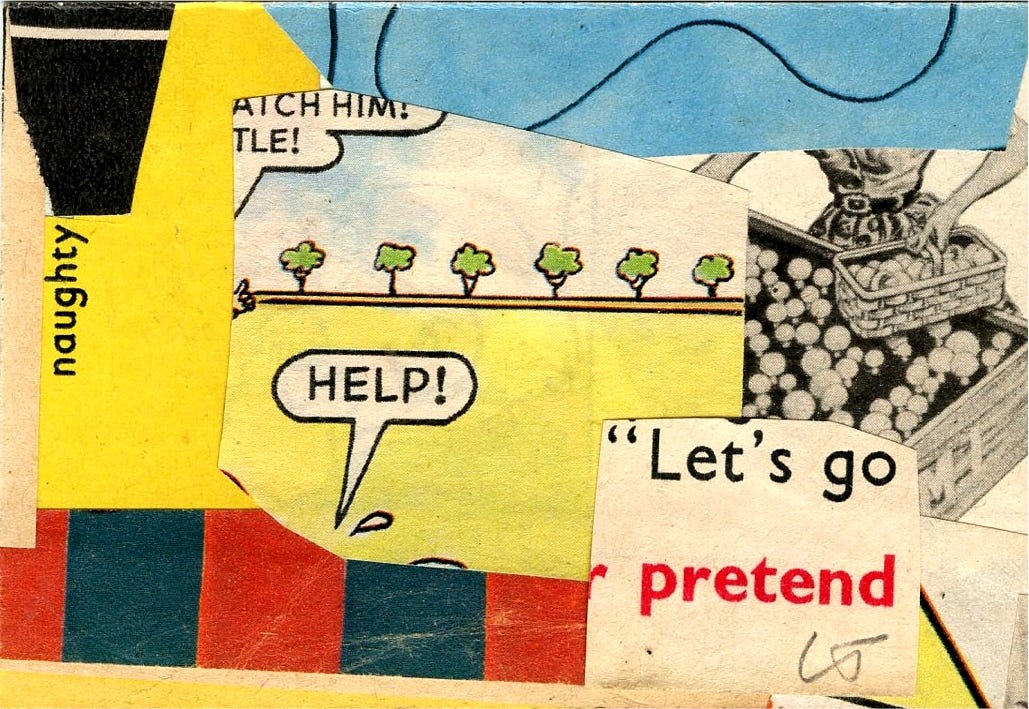
Always Imagine a Future Audience
Thinking more about audience… I am recalling one of my earliest public exposures in a group exhibition, around 1982. I had invested in having one of my early collages professionally framed for the occasion, a piece I still have. Seeing my work displayed in a formal exhibition setting gave me new insights into the importance of presentation in the public sphere.
As my career developed and my work appeared more frequently, I began to observe how people responded to it. I realized that viewers bring their own issues, interests, and understandings to an artwork. They do not see it the same way the artist does. At first this felt frustrating realizing that it is impossible to convey a specific message. Later it became liberating. Since I had no control over how others would respond, I no longer needed to concern myself with shaping their interpretation. Every artwork functions like a Rorschach test. It reveals the viewer more than the thing they are looking at.
Still, with this understanding in mind, I try to shape my works so that the attentive viewer can have a satisfying experience. I keep this in mind while working. I also imagine how a piece might be seen one hundred years from now in a museum environment. I want the work to hold up under that level of institutional scrutiny and public attention.
My sense of audience is also shaped by my early research into other artists. I always sought out artists whose bodies of work were diverse enough and complex enough that I could return to them again and again and find something new. That remains a guiding influence.
So I imagine a future audience when I work. I think about how my progressions, motifs, and ideas fuse and change over time. I hope to keep improving. I want to leave a labyrinth of signs and clues for those who come later. This requires thinking of the work in an archival way across an entire lifetime, treating it all as a single, ongoing creation.
It's a fine line, isn't it? You walk it well