


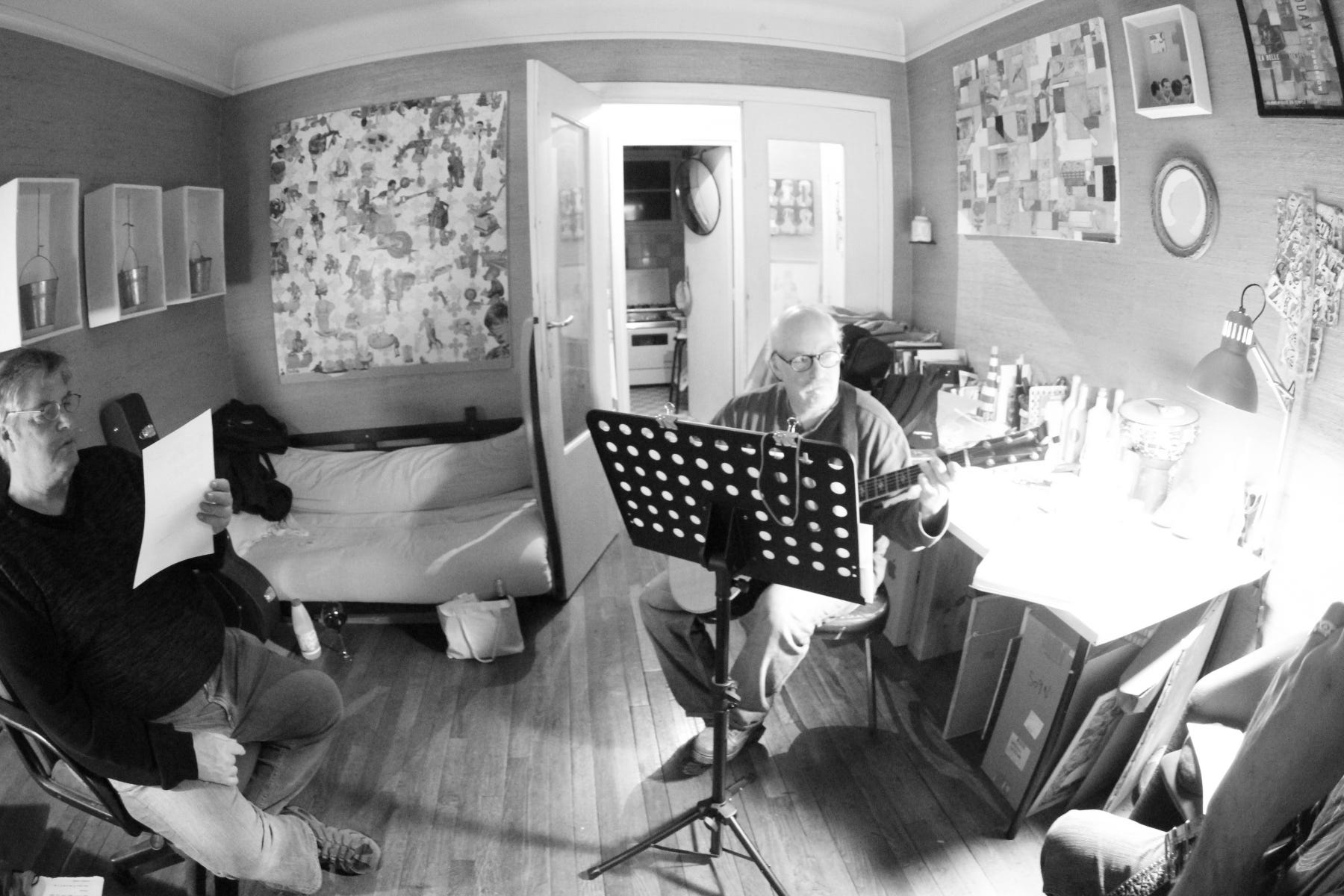
Entering the Work
There is a moment in creative work when the ordinary world begins to fall away.
You may have been in the studio for twenty minutes or two hours. At first you are still carrying everything with you. There are emails to answer, groceries to buy, bills to pay, people to call. Something somebody said yesterday is still rattling around in your head. You wonder what time it is. You remember something you forgot to do. You reach for your phone.
You are physically in the studio, but you haven’t arrived yet.
Then, if you stay with the work long enough, something begins to change.
The distance between yourself and what you are doing starts to diminish. The conversation in your head becomes quieter. You stop wondering whether you feel like working. You stop evaluating every decision. One action suggests another. A piece of paper leads to another piece of paper. A color requires another color. One sentence opens a door into the next.
Eventually you stop noticing the room.
And then you stop noticing yourself.
How do we get there?
That may be one of the most important practical questions in an artist’s life.
We often speak about inspiration as though the artist must wait for something extraordinary to arrive. My experience has been almost the reverse. The important thing is to make oneself available.
You cannot demand immersion.
You can prepare a place for it.
Crossing the Threshold
Every artist eventually develops ways of crossing from ordinary consciousness into creative consciousness, whether they recognize them as such or not.
The studio itself can become one of these devices.
When I enter the studio, the materials are already waiting. There are paintings at various stages, collages underway, scraps of language, images, books, brushes, paper and unfinished possibilities. I do not necessarily have to know what I am going to make.
I only have to begin interacting with something. It is a call and response action. Something calls to me and I respond. That is a low stakes threshold. Do one thing and that leads to the next thing.
This is important because waiting on inspiration to know what you are going to do can prevent you from ever discovering what you are doing.
Pick something up.
Move something.
Make a mark.
Read yesterday’s paragraph.
Mix a color.
Cut a piece of paper.
The first action does not have to be important. Its purpose may simply be to lead to the second action. Then the second leads to the third. Eventually intention gives way to momentum.
Give the Mind Somewhere to Go
The distracted mind is not necessarily an undisciplined mind. It may simply be a mind presented with too many possible objects of attention.
A phone is an extraordinary machine for providing possible objects of attention. So is a computer connected to the internet. So, for that matter, is everyday life.
The artist therefore has to create a temporary narrowing of possibilities.
For this period of time, I am here. This is what I am doing. Everything else can wait. That doesn’t require hostility toward the outside world. It requires a temporary agreement with it. I will come back later. Then clear your mind. Be present.
This is where ritual becomes useful. Coffee made a certain way. Particular music. Silence. Sweeping the studio. Sharpening pencils. Laying out brushes. Reading what was written yesterday. Taking a walk before beginning.
The ritual itself has no magical power. Its power lies in repetition. Eventually the mind recognizes the sequence. Ah. We are going there now.
Stay Long Enough
The most difficult part is remaining through the period when nothing much seems to be happening.
We sit down to work and immediately encounter resistance. The painting seems uninteresting. The sentence feels dead. We are restless. Suddenly cleaning the refrigerator seems unusually important. This may be precisely the moment when we need to remain.
Immersion often requires time to gather itself.
The surface agitation of everyday consciousness does not necessarily disappear the moment we enter the studio. It may take twenty minutes. It may take an hour. Some days it may never happen.
That is all right.
The practice is not entering the immersive state on command. The practice is remaining available long enough for it to become possible.
Protect the Threshold
This also means recognizing how fragile the transition can be.
A single interruption at the wrong moment can return us instantly to ordinary consciousness. The phone rings. A notification appears. Someone asks a question. We check an email “for just a second.” And suddenly we are back.
The problem isn’t simply the minute consumed by the interruption. We may have to travel the entire distance inward again.
This is why uninterrupted time is so valuable to creative work. An hour without interruption may be worth considerably more than three scattered twenty-minute periods.
We need enough time to forget about time. Enough silence to stop noticing silence. Enough solitude to stop noticing that we are alone. And enough engagement with the work that eventually there is no longer an artist standing outside it wondering what to do. There is only the doing.
That is the threshold we are trying to cross.
And once we cross it, something even stranger can happen. The person who entered the studio begins to disappear. The work seems to take over. Hours pass without notice.
And sometimes, when we finally look up, we have the peculiar feeling that whatever has appeared before us was not entirely made by us.
Which raises another question.
If I wasn’t consciously directing everything that happened, who exactly was making the work?
Stay tuned for #2
You stated: "The most difficult part is remaining through the period when nothing much seems to be happening." Yes, this. Truth speaks! I will make myself stay in the studio. I've learned I can't force the immersion but if I sit or wander a while.......sometimes a long while......that "nothing" time is really something as I play or fondle objects that appear to have nothing to do with one another then often eventually something will click......an idea, a perfect fit of things, a story to be told. I have very little patience for interruptions of any kind and that has become more so as time goes on. I don't take my phone into the studio as I rarely get calls that matter and I don't want to answer the spam calls as then I'll end up cursing them out and losing my mojo. Even my dog will interrupt me to go out or just be restless and that's annoying to me but she's a living breathing entity so I make an exception for her. I've had thoughts that have bothered me about someone who has wronged me and those will go away or I can use them to create a piece about it/the person in order to exorcise them from my psyche. Another great article by the way as it feeds my brain.