


Chapter One
Reconstruction of the Previous Day (1)
The Archive, for all its traditions, is not sentimental about time. It files by relation. It catalogues by adjacency. It contains centuries the way a desk contained papers: stacked, rearranged, re-encountered.
The previous day began in the Director’s office.
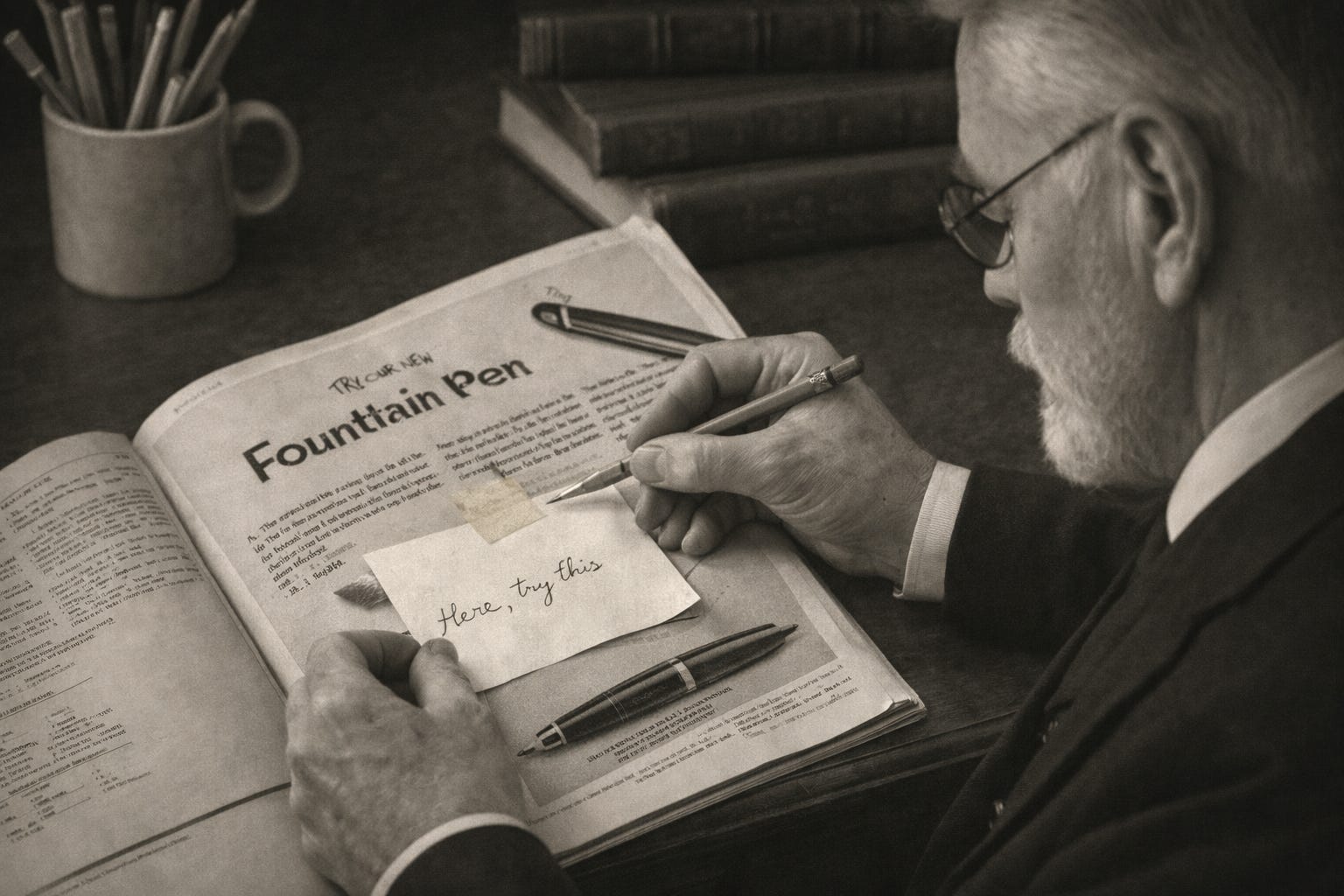
It began with an advertisement. A magazine ad for a fountain pen.
The Director had seen the advertisement earlier, tapped the page twice with his index finger, and torn a scrap from a notepad with the speed of someone who had been ordering tools his whole life. He wrote on the scrap with an old pencil that lived in the cup on his desk.
A note to himself.
Then he tore a narrow strip of tape, flattened the scrap onto the advertisement so it would not drift, and turned the page once more just to see if it held.
Then, almost as a second thought, he opened a catalog listing and ordered the pen marked in the ad.
“Well, if I don’t order it now,” he thought to himself, “I’ll forget to order it later.”
He submitted the order, printed the confirmation, and set the confirmation beside the magazine, aligning its edge in the way a person aligns edges when they have trained their hands to prefer order.
No longer needing it for reference, he placed the magazine in his outbox with the other minor accumulations: clippings, envelopes, a folded brochure, two pages of correspondence he did not intend to answer personally.
Within the hour, staff came through the corridor and did what they always did. They collected the outbox.
It was a quiet institutional practice, not unlike the janitorial sweep that came later. Material moved. Surfaces cleared. The Archive maintained itself by steady, low-drama routine.
The staff member who carried the outbox materials returned to the stacks. The magazine went into a stack with other magazines. The brochure went into a stack with other brochures. The various correspondences went into a folder marked for later review.
And in the act of stacking, the note on a scrap the director had taped to the ad detached unnoticed and drifted silently to the floor.
It landed face-up.
Only three words on a scrap of paper.
No name. No context.
The staff member did not see it. Or saw it in the same way one sees a staple on a floor: registered without meaning, then forgotten.
Later, in sorting, another staff member noticed it on the floor while cleaning up and it made its way into a small tray of unassigned ephemera.
to be continued…